Is Home Automation Worth It, or Just a Gimmick?
Both exist, and which one you end up with is decided before you buy anything. The technology is identical. What separates them is whether you asked it to remove something you repeat, or to make something impressive.
It is worth it when it removes something you repeat every day. It is a gimmick when it adds a step to something that already worked. That single test decides it, and it has nothing to do with how much you spend.
We sell this, so the honest thing to do is start with the part that is a gimmick, and be specific about it rather than vague.
What makes home automation a gimmick?
One thing, almost always: it added a step. If switching on a light now means finding your phone, unlocking it, opening an app and waiting for it to connect, the wall switch was faster and you have made your home slower in exchange for money. That is the whole failure mode, and most disappointing smart homes are a collection of it.
Four versions of the same mistake:
- The phone as the only way in. A device that can only be triggered by an app is a device you will use for a fortnight. The ones that survive are triggered by something else: a time, a sensor, a door opening, or one press on a wall that does six things.
- Voice as the main interface. Voice is a good third option and a poor first one. It needs the internet, it needs to hear you over a television, and it fails in front of guests, which is the moment you most wanted it to work.
- A solution to a problem you do not have. If nothing about your lighting irritates you, automating it buys you a demonstration, not a change.
- Scenes nobody ever sat down and defined. A house full of coordinated hardware with no scenes set is simply a more expensive set of switches. This is the most common way a real system still ends up feeling like a gimmick.
None of those are hardware faults. They are decisions, which is good news, because decisions are the part you control.
Does home automation pay for itself on the electricity bill?
No. It saves electricity, and it does not pay for itself. Those are two different claims and the industry runs them together, so here is the arithmetic in full.
India's Bureau of Energy Efficiency states it plainly: "Increasing the air-conditioner temperature setting by just 1 degree Celsius can save about 6 per cent of electricity consumption." On a Mumbai bill, where the slabs are telescopic and an air conditioner's extra units land in your most expensive slab rather than your cheapest, that works out at roughly ₹500 to ₹700 a month for a single 1.5 ton AC moved from 22°C to 24°C. We walk through that calculation against the MERC tariff order for Adani Electricity in the ideal AC temperature for a Mumbai flat.
Now take the generous case. Three air conditioners in a 3BHK, every one of them held two degrees higher by a scene rather than by somebody remembering, across Mumbai's unusually long eight to nine month cooling season.
| Line | Figure | Where it comes from |
|---|---|---|
| Saved per AC, per month | ₹500 to ₹700 | BEE's 6 per cent per degree, on a verified Mumbai tariff |
| Three ACs, per month | ₹1,500 to ₹2,100 | The same figure, three times |
| Over a cooling season | ₹12,000 to ₹19,000 a year | Eight to nine months of cooling |
| A complete 3BHK system | About ₹5 lakh | An estimate rather than a quote |
| Payback on electricity alone | Roughly 25 to 40 years | The two rows above, divided |
And that is the kind reading. It credits the system with the entire saving, and it assumes every air conditioner in the flat would otherwise have been run two degrees colder, all season, by everyone in the house. Curtains help a little more. A ten month Illinois Tech study found automated insulating shades cut energy use by roughly a quarter across heating and cooling seasons, though that was an office tower in Chicago rather than a Mumbai flat, so read it as a direction rather than a promise. It does not change the order of magnitude.
So if you are buying it to save money on electricity, it is a gimmick, and anyone telling you otherwise is selling. The saving is real, it is worth having, and it is not the reason. Which raises the obvious question.
So what is actually worth paying for?
Three things, and none of them appear on a bill.
Repetition. Count moments, not devices. A household with four scenes it uses most days, say everyday evening, everyone out, people over, and going to bed, runs through something close to three thousand of those moments in a year. Each one individually is trivial. That is exactly why automating them is worth money and automating a once a month event is not. Automation pays on frequency, the way a good kitchen layout does.
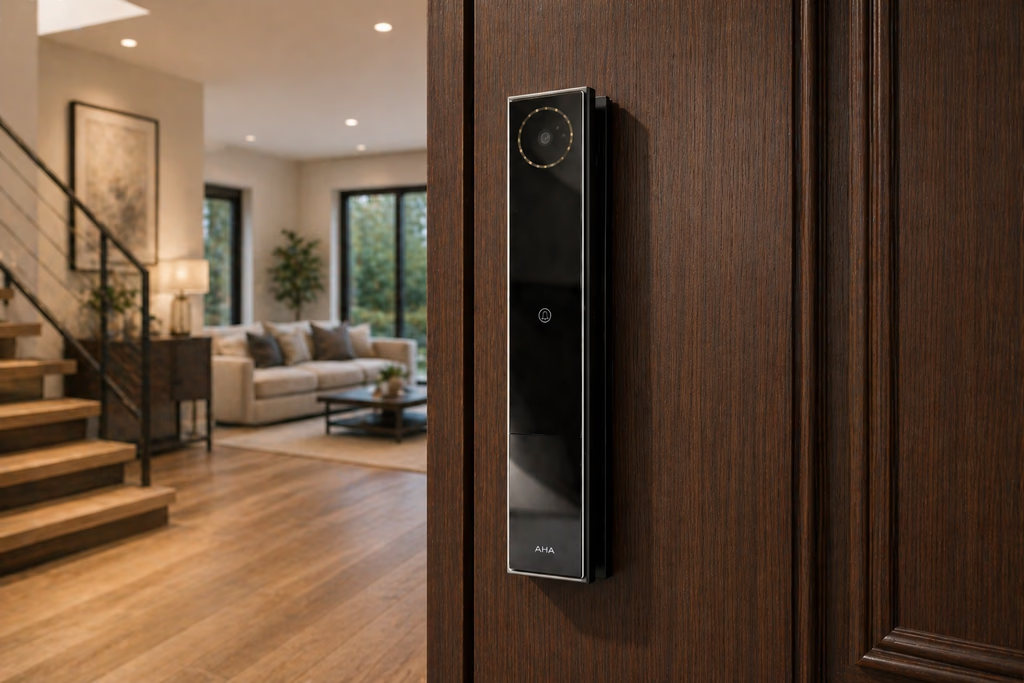
A home that works for people who do not live in it. This is the one most buyers underrate and the one they notice first. A guest, a visiting parent, the person who cleans, a child. If running the house requires knowing which app owns which light, the house is automated for exactly one person. A keypad on the wall labelled with what it does is usable by anybody who can read, which is the actual point of putting the intelligence behind the wall rather than in a phone.
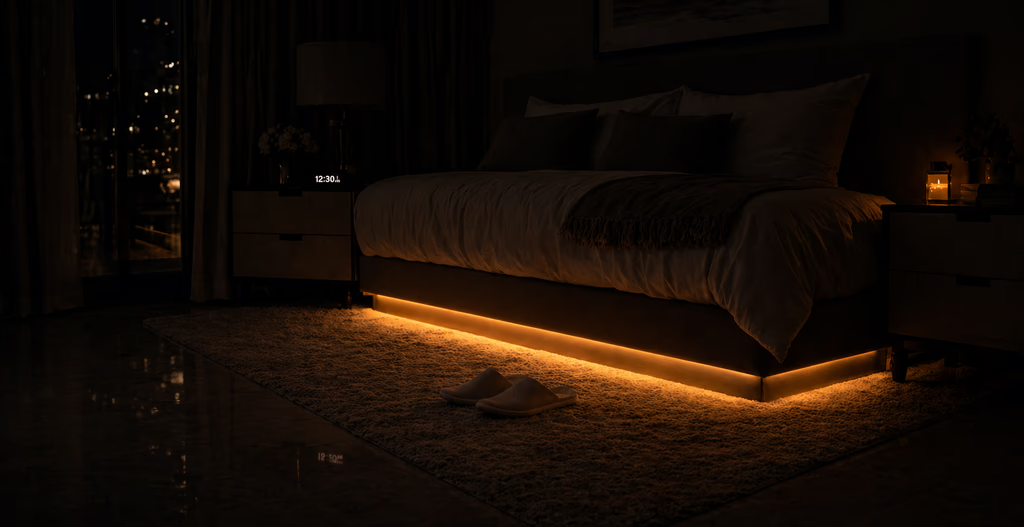
Things that cannot be done any other way. Not faster versions of switching on a light, but genuinely different: every light in the flat off from the lift, confirmed; a door that opens for your house help at 9am without a key changing hands; soft floor level light at 2am so an older parent does not reach for a switch in the dark. That last one is the one families tell us about afterwards, and it is covered properly in home automation for elderly parents.
Which rooms earn it, and which do not?
The same test, applied room by room. What repeats here, and how often?
| Room | What repeats | Worth it? |
|---|---|---|
| Living room | Evening, television, guests, everyone out | Yes, the highest return in the house |
| Main bedroom | Waking, reading, sleeping, the AC setting | Yes, twice a day every day |
| Entrance | Arriving, leaving, letting someone in | Yes, and the most underrated of the three |
| Child's room | Bedtime, study, night light | Yes if there is a routine, no if there is not |
| Kitchen | Task light on, task light off | Rarely. Good task lighting is a wiring decision, not an automation one |
| Guest bedroom | Twice a year | No. Put the money in a room you stand in daily |
| Bathroom | The 2am trip | One dim night light, and nothing more |
Read that table as a budget instruction rather than a verdict. Nobody has to do the whole flat at once, and the rooms at the top are where a limited budget belongs. What home automation should cost breaks the same rooms down by figure.
What will an automated home not do?
The fastest way to end up feeling cheated is to buy a system expecting four things it was never going to do. So, plainly:
- It does not control your geyser or your water pump. AHA does not automate either. They are high load appliances on their own circuits, which is not what a keypad or a lighting driver is for. If somebody promises you an app controlled geyser as part of a lighting system, ask exactly what hardware is switching it.
- It does not dim a chandelier whose bulbs do not dim. The limit is the bulbs, not the controller. In practice most chandeliers end up on or off. If you want yours dimmable, that decision belongs at the moment you buy the chandelier, not afterwards.
- It does not run during a power cut. The hub has no battery of its own, so scenes stop until mains power returns. An AHA system keeps working without internet, which is a different and much more common problem, and we cover it in does a smart home work without internet. Without power, nothing electrical in your flat is working anyway.
- It does not make a badly lit room well lit. No amount of control invents a place for light to come from. A room with one fitting in the middle of the ceiling has a ceiling problem, and that gets solved before anything is automated.
One practical catch worth knowing early rather than late: a keypad needs a neutral wire at its switch box, and a good many older Mumbai switch loops do not have one. The lights themselves need nothing new. That distinction is set out in do smart switches need a neutral wire, and it is the single most common reason a quote changes after a site visit.
What do people actually regret buying?
From the conversations we have with people who already own some of this, four patterns come up repeatedly.
Cameras they never watch. Bought during a worry, checked twice, then a subscription. The useful version is a notification about something specific, not a feed nobody opens.
A second ecosystem. One brand's hub for the lights, another brand's for the lock. Two apps, two logins, two things to explain to a guest. This is the state most homes drift into by accident, and it is the difference described in smart home versus home automation.
Scenes built for a life they do not live. A dinner party scene in a house that does not host. A cinema mode nobody uses because the family watches on a tablet. Scenes should be written from how the week actually goes, which is why we ask about routines before hardware.
Buying everything at once to avoid deciding. The opposite failure to under-buying, and more expensive. One room first, for a month, teaches you more about what you will use than any showroom can.
How do you decide before you spend?
Four questions. None of them needs a salesperson, and you can answer all four this evening.
- How many moments repeat most days? Write them down. Four or more and a coordinated system has something to work with. Fewer than four and you are better served by two or three good individual devices.
- Could someone who does not live here work it? If the honest answer is no, whatever you buy needs to be usable from a wall, not only from a phone.
- Will you still be in this home in three years? If not, the question changes, because what moves and what stays matters more than what it does. Drivers and keypads can be shifted to a new home, and the product list is adjusted to fit a different size of flat.
- Is it one irritation, or a pattern? One irritation is one device. A pattern across rooms and times of day is what a system is for.
A fifth, for anyone mid renovation: timing beats almost everything else, because cabling decisions are cheap before a false ceiling closes and expensive afterwards. That order is laid out in before or after interiors.
What does it cost to find out?
Nothing, which is the point of having two experience centres rather than a brochure. They are laid out as real flats, so you press a keypad, walk into a scene and decide for yourself whether it reads as useful or as a trick. A visit takes about an hour, it follows whatever you ask about rather than a fixed tour, and there is nothing to buy on the day.
If it helps to know the scale before you come, these are room and project estimates rather than a price list, and they move with layout, room count and how much you choose to automate:
- A typical 150 sq ft bedroom₹80,000 to ₹1 lakh
- A living or media room, more circuits and sources₹1.5 lakh to ₹2 lakh
- A complete system, modern 3BHK in MumbaiAround ₹5 lakh
Two things worth knowing about what that buys. Automation parts carry a two year warranty from the date of invoice, curtain motors five years, and on a warranty claim you are told the replacement timeline within seven days. And AHA designs, supplies, configures and commissions the system while your electrician does the wiring and the mounting, which is the division of labour explained in who should build your smart home. The full scope for an apartment is set out on whole home automation.
What do people ask us next?
Is home automation worth it in India?
It is worth it when it removes something you repeat every day, and a gimmick when it adds a step to something that already worked. The deciding factor is repetition, not square footage or budget. A home where four people come and go all day has more to automate than a larger one used by a person who is out all week. If you cannot name four moments that happen most days, individual smart devices are the better buy.
Does home automation save electricity, and does it pay for itself?
It saves electricity. It does not pay for itself. India's Bureau of Energy Efficiency estimates about 6 per cent saved for each degree you raise an air conditioner's setting, which on a Mumbai bill is roughly ₹500 to ₹700 a month per 1.5 ton AC moving from 22°C to 24°C. Three air conditioners held two degrees higher across Mumbai's eight to nine month cooling season comes to roughly ₹12,000 to ₹19,000 a year. Against about ₹5 lakh for a complete 3BHK system, that is a payback measured in decades. The saving is real and it is not the reason to buy.
What is the most useless smart home device?
Any device whose only trigger is your phone. If switching on a light means finding the phone, unlocking it, opening an app and waiting for it to connect, the wall switch was faster and the device has made the house slower. The same test rules out most appliances with screens added to them. A device earns its place when something other than you can trigger it: a time, a sensor, a door opening, or one press that does several things at once.
Does home automation increase the resale value of a flat?
We have no data to support that claim, so we do not make it. What is documented is that the parts move. Drivers and keypads can be shifted to a new home, and products are added or removed to fit a different size of flat, so the money is not necessarily left behind in the walls when you sell. Treat anything you are told about a resale premium as a claim that needs evidence.
Is home automation worth it in a rented flat?
Usually not, if the tenancy is short. Anything that replaces a switch plate or sits inside a light fitting belongs in a home you will keep, and plug-in devices and smart bulbs already cover most of what a one year rental needs. The exception is a long tenancy with the landlord's agreement, where the same repetition argument applies as it would to an owned home.
Can you start with one room and add the rest later?
Yes, and it is a reasonable way to test whether you will use it. The hub is one per home rather than one per room, so a second room joins the system and the scenes that already exist rather than starting again. Starting with the room that has the most repetition, usually the living room or the main bedroom, tells you more in a month than any amount of reading.
The short version: ignore the word smart and ask what the house will do differently on an ordinary Tuesday. If the answer is a list of things you would have to open an app for, that is a gimmick at any price. If it is a list of things you currently do by hand, twice a day, every day, that is the case.
Both AHA experience centres, in Santacruz West and Lower Parel, are laid out as real homes rather than showrooms, so you can decide that by pressing things rather than by reading about them. Open 11am to 7pm, Santacruz West is closed on Tuesdays, and nothing to buy on the day. Either Santacruz West or Lower Parel.
Book a free consultation →