Do Smart Switches Need a Neutral Wire in India?
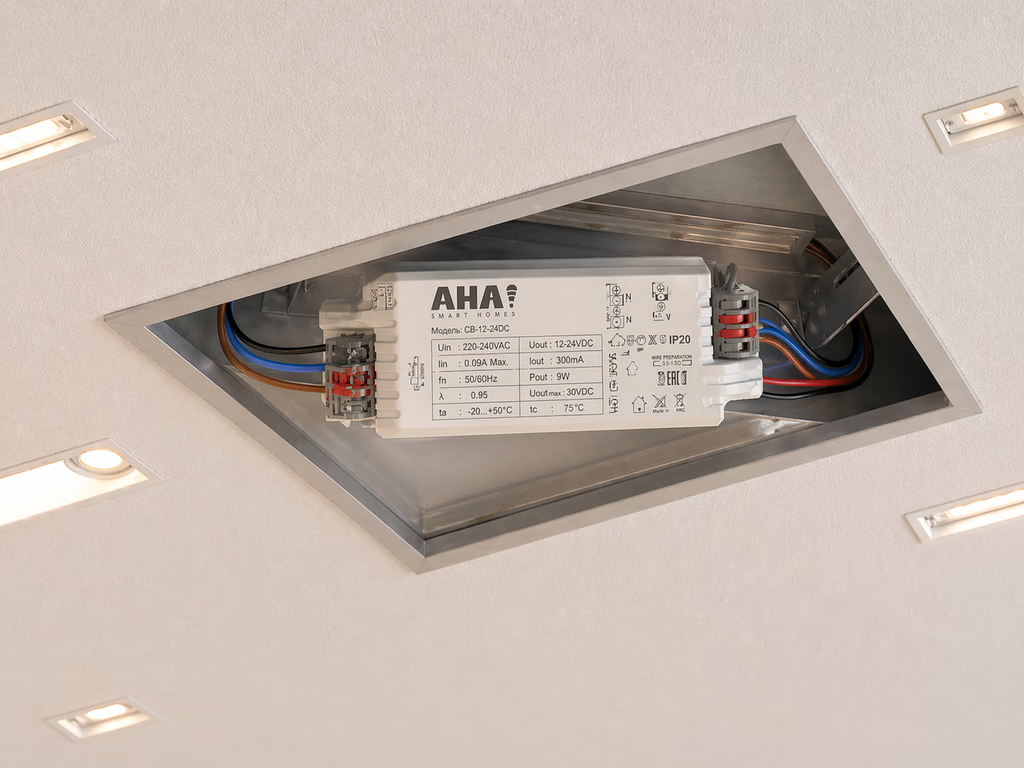
Most do: a smart switch that keeps electronics running in the switch box needs a neutral there, and many Indian switch boxes do not have one. AHA's lights do not need it, because their driver sits in the light fitting. AHA's X7 keypad does.
It depends on where the smart part of the system sits. If it sits in the switch box, it needs a neutral in that box, even when the light is off. If it sits in the light fitting, the neutral is already there. An AHA home uses both: drivers in the fittings, which need nothing new, and X7 keypads on the wall, which need a neutral at each keypad's switch box.
It is one of the first questions an electrician asks when someone mentions smart switches, and it catches a lot of people off guard: is there a neutral in the box? In a great many Indian homes, there is not. That is not a fault. It is exactly how a plain switch was always meant to be wired.
Why do most Indian switch boxes have no neutral?
A conventional switch has one job: break the live wire on its way to the light. So only two wires ever needed to reach the switch box, the live coming in and the switched live going out to the fitting. The neutral runs straight to the light fitting and never visits the switch at all.
For a plain switch that is perfectly sensible. A plain switch has no electronics, needs no power of its own, and does nothing while it is off. The trouble only starts when you want the switch itself to be smart.
Why does a smart switch need a neutral at all?
Because a smart switch is never really off. It has to keep listening for a tap, an app command or a schedule, even while the light is dark, and that takes a small, constant supply of power. To draw that power, the electronics need a complete circuit at the switch: live and neutral.
This is well enough understood that electrical codes now plan for it. The US National Electrical Code requires a neutral at most lighting switch locations, and the trade publication EC&M explains the reason plainly: the neutral at a switch is there "to complete a circuit path for electronic lighting control devices", which need line-to-neutral voltage to keep their electronics running in standby. Indian homes were mostly wired before anyone expected the switch to hold a computer.
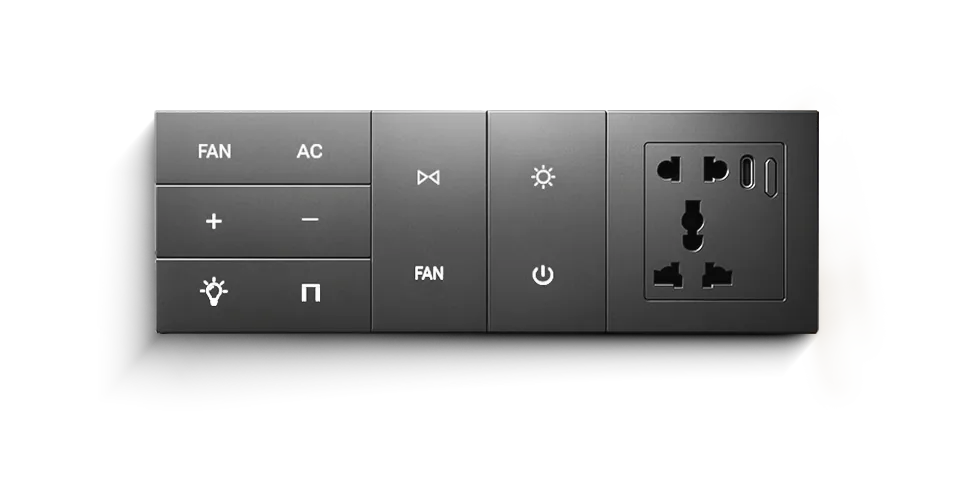
There is a second, simpler reason in the X7's case. Alongside its keypads, it carries a smart international socket and a fast-charging USB-C port on the same modular plate. A socket needs a neutral no matter what, smart or not.
Where does the smart part sit, and why does that decide everything?
This is the one distinction worth carrying into any conversation with a smart home company or an electrician. "Do smart switches need a neutral?" has no single answer, because smart home products put their electronics in three very different places.
| Approach | Where the electronics sit | Needs a neutral at the switch box? | What to know |
|---|---|---|---|
| Smart switch module behind a plate | In the switch box | Usually, yes | The most common kind of smart switch, and the one the neutral question is really about |
| Smart bulb | Inside the bulb | No | Only works while the wall switch stays on. Switch it off and the bulb drops offline |
| AHA driver, one per light | Inside the light fitting | No, the neutral is already at the fitting | Dims and sets colour temperature for each light individually, with the fixtures of your choice |
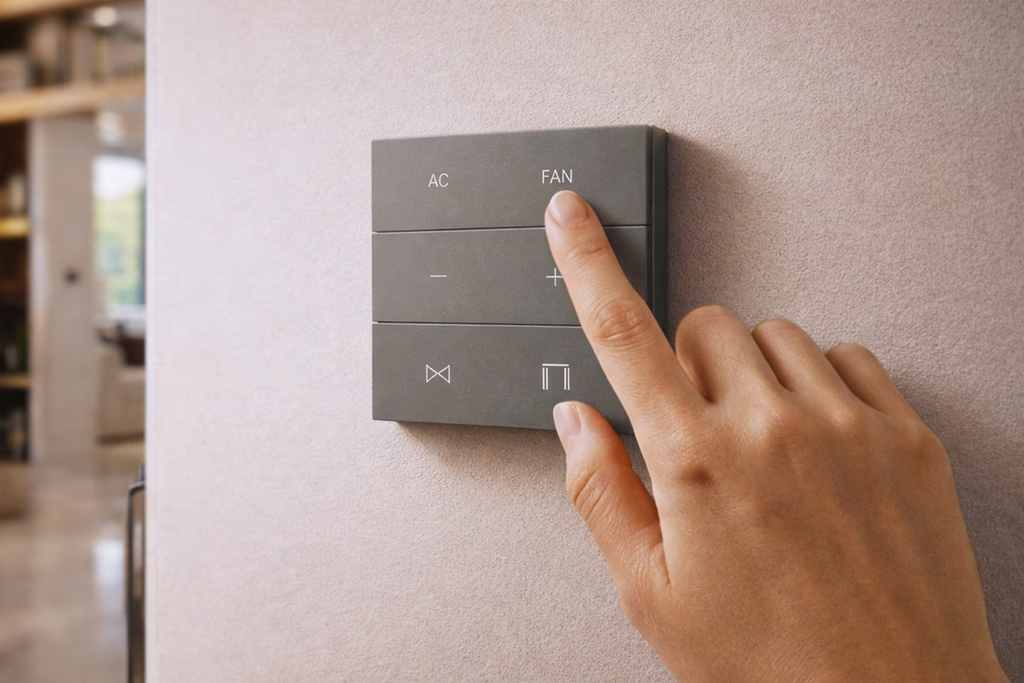
| AHA X7 keypad | In the switch box | Yes | Haptic buttons with three presets each, plus a socket and USB-C port on the same plate |
Put simply: the lights in an AHA home need nothing new at the switch, because the intelligence lives in the fitting. The keypads do, because a keypad is electronics in a box on the wall.
What does this mean if you are planning an AHA home?
Two different answers, for two different parts of the system.
For the lights: nothing changes at the switch. A smart driver goes inside each existing light fitting and takes over dimming and colour temperature for that one light. This is why smart lighting can go into a finished flat as readily as one still under construction.
For the keypads: every switch box that will hold an X7 keypad needs a neutral. Where a box already has one, the keypad goes straight onto the existing plate position. Where it does not, your electrician runs a neutral to that box first.
The division of work stays the same either way. Your own electrician installs, mounts and wires the hardware to AHA's plan, including any neutral that needs running. AHA designs the system, supplies it, and then configures and commissions it: pairing every device, programming the scenes and handing the home over.
Once powered, each keypad joins the home's Zigbee mesh, and every mains-powered device on it also relays signals for the others. The Connectivity Standards Alliance, which maintains Zigbee, describes that as a "self-healing mesh network" that eliminates single points of failure, so each keypad you add strengthens the network rather than straining it.
How do you find out whether your switch boxes have a neutral?
Ask your electrician to check, and do not open a switch box yourself: it carries live mains voltage. The useful way to ask is specific. Mark on your electrical plan where each keypad is likely to go, and have the electrician check those boxes, not every box in the house.
- Still building or renovating? Ask for a neutral at every switch box while the walls are open. It costs almost nothing now
- Flat already finished? Have the electrician check the keypad boxes before anything is ordered
- No neutral in a box? The electrician runs one to that box before the keypad is fitted
- Coming for a consultation? Bring your electrical plan. It helps us design the system accurately
If you are at the wiring stage right now, our electrical points checklist for a new home covers the neutral alongside every other point worth deciding before the plaster goes on.
What does a neutral not solve?
A neutral gives the keypad power. It does not change anything else about how the system behaves, and it is worth being clear about the edges.
- It does not help in a power cut. The hub runs on mains power, so in a power cut the scenes stop until power returns. A neutral is about how power reaches the switch, not whether there is power at all.
- It does not make voice work offline. The system keeps running without internet, but voice assistants are cloud services and pause when the connection drops. Here is what keeps working without internet.
- We cannot tell you in advance how your flat was wired. Whether your boxes have a neutral, and whether running one needs any chasing, depends on the building and the conduit. Only a site check answers that.
What do people ask us next?
Do smart switches need a neutral wire?
Most do. Any smart switch that keeps electronics running inside the switch box needs a neutral there, because those electronics need power even while the light is off. What decides it is where the smart part of the system sits: in the switch box, in the bulb, or in the light fitting.
Why do most Indian switch boxes not have a neutral?
Because a conventional switch only ever needed to interrupt the live wire going to the light. The neutral runs straight to the light fitting, so the switch box ends up with just the live and the switched live. That was all a plain switch needed, and it is why a smart switch often cannot simply replace it.
Do AHA smart lights need a neutral at the switch box?
No. AHA puts a driver inside each light fitting, where the neutral already is, and the driver handles dimming and colour temperature for that light. The lights themselves need no new wiring at the switch.
Does the AHA X7 keypad need a neutral?
Yes. The X7 keeps its electronics running in the switch box, and it also carries a smart international socket and a USB-C charging port, so it needs a neutral at every switch box where a keypad goes. Where a box has none, your electrician runs one before the keypad is fitted.
Can a neutral be added to an existing switch box?
Usually your electrician can run one. Whether that needs any chasing depends on the existing conduit and how the flat was wired, which only a site check can tell. Ask for it to be checked at every box where a keypad will go, before anything is ordered.
Is it safe to check my switch box for a neutral myself?
No. A switch box carries live mains voltage. Ask a licensed electrician to check it, and bring your electrical plan to the consultation, because it helps the system be designed accurately.
The short version: ask where the smart part sits. In an AHA home the lights keep their intelligence in the fitting and need nothing new at the switch, while each keypad needs a neutral in its box. Knowing that before the electrician arrives saves a second visit.
You can press an X7 yourself at either of our experience centres, laid out as real homes in Santacruz West and Lower Parel, open daily 11am to 7pm. Walk in, or book ahead.
Book a free consultation →