Home Automation in Mumbai: A New Homeowner's Guide
Most of what decides how a Mumbai flat gets automated has nothing to do with the technology. It is your society's permission, the length of your fit-out window, and what the monsoon does to anything you seal into a ceiling.
Three things decide how this goes, and only one is about products: whether you have written permission from your society, whether you are inside your fit-out window, and whether the hardware is specified for a city that runs at 86 per cent humidity through July and coats sea-facing buildings in salt.
This guide is for someone who has taken possession, or is about to, in a Mumbai flat. It is not a comparison of companies, and it deliberately avoids that: if you are shortlisting, our home automation company in Mumbai page covers what to ask each of them.
What follows is the part nobody sends you: the rules that actually gate the work, the dates after which decisions stop being reversible, and the local conditions that decide whether the hardware is still working in year five.
Do you need society permission to automate a flat?
For anything that counts as an addition or alteration, yes, and it is a legal requirement rather than a courtesy. This is the item that delays Mumbai projects most often, almost always because someone assumed it was informal. Bye-law 45(a) of the Maharashtra Model Bye-Laws requires the Committee's previous written permission, before the work starts, not after someone complains, and two more, 47(a) and 47(b), are what a neighbour actually invokes if the work causes a nuisance.
Automation on a wireless system sits inside the easiest tier of that permission structure, since nothing about it is structural. For the full breakdown of what needs society permission, what needs the BMC's, and what needs neither, our guide to drilling and rewiring rules for a Mumbai flat goes through Bye-law 45 in full, the exact line Section 342 of the Municipal Corporation Act draws around structural work, and what actually happens when someone crosses it.
Noise limits are law. Drilling hours are not.
These two get quoted interchangeably and they are completely different things, which matters if you are ever arguing about one.
The law: the Noise Pollution (Regulation and Control) Rules, 2000 set ambient limits for a residential zone at 55 dB(A) between 6am and 10pm and 45 dB(A) at night. A complaint lies where noise exceeds the standard by 10 dB(A) or more. Within 100 metres of a hospital, an educational institution or a court, you are in a silence zone and the limits are stricter.
Not the law: your society's working hours. Almost every building sets its own, commonly a morning and an afternoon window on weekdays and Saturdays with nothing on Sundays or public holidays, usually alongside a refundable renovation deposit and an indemnity bond. These are typical society rules, they vary building to building, and they are enforceable as society rules rather than as statute. Ask for your society's circular in writing rather than relying on what you are told at the gate.
What about structural work?
Anything structural is a different matter entirely: it engages municipal permission, and under the RERA framework a structural change needs the written consent of two thirds of allottees. Automation done on a wireless system is not structural work, which is a large part of why it avoids most of this, our drilling and rewiring guide covers exactly where that line sits, including why it is worth taking seriously.
One more thing worth checking if your building is not new. Buildings 30 years and older carry a mandatory structural audit obligation under Section 353B of the Mumbai Municipal Corporation Act, repeating every ten years and certified by a municipally registered structural engineer. If yours is near that point, settle any concealed work before the audit rather than after it.

What does Mumbai do to a smart home that other cities do not?
Most home automation advice online is written for a dry climate and a house. Mumbai is neither, and three local conditions change what should be specified.
The monsoon is long, and it is the humidity that matters
Normal onset is 11 June. The June to September seasonal normal is 2,168 mm, and July relative humidity averages around 86 per cent, going past 90 on active days. Sustained humidity above roughly 70 to 80 per cent is where mould becomes a real risk, and this city holds that for weeks at a time.
The failures that follow are rarely dramatic. They are staining, sagging edges and mould appearing one or two monsoons after handover, usually traced to seepage from the flat above, an external wall, or condensation on a concealed air conditioning duct.
Salt air, if you are near the sea
ISO 9223 is the international standard for atmospheric corrosivity, and genuine marine exposure sits at category C5 or above. Sea-facing Worli, Marine Drive, Bandra Bandstand, Juhu and Versova are in that band. Salt corrodes housings, fasteners and metal contacts considerably faster than plain humidity does.
An IP rating does not help you here, and this is the most common specification mistake. IP describes water and dust ingress, not corrosion. A fitting can be perfectly sealed against rain and still have its contacts eaten over two monsoons. For anything exposed, ask about the housing material as well as the number: marine-grade stainless rather than the standard grade, sealed housings, and sensible siting relative to the weather side.
Older buildings and their wiring
An automated home is a different electrical proposition from the two ceiling points it replaces. In older Mumbai stock that can mean an inadequate sanctioned load, a distribution board with no spare ways, missing earthing, or switch boxes with no neutral conductor. That is an electrician's assessment rather than an automation one, and it belongs before the work starts, not after.
AHA's hardware is engineered specifically for Indian power fluctuation and for this climate, with every batch tested before it goes into a home, and the lighting drivers carry 4kV surge protection. That helps with the supply. It does not substitute for an assessment of what is already in your walls.
The number that should change your specification. July relative humidity in Mumbai averages around 86 per cent and the monsoon runs from an 11 June onset through September. Anything you seal permanently into a ceiling is sealed into that. The practical rule that follows is simple and it is worth insisting on: anything that will need reaching later should stay reachable. Drivers fail before LEDs do, and reopening a sealed ceiling in a humid, salt-exposed building is the expensive version of a small job.
What gets decided at fit-out and cannot be changed later?
Automation gets treated as something you add later. Some of it genuinely is, and that is the honest advantage of a wireless system. But a short list is settled at fit-out, and it gets settled whether or not anyone decided it deliberately. If you have just been handed the keys, our new flat possession checklist puts this list next to the builder's snag list.
Fixed once the plaster is on
- A neutral conductor at each switch box. The big one (here is why smart keypads need it). A conventional Indian switch loop drops only the live to the switch and sends the neutral straight to the fitting, so the box has no neutral. Adding it later means opening the wall.
- Back box depth and count, and whether there is a spare module in the plate.
- Conduit routes and spare conduit capacity, with a pull string left in.
- False ceiling depth against the beam depth, which in Mumbai's floor to floor heights is tighter than most guides assume.
- Curtain pelmet power above each window, on the correct side for the motor head. Almost no Indian flat has a socket up there.
- Network cabling and where the rack lives, plus power and data at the main door.
- Which circuits sit on the inverter. Decide it rather than discovering it.
Genuinely addable later
The drivers themselves, keypads, curtain motors on an existing track, sensors and the hub. A driver sits inside each existing light fitting, and keypads replace existing switch plates, each with a neutral at its switch box. No rewiring and no wall breaking for the lights. This is why a flat you already live in can be automated one room at a time.
| Item | Decide at fit-out | Can wait until later |
|---|---|---|
| Neutral at each switch box | Yes. Adding it later means opening the wall | No |
| Back box depth and spare modules | Yes, before the plaster | No |
| Conduit routes and spare capacity | Yes, with a pull string left in | No |
| False ceiling depth | Yes, against the beam depth | No |
| Power at the curtain pelmet | Yes, on the motor-head side | No |
| Which circuits the inverter backs up | Yes, on the drawing | No |
| Light drivers | Optional. On a new build they go in after the false ceiling | Yes, inside the existing fittings |
| Keypads | Optional. They go in after the first coat of paint | Yes, onto existing switch plates |
| Curtain motors and tracks | Optional. Tracks go in last, on a dust-free site | Yes, motors fit an existing track |
| Sensors and the hub | No | Yes |
The full first-fix list, including the questions to read out to your electrician, is in our electrical points checklist. If a false ceiling is going in, the cove and false ceiling guide covers driver positions and access.
If your building is being redeveloped, the fit-out window on the new flat is the moment to use. Durations, deposits, gate passes and lift bookings are set by the developer or the society rather than by law, so they vary, but the window is real and it is short. Ask for those terms in writing early.
Which Mumbai buildings has AHA worked in?
A fair question to ask any company, and a fair way to judge whether they have worked in buildings like yours. Across 1,200+ Mumbai homes, the work concentrates in towers where a lot of people are fitting out at the same time.
- Worli and Lower Parel: 89 homes across 57 towers. The densest belt, and where fit-out windows run tightest.
- Andheri and Juhu: 78 homes across 64 towers, the widest spread of individual buildings in the city.
- Bandra and Khar: 65 homes across 49 towers, including sea-facing stock where the salt-air specification applies.
- Ghatkopar and Chembur: 38 homes across 30 towers, weighted to newer construction and pre-possession fit-outs.
- Powai and Vikhroli: 37 homes across 25 towers, largely planned developments.
- Borivali and Malad: 26 homes across 20 towers, mostly larger floor plates in newer buildings.
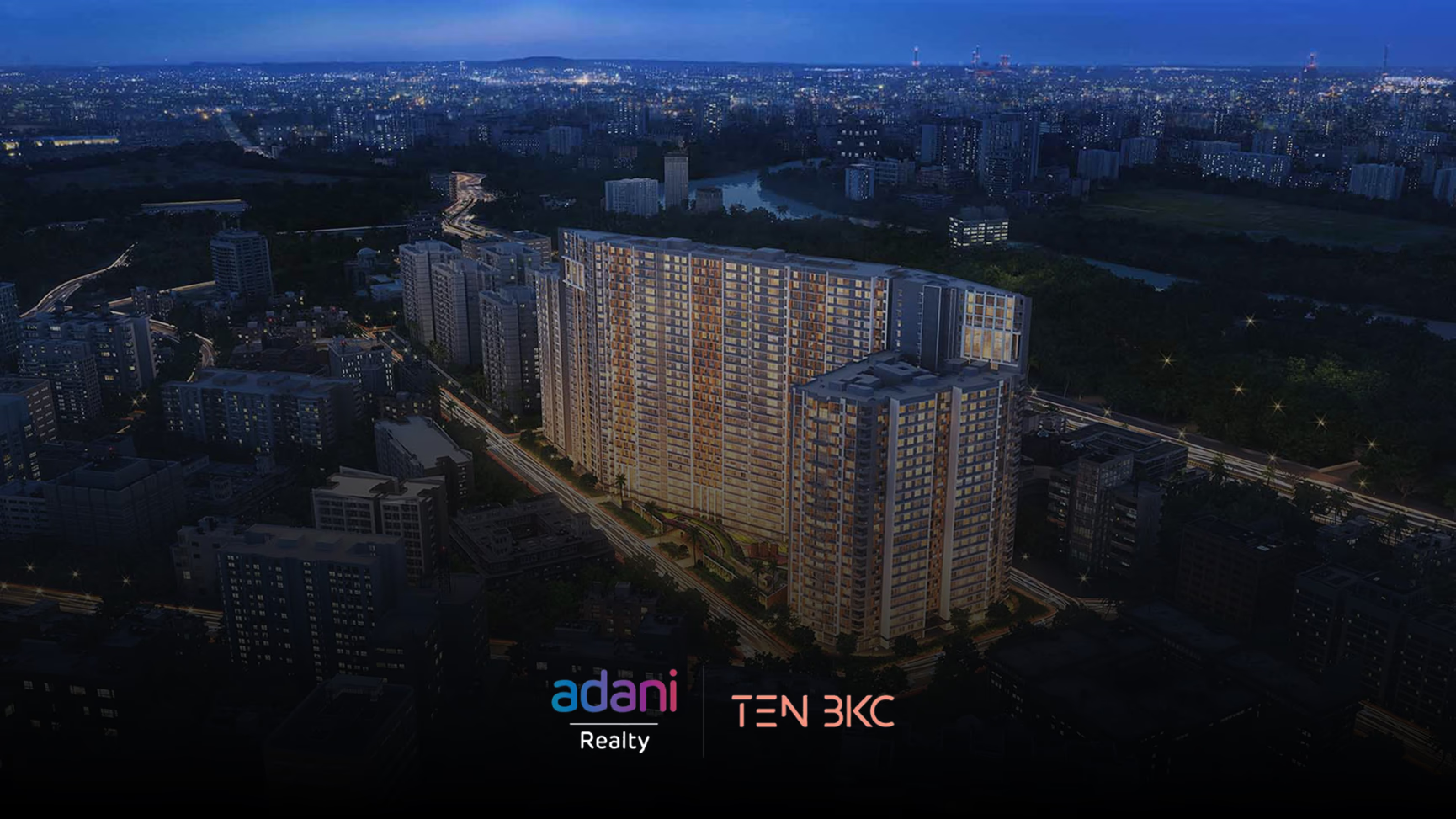
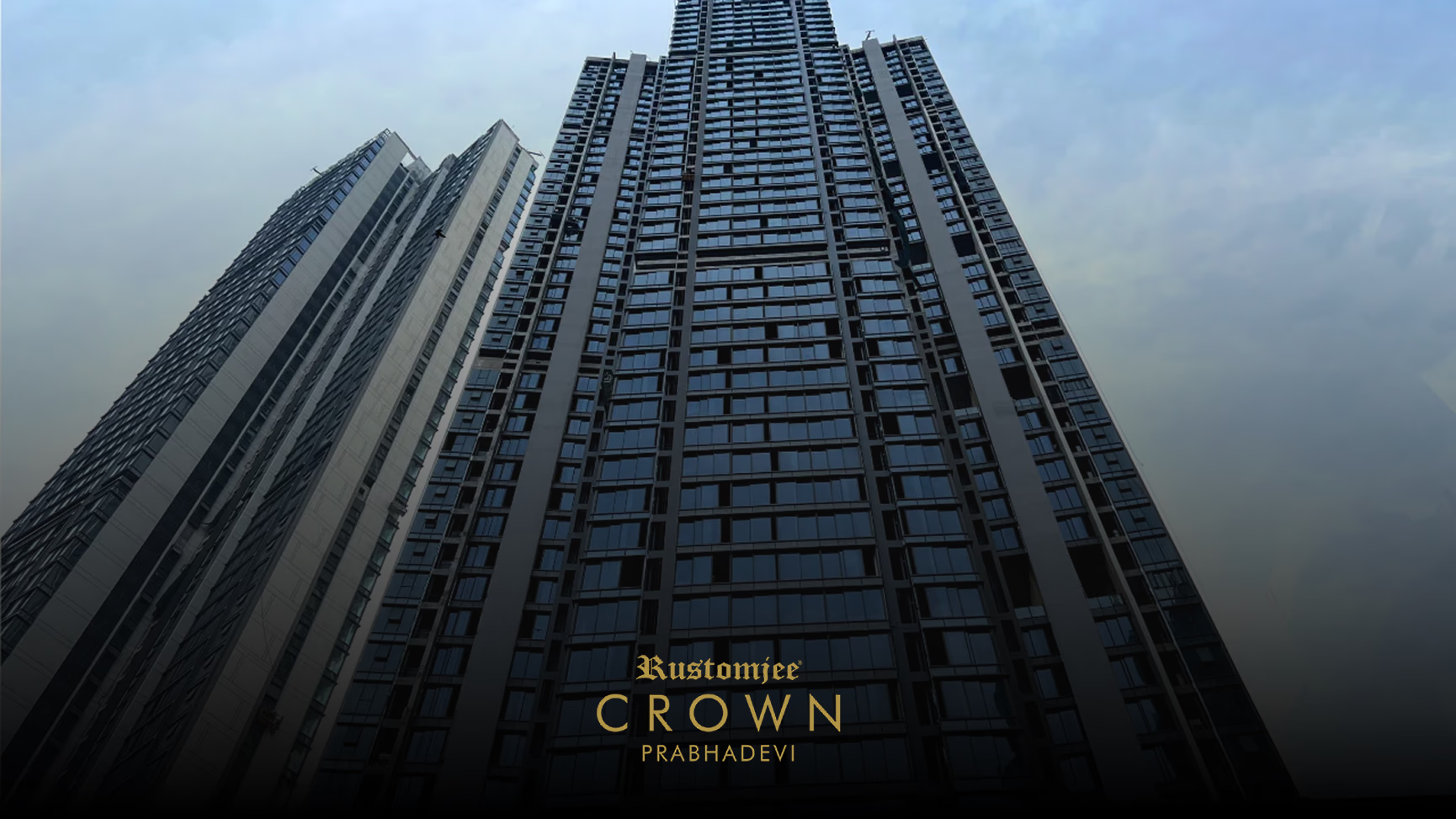
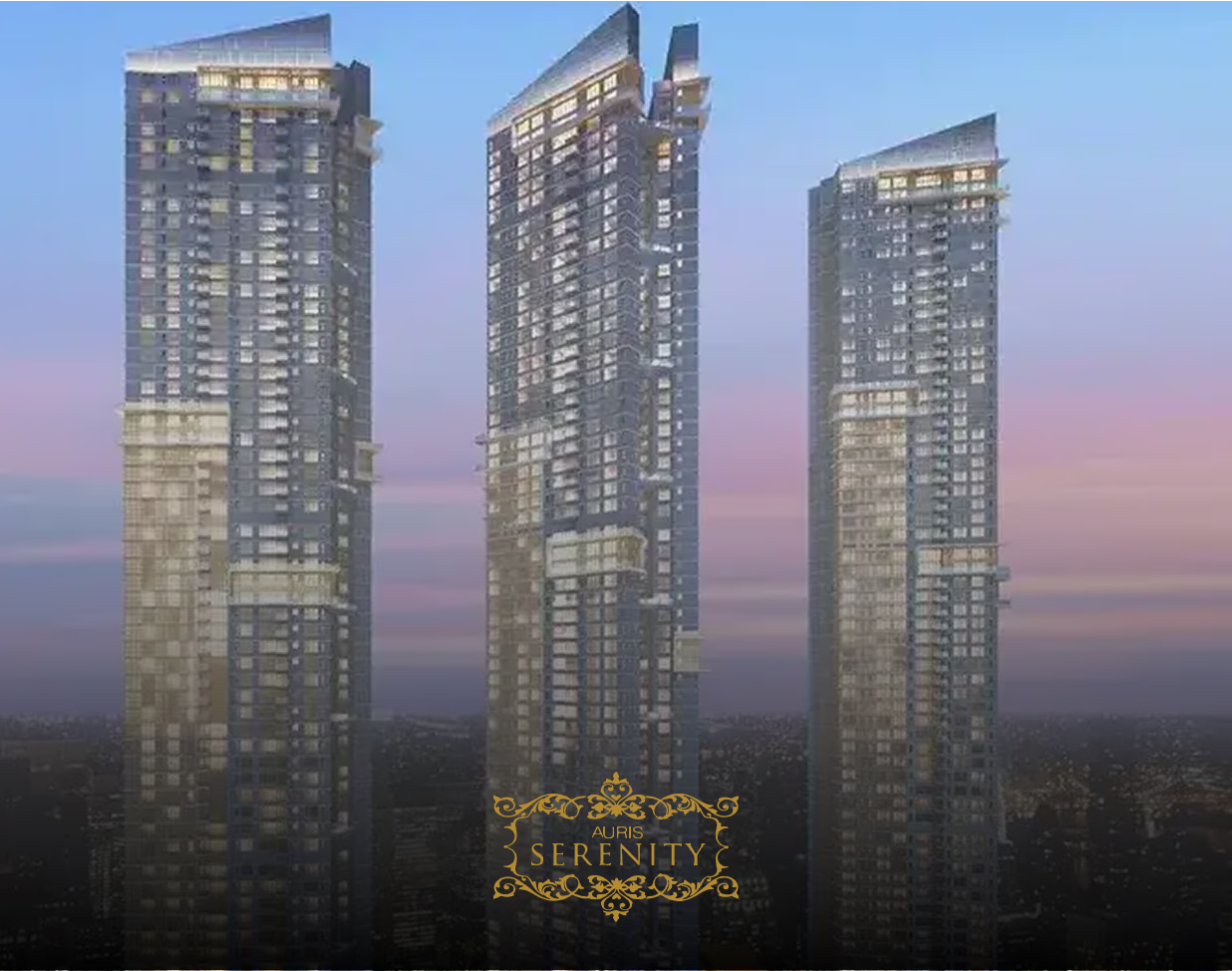
Named buildings with the most work include Ten BKC by Adani Realty, Rustomjee Crown in Prabhadevi, Lodha World One in Worli, Bhoomi Celestia, Auris Serenity and Oberoi Sky City. There is work in Indiabulls and Raheja developments too.
If your building is not on that list it changes nothing about the work itself. It does mean the first site visit matters more, because the riser layout and the society's particular rules will not already be known.
When should you actually plan this?
Before interior fit-out, while the electrical plan is still being drawn and the switchboards are still open. That is the cheap moment. It is not the only moment, and it is worth being clear about the difference.
Provisioning during construction means the extra points, a driver location with access to it, and control wiring where it is needed. All of that is dramatically cheaper than retrofitting it. Bringing an electrical plan to the first conversation is what makes the sizing accurate rather than a guess.
But if you have already moved in, you have not missed anything structural. The wireless system exists precisely for that case, and a single room is a reasonable place to start and expand from later.
On sequencing, if a fit-out is running: drivers go in after the false ceiling, keypads after the first coat of paint, and curtain tracks last, on a dust-free site. Worth knowing so it can be scheduled rather than squeezed.
On who does what, because this industry blurs it. AHA designs the system, supplies the drivers and controls, configures them and commissions the scenes. Your own electrician installs, mounts and wires the hardware. AHA does not install.
What does it cost in a Mumbai flat?
As scope estimates rather than quotes, because the figure moves with the number of light points:
- A bedroom: around ₹80,000 to ₹1,00,000.
- A living or media room: around ₹1,50,000 to ₹2,00,000.
- A full 3BHK apartment: around ₹5,00,000.
Lighting only, if that is where you want to start, runs around ₹45,000 for a bedroom and ₹65,000 for a living room, covering every point in the room made dimmable and scene controlled.
A room by room breakdown is more useful than a single number, because it lets you cut scope rather than quality. Our room by room cost breakdown for a 3BHK goes through it properly.
Does it keep working when the internet drops?
Yes, and it is worth understanding why, because it is the question that separates two quite different architectures.
The automations run on a hub inside the home rather than on a server elsewhere, on Zigbee 3.0 with Matter and Thread certification, on its own mesh rather than on your Wi-Fi. The Connectivity Standards Alliance, which maintains Zigbee, describes that mesh as self-healing, with no single point of failure: every mains-powered device relays for the others. Lighting, curtains, locks and scenes keep working through an outage. Internet is only needed for remote access from outside the home, camera viewing and voice assistants. There are no subscriptions or monthly fees.
Power is a separate question from internet, and a more Mumbai-specific one. Most inverter setups back up selected circuits rather than the whole flat, and which circuits those are gets decided during wiring, often by whoever is holding the cable. Decide it on the drawing: back up one modest circuit that keeps the home usable, and make sure the control layer is on it too, because a lit room whose switches have no power is not much use.
What do new homeowners ask us next?
Do you need society permission to automate a flat in Mumbai?
For anything that counts as an addition or alteration, yes, and it is a legal requirement rather than a courtesy. Bye-law 45(a) of the Model Bye-Laws for Co-operative Housing Societies says no member may make additions or alterations without the Committee's previous written permission, and 45(b) sets out how to apply through the Secretary. Apply early: the permission gates your start date.
What are the legal noise limits for renovation work in Mumbai?
The Noise Pollution (Regulation and Control) Rules, 2000 set ambient limits for a residential zone at 55 dB(A) during the day, 6am to 10pm, and 45 dB(A) at night. A complaint lies where noise exceeds the standard by 10 dB(A) or more, and within 100 metres of a hospital, school or court the limits are stricter. Your society's drilling hours are a separate thing: those are the society's own rule, not law.
Do you need to rewire a finished Mumbai flat to automate it?
Not with a wireless system. A driver sits inside each existing light fitting and keypads replace the existing switch plates, so the lights need no rewiring and no wall breaking. The one wiring check is a neutral at each keypad's switch box, which your electrician runs if it is missing. That is why automation can be added to a flat you already live in, one room at a time.
When is the best time to plan automation in a new Mumbai home?
Before interior fit-out, while the electrical plan is still being drawn and the switchboards are open. It is not required, because a wireless system retrofits into a finished home, but provisioning during construction is dramatically cheaper than adding it afterwards. Bringing an electrical plan to the first conversation is what makes the sizing accurate.
What does Mumbai's climate do to smart home hardware?
Two things. The monsoon holds relative humidity around 86 per cent through July, above the level where mould becomes a real risk, and it runs for weeks. Separately, in sea-facing buildings salt air corrodes housings, fasteners and contacts faster than humidity alone, and an IP rating does not protect against corrosion, because IP describes water and dust ingress rather than chemical attack.
What does home automation cost in a Mumbai flat?
As scope estimates rather than quotes: a bedroom around ₹80,000 to ₹1,00,000, a living or media room around ₹1,50,000 to ₹2,00,000, and a full 3BHK around ₹5,00,000. These move with the number of light points, which is why a room by room quote is more useful than a single figure.
Does a smart home in Mumbai keep working during a power or internet outage?
The automations run on a hub inside the home rather than on a server elsewhere, so lighting, curtains, locks and scenes keep working when the internet drops. Internet is only needed for remote access, camera viewing and voice assistants. Power is a separate question, and which circuits sit on your inverter is worth deciding before the wiring is done.
Does AHA install the hardware?
No. AHA designs the system, supplies the drivers and controls, configures them and commissions the scenes in your home. Your own electrician installs, mounts and wires the hardware itself. The two jobs are separate, and it is worth knowing which company is accountable for which.
Almost none of the decisions that matter here are about products. They are about a written permission you need before you start, a fit-out window that closes quietly, and a climate that punishes anything sealed in and forgotten.
If you have an electrical drawing or a possession date, that is the moment worth using. Both experience centres are laid out as real flats rather than showrooms, in Santacruz West and Lower Parel, and you can bring the drawing to either.
Book a free consultation →If you are still comparing firms, our home automation company in Mumbai page covers what to ask each of them, and who should build your smart home covers the routes available.