Wired vs Wireless Home Automation
For most Mumbai apartments, wireless is the better choice: it retrofits into a finished flat without breaking walls, and published Indian ranges put it at ₹200 to ₹600 per sq ft against ₹800 to ₹1,500 for wired. Wired still wins for villas planned before construction.
Wireless (ZigBee/Matter), for almost every home in India. It fits apartments, finished homes, renovations and new builds alike, typically costs roughly a third of wired per sq ft, and needs no civil work. Wired still wins for a large new-build villa where cabling is decided at the civil stage. The full comparison is below.
Somewhere in most consultations, usually right after the floor plan comes out, someone asks the question: "isn't wired more reliable?"
It is a fair question, and it used to have a simple answer. In 2010, wireless control in a home meant a battery remote and a receiver that lost the plot every third command. Wired was not just better, it was the only serious option. That reputation stuck.
The hardware has moved on considerably since. Here is the short answer, before the detail:
- Home already built, or an apartment you are moving into Wireless
- New build, walls open, big camera and AV scope Wire the network, not the control
- Lights, curtains, AC, fans, locks, sensors, scenes Wireless
The wired versus wireless debate is largely a debate about 2010 hardware. The radios got good, and the argument moved on.
Think about it this way: your phone transmits and receives wireless signals all day without a second thought, and so do satellites in orbit. Wireless communication has become extremely robust by 2026. That is our position, and we will show our working. Including the parts where wired genuinely still wins.
What is the difference between wired and wireless?
Wired automation means KNX, C-Bus, DALI or Modbus. A dedicated low voltage control cable runs from every switch, light and sensor back to a bus or a panel, alongside the power wiring and often the same Cat6 or internet cabling. It has to go in during the civil and electrical stage, while walls and ceilings are open, and it is commissioned afterwards by a certified integrator working in software like ETS. KNX is a genuine open standard, ISO/IEC 14543-3, and installations from the 1990s are still running.
Wireless automation means ZigBee, Matter or plain Wi-Fi. Devices talk to each other over a low power radio mesh, and only the hub needs a connection back to the network, either a Cat6 cable or Wi-Fi, both work equally well. Our systems run ZigBee 3.0 with Matter and Thread certification, on a dedicated local network that is separate from your Wi-Fi, so it neither uses your internet bandwidth nor slows your router.
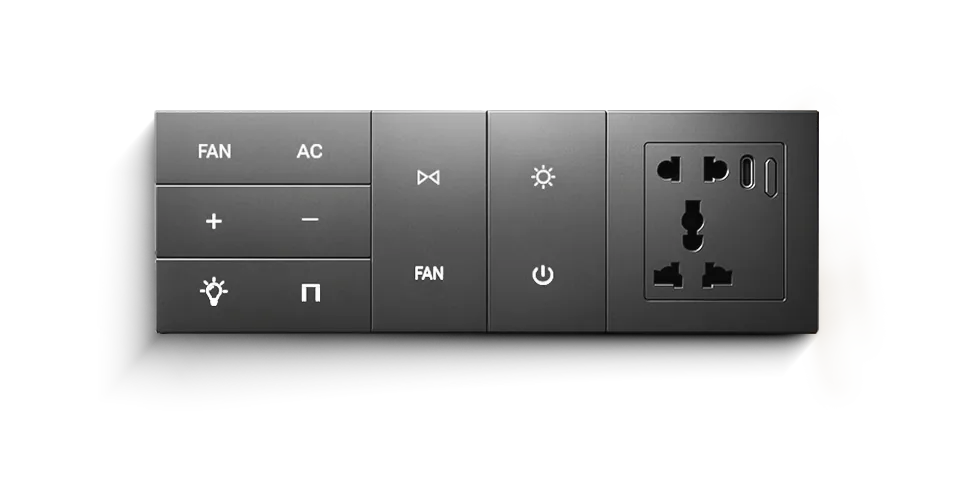
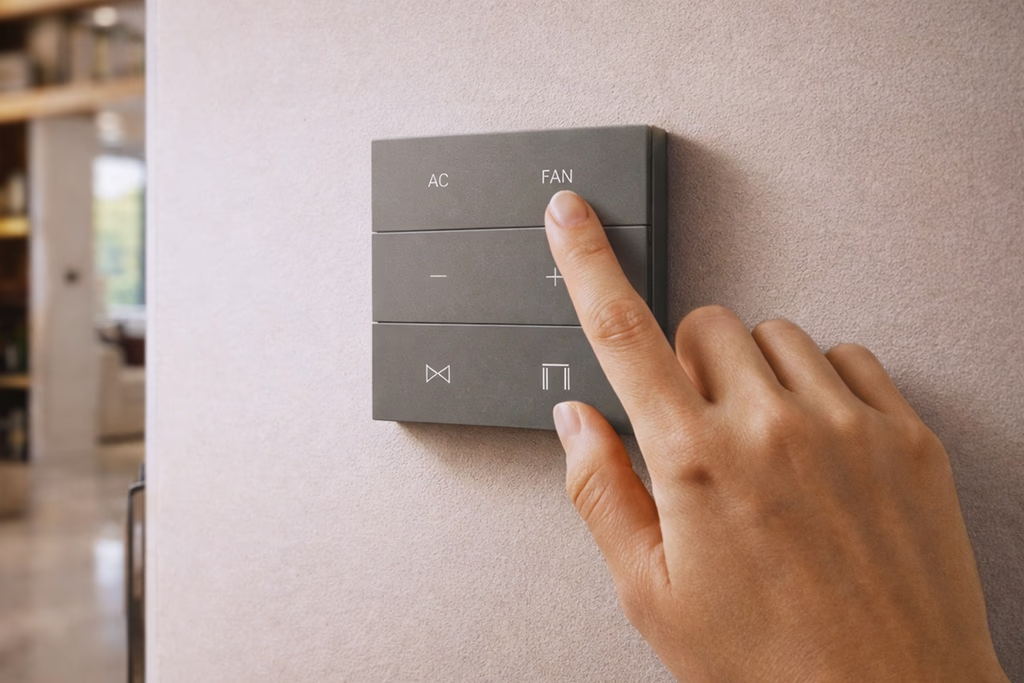
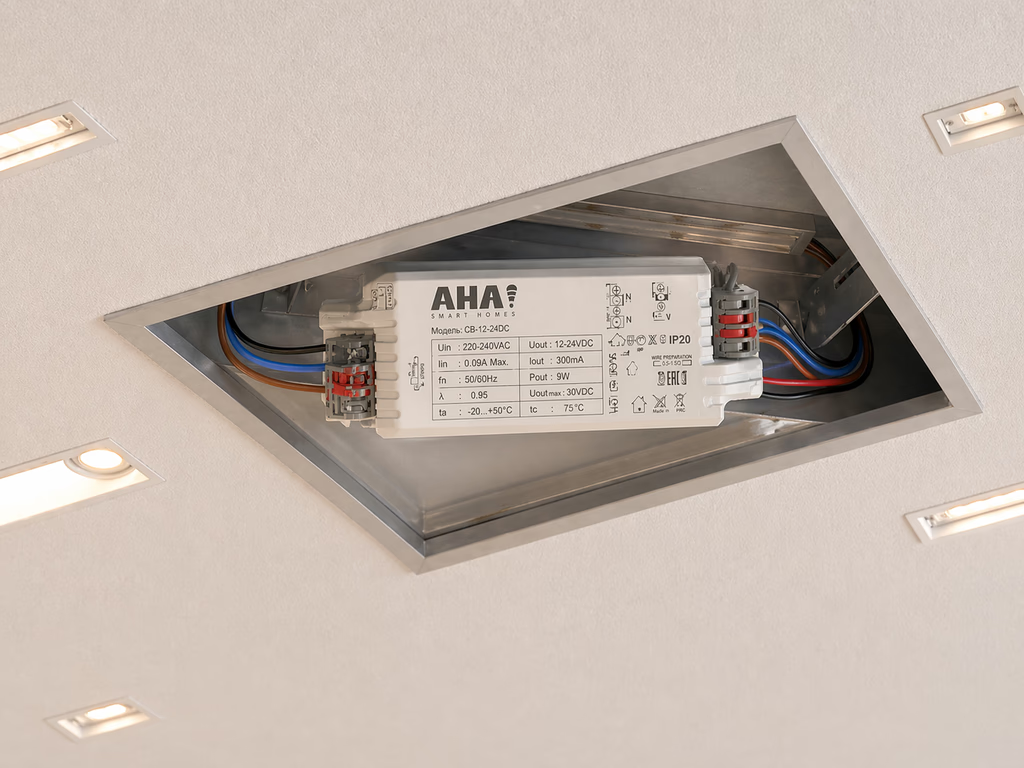
In practice, in an AHA home, that looks like this: a smart driver sits inside each existing light fitting, an IR controller handles the AC and TV in each room, and keypads replace the existing switch plates, each with a neutral at its switch box. Close to plug and play, in a home where people are already living.
How do they compare, factor by factor?
| Factor | Wired (KNX, C-Bus, DALI) | Wireless (ZigBee, Matter) |
|---|---|---|
| Best fit | New villa or large commercial project, decided at the civil stage | Apartments, finished homes, renovations and new builds alike |
| Install time | Weeks of conduit, chasing and cable pulls, then commissioning | 1 to 3 days of hardware, plus half a day to a full day of programming |
| Typical cost in India | Roughly ₹800 to ₹1,500 per sq ft* | Roughly ₹200 to ₹600 per sq ft* |
| Retrofit into a lived-in home | False ceilings opened or surface conduit run | Existing fittings stay; keypads need a neutral at the switch box |
| Works without internet | Yes, the bus is local | Yes, when the hub processes locally |
| Adding a device or room later | A new cable run, usually civil work with it | New devices join the existing mesh, no rework |
| Interference | Immune, the signal is on a shielded cable | Real and managed, through mesh routing and a network separate from Wi-Fi |
| High bandwidth loads | Built for it, Cat6a and PoE carry cameras and AV | Not its job, this is a control layer |
| Upkeep | No batteries anywhere | Mains devices need none, battery devices run 2 to 5 years |
| Who can service it | In practice, only the vendor who originally installed it, you are locked in for life | Any ZigBee compatible company, it is an open standard |
Read that honestly and a pattern shows up. Wired wins on the physics: cable does not care about walls, microwaves or neighbours. Wireless wins on everything to do with living in a real home, in a real building, on a real budget, and being able to change your mind later.
Does wireless drop out, need the internet, or go obsolete?
"It drops out"
Individual Wi-Fi gadgets drop out. Every device is a separate client on your router, every one of them competing for the same airtime, and there is nothing holding them together. That is the experience most people are remembering when they raise this.
A mesh does not behave that way. Every mains powered device in the home, each light driver, each keypad, each curtain motor, is also a repeater. The network gets stronger as the home fills up, and it re-routes around anything that stops answering. That is not our marketing line: the Connectivity Standards Alliance, which maintains Zigbee, describes it as a self-healing mesh network that eliminates single points of failure. Add a dedicated local network that is not sharing airtime with your streaming, and the failure mode people are worried about mostly stops existing.
The number we can point to is our own: about 95% of issues that do come up are resolved remotely, over phone or WhatsApp, in under 30 minutes, with nobody visiting the site.

"It stops working when the internet goes down"
This one is worth separating carefully, because half of it is true of cheap wireless and none of it is true of ours. Cloud dependent devices, the ones that round trip a command to a server in another country and back before your light comes on, do stop when the line drops. Ours do not: automations are processed by the hub, inside your home, so lighting, curtains, locks and scenes keep running through an outage exactly as before it. The intelligence lives in your home, not the cloud.
The honest exception is voice, since Alexa, Google Home and Apple Home are cloud services. For the full breakdown of what does and does not need a connection, and why, see our piece on whether a smart home works without internet.
"It will be obsolete in five years"
This is the objection wired advocates lean on hardest, and it is the one that has aged worst. It assumes wireless means proprietary, and proprietary means stranded when the vendor loses interest.
ZigBee 3.0 is an open global standard. Matter, which we are certified for alongside Thread, was co-developed by Apple, Google, Amazon and more than 300 other companies specifically so that no single vendor owns your home. And it is not standing still:
Which standard a company builds on is one of the eight tests in our guide to choosing a home automation company in India.




-
November 2024, Matter 1.4
Added home routers and access points, plus energy management for solar, batteries and EV charging.
-
November 2025, Matter 1.5
Added native camera support and a unified framework for closures, meaning blinds, curtains, gates and garage doors. The Thread Group reported over 1,000 certified Thread products and components in the market by this point.
Hardware bought into a standard on that trajectory gains capability over time rather than stranding you, and practically, that means any Matter compatible device, no matter who made it, works with an AHA system. The fallback matters too: because ZigBee is open, any ZigBee compatible company could service an AHA system, even in our absence. That is a harder guarantee to give on a proprietary wired bus.
What does it cost to add something later?
Everything so far has been about day one, what it costs to get the system in. The bigger gap between wired and wireless opens later, once you are actually living in the home and want to change something.
A wired KNX or C-Bus system is fixed the day it is commissioned. Every device sits on cable that was pulled once, during construction, back to a bus line sized for exactly what was specified at the time. Decide two years later that you want a sensor in the nursery, one more scene in the living room, or a curtain motor on a window that did not have one, and that is not a quick add-on. It means a new cable run: a false ceiling reopened or a wall chased, cable pulled back to the nearest bus line, then a certified integrator brought back on site to reprogram it in specialised software. Every one of those steps is its own cost on top of the device itself, and every one of them means dust and disruption in a home you are already living in.
A wireless mesh does not carry that problem, because there is no separate infrastructure to expand. New devices, another light driver, a sensor, a curtain motor, join the existing mesh the moment they are powered on, as long as the current hub already covers that part of the home. Nothing gets reopened and nothing gets reprogrammed from scratch. It is the same plug and play setup on day one or five years in, which is also why we are comfortable telling clients to automate one room now and the rest later: additions integrate into the existing system with no rework.
Is what adding a new sensor, curtain motor or light driver to an existing AHA system takes, as long as the current hub covers that part of the home. A wired system needs a new cable run back to its bus line and a certified integrator on site to reprogram it, every single time.
Why does this settle differently in India?
Most of the wired versus wireless writing online is European or American, and it quietly assumes a house with a neutral wire in every switch box, open studwork behind the plasterboard, and no housing society committee. Mumbai is a different problem.
1. The neutral wire
Traditional Indian switch boxes usually carry only live and switched live, no neutral, which is exactly what a conventional smart switch needs for continuous power to its electronics. That matters for our keypads too: the X7 needs a neutral at its switch box, so where one is missing your electrician runs it before the keypad goes in. The dimming itself happens in the smart driver inside the light fitting, not the switch box, which is why there is no flicker on low wattage LEDs. Nothing about the wiring is specialised, so installation is not locked to us: any local electrician can fit it.
2. The timing window
Wired has to be decided at the electrical stage. Miss that window and the cost climbs sharply, because everything that would have been a cable pull becomes civil work. Wireless is the same system at bare shell or five years after handover. The best time to plan is still before interior fit-out, so hub routing and keypad positions can be worked out alongside the electricals, but it is a preference rather than a deadline.
3. The market has already voted
Mordor Intelligence puts Wi-Fi at 63.80% of the India smart home market in 2025, with urban apartments taking 41.80% of revenue. Indian metro cities are an apartment market before they are a villa market, and apartment owners overwhelmingly buy retrofit.
Is how long the hardware takes to go into a full apartment, plus half a day to a full day of programming. A single room can be done in a day. A wired system for the same home is a multi-week job that has to start before the interiors do.
Where does wired still win?
If your walls are open, run cable. We say this to clients regularly, and it is not a concession, it is a different layer of the house.
Cat6 or Cat6a, home run back to a labelled rack, with PoE for cameras, access points, touchscreens and a NAS. That is bandwidth, and bandwidth is the one thing radio genuinely should not be asked to carry. Multi camera CCTV and whole home AV belong on cable. Over-wire while it is cheap, because a spare run costs very little now and a great deal later. A build on that scale usually needs a dedicated server room for the rack itself too, which adds real cost and complexity on top of the cabling, and rarely makes sense inside an apartment.
Then put the control layer on top of it, wirelessly: lighting, one of the main systems in any smart home, along with curtains, climate, locks, sensors and scenes. That is what nearly every home we build actually is: a wired network backbone carrying data, and a wireless mesh carrying control. Centralised enough that a hub coordinates the day to day, distributed enough that individual devices react instantly and there is no single point of failure.
Wired installations for lighting automation
Against a wired DALI installation specifically, which is the usual alternative quoted for lighting, we deliver comparable reliability and scene capability without the cost and complexity of the wired infrastructure, go in faster, and leave the system far easier to extend later. That last point compounds: rooms get added, families change, and a system you can grow without opening a ceiling is worth a great deal five years in.
If you want the full picture of how that gets scoped across a home, our whole home automation page walks through the complete system, and home automation services covers how the process actually runs.

What does the wireless route cost?
Since cost is doing a lot of the work in this argument, here are our real numbers rather than a per sq ft abstraction. These are the ranges we quote, hardware through configuration and commissioning.
- Bedroom, full setup, roughly 150 sq ft ₹80,000 to ₹1L
- Living or media room, more circuits and media ₹1.5L to ₹2L
- One window, motorised, 4 to 5 ft span ₹17,000 to ₹25,000
- Complete system, modern 3BHK in Mumbai ~₹5,00,000
Two things worth noting. Smart switches cost only about 25 to 30% more than the standard switches you were going to buy anyway, which makes them the best value line in the whole system. And pricing is component driven, so you only pay for what you automate: one room now and the rest later is a legitimate plan, not a compromise, because additions integrate into the existing system with no rework.
The full breakdown, room by room, is in our 3BHK Mumbai cost guide.
So which one is right for your home?
Find your situation, take the answer.
- Apartment, possession done, interiors already in Wireless
- New apartment, before fit-out Wireless
- Rented home you may leave Wireless
- One room now, the rest over time Wireless
- Mission critical commercial building Wired
For automated apartments, wireless is the best option.
What do people ask us next?
Is wireless home automation reliable enough for a whole home?
Yes, when it runs on a mesh rather than on individual Wi-Fi gadgets. Every mains powered device, the drivers, keypads and curtain motors, also acts as a repeater, so the network strengthens as the home fills up and re-routes around anything that stops responding. About 95% of issues are resolved remotely in under 30 minutes.
Does wireless home automation work without internet?
Yes. The hub processes automations locally, so lighting, curtains, locks and scenes keep working through an outage. Internet is only needed for remote access from outside the home, camera viewing and voice assistants. Voice is a cloud service and will stop, but every keypad still controls everything.
Is wired or wireless home automation cheaper in India?
Wireless, by a wide margin. Published Indian integrator ranges put wired KNX at roughly ₹800 to ₹1,500 per sq ft against ₹200 to ₹600 per sq ft for wireless. A complete system for a modern 3BHK in Mumbai typically comes to around ₹5 lakh, with no civil work, conduit or chasing inside that number.
Can home automation be installed in an already finished apartment?
Yes, and it is the clearest advantage wireless has. A driver goes inside each existing light fitting, an IR controller handles the AC and TV per room, and keypads replace the existing switch plates, each with a neutral at its switch box. Nothing is broken open for the lights. Hardware takes 1 to 3 days depending on scope, plus half a day to a full day of programming.
Will wireless smart home devices become obsolete?
Not on open standards. We run ZigBee 3.0 and are Matter and Thread certified. Matter was co-developed by Apple, Google, Amazon and 300+ companies, and keeps expanding: version 1.4 in November 2024 added home routers and energy management, version 1.5 in November 2025 added cameras and a closures framework for blinds, curtains and gates. Because ZigBee is open, any ZigBee compatible company could service the system.
Is it expensive to add new devices to an existing smart home system?
Not on a wireless mesh. A new sensor, light driver or curtain motor joins the existing network the moment it is powered on, as long as the current hub already covers that part of the home, with no new cable and no ceiling work. A wired KNX or C-Bus system needs a new cable run back to its bus line and a certified integrator on site to reprogram it, which usually means reopening a ceiling or wall that is already finished.
Do I need a neutral wire for smart switches in an Indian home?
Most Indian switch boxes carry only live and switched live, with no neutral, which rules out conventional smart switches that need a neutral for continuous power. AHA's lights avoid the problem, because the smart driver sits inside the light fitting, where the neutral already is. AHA's keypads do need a neutral at their switch box, so where one is missing your electrician runs it before the keypad goes in.
For nearly everyone reading this, wireless is simply the right call. Wired automation is excellent engineering, but it is an answer to a construction-stage question, and most people asking us about smart homes are standing in a home that is already finished.
The fastest way to settle it is to stop reading comparisons and go press something. Both our experience centres are real, lived-in smart homes running the wireless system described here, in Santacruz West and Lower Parel. Come have a coffee, open 11am to 7pm (Santacruz West is closed on Tuesdays), walk-ins welcome, appointments also available.
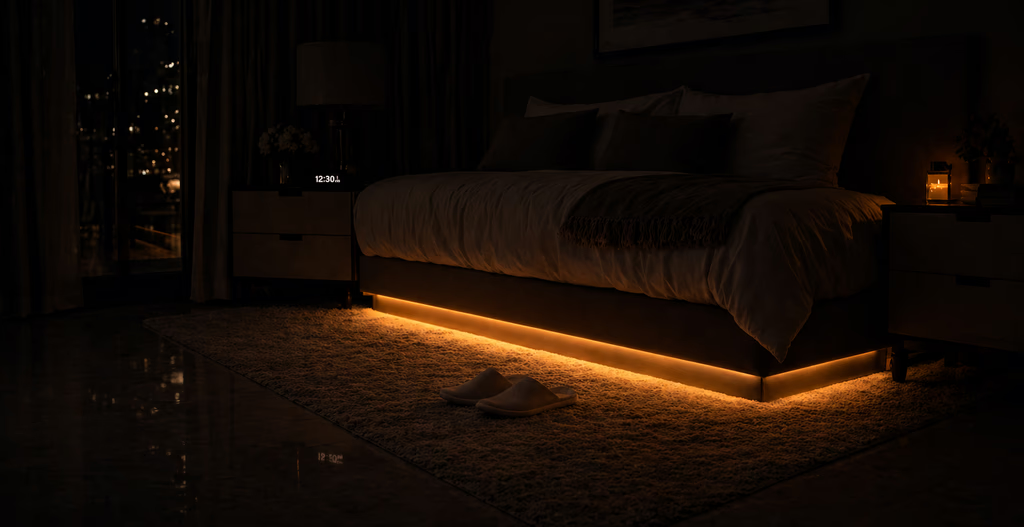
Book a free consultation →For what the wireless mesh actually enables once it is in, Midnight Walk and Grand Welcome are two scenes that depend on it responding instantly.