What Is Home Automation?
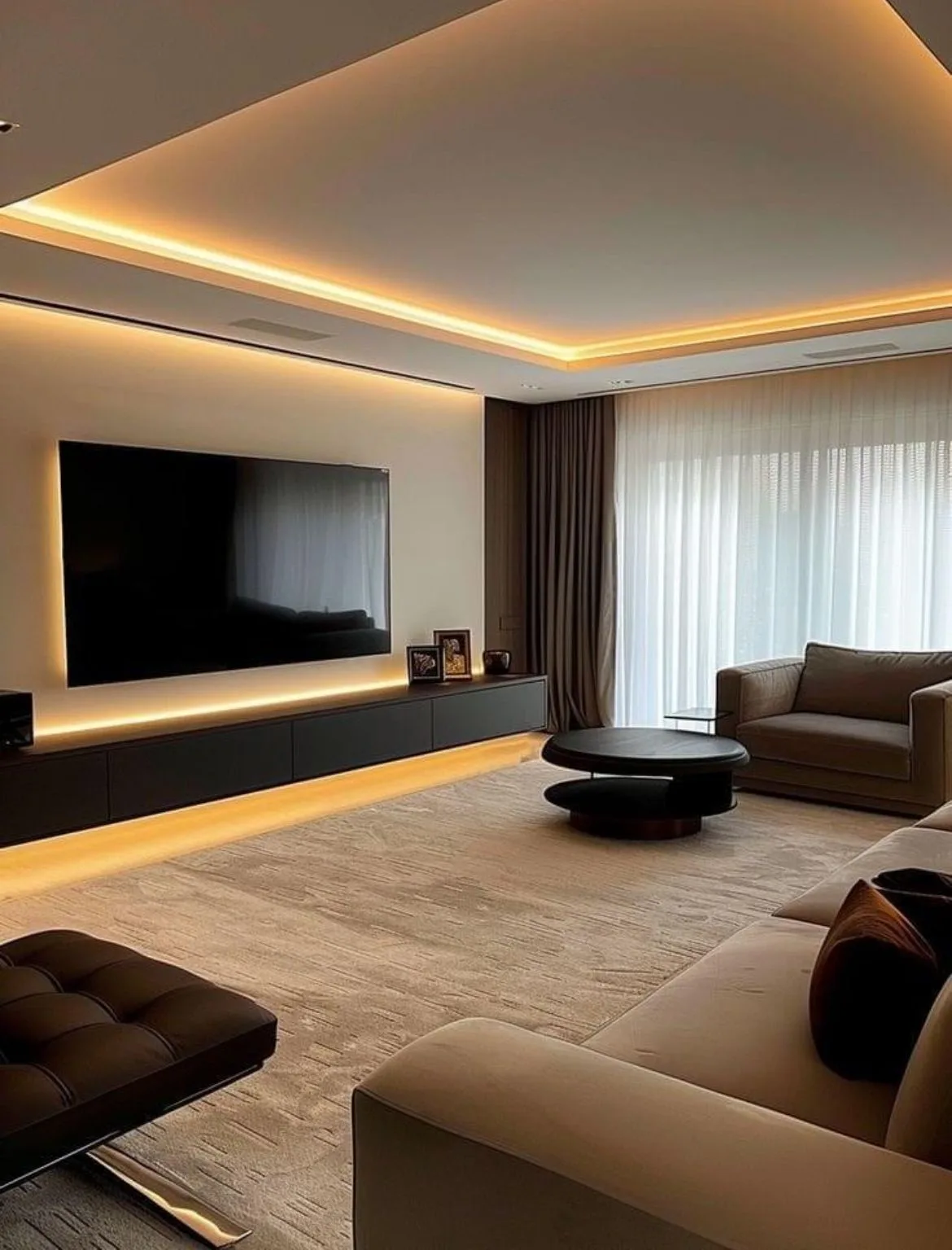
Home automation is one system that runs the parts of a home that used to be operated separately: lighting, air conditioning, curtains, locks, security and music. Instead of an app per device, a hub coordinates all of them, so a single button, schedule or phrase changes the whole room.
Smart devices give you control. Home automation creates experiences. That is the whole difference, and it is the reason two homes with the same hardware can feel completely different to live in. One asks you to open an app; the other has already drawn the curtains.
Ask ten people what home automation means and you will get ten answers: a smart bulb, a voice assistant, a lock that opens with a fingerprint, something expensive in somebody else's flat. All of those are parts. None of them is the thing.
What does home automation mean?
Home automation means a home where the systems that used to be operated one at a time are joined into one system that can act on its own. The lights, the air conditioning, the fans, the curtains, the locks, the cameras and the music stop being separate products with separate apps and become one thing you address in one place: a keypad on the wall, a phone, a schedule, or your voice.
The word doing the work in that sentence is automation. Control is being able to switch something on from your phone. Automation is the house doing it because it is 7am, or because the front door just opened, or because nobody has moved in that room for four minutes.
Hindi speakers search for the same idea as home automation kya hai, and the answer does not change with the language: one system, one set of instructions, a house that behaves the way the household lives.
Whole home automation brings every part of your home onto one platform, so the house works as one system rather than a drawer full of remotes.
What is the difference between a smart home and home automation?
The two phrases are used interchangeably in advertising, and they are not the same thing. In AHA's own words: a smart home typically consists of individual smart devices controlled separately through different apps, while home automation brings everything together on a single platform, allowing devices to work as one coordinated system.
| Smart devices | Home automation | |
|---|---|---|
| How you operate it | One app per brand | One keypad, one app, one voice command |
| What it does on its own | Nothing, until you ask | Runs scenes and schedules without being asked |
| Who it suits | One room, one problem, a rented flat | A whole home, a household with different routines |
| When the internet drops | Often stops working | Keeps running on the hub inside the house |
| Adding to it later | Another app, another account | Joins the same network and the same scenes |
This is why the honest question is not "which smart devices should I buy" but "do I want a system". Our guide to who should build your smart home covers the four kinds of company that answer that question very differently.
And once you are comparing firms rather than categories, how to choose the best home automation company in India is the checklist to take into the meeting.
What are the main types of home automation?
Six layers cover almost everything an Indian home actually automates. Most households start with the first and add the rest over time.
| Layer | What it does | What it replaces |
|---|---|---|
| Lighting | Every light dimmable and set to a colour temperature, grouped into scenes | A wall of switches and one shared dimmer |
| Climate | AC and fans brought onto the system and into schedules | Two remotes per room, and the AC left running all afternoon |
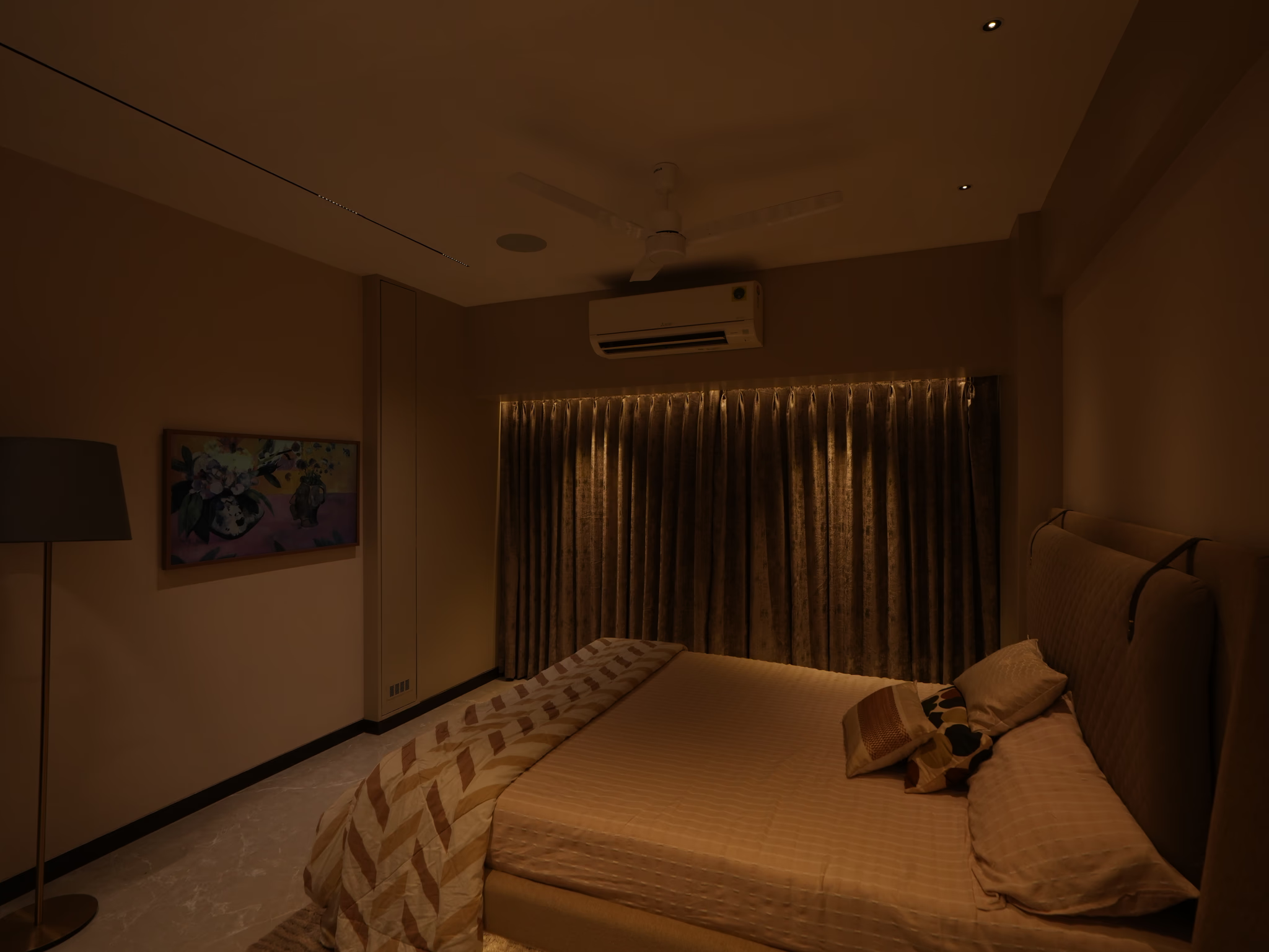
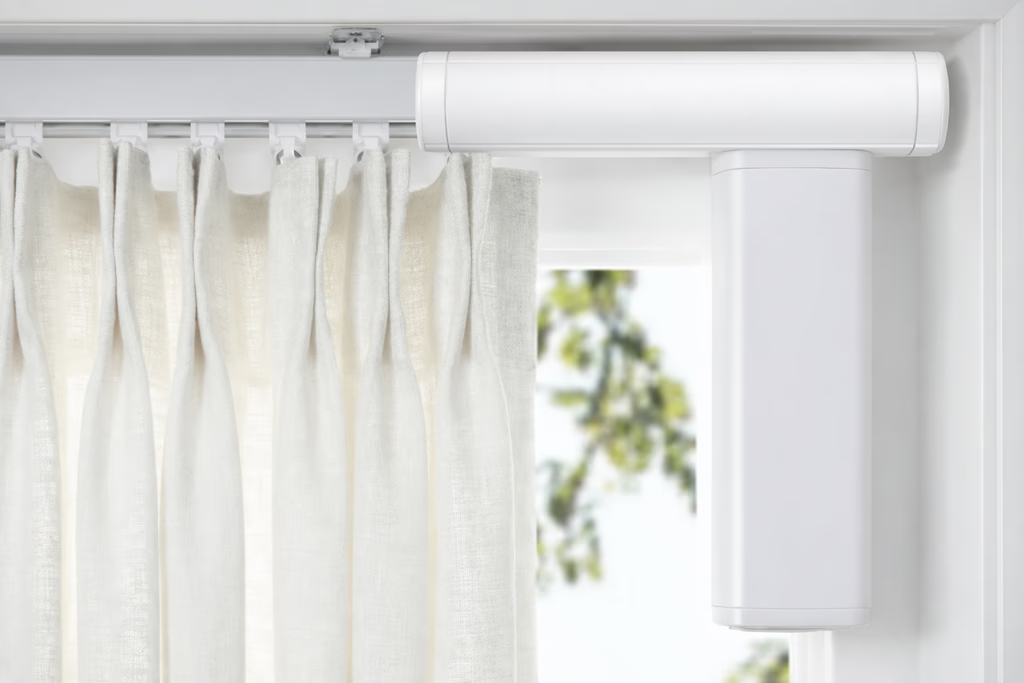
| Curtains and shading | Motorised tracks that open and close on time, voice or a button | Pulling six windows by hand, twice a day |
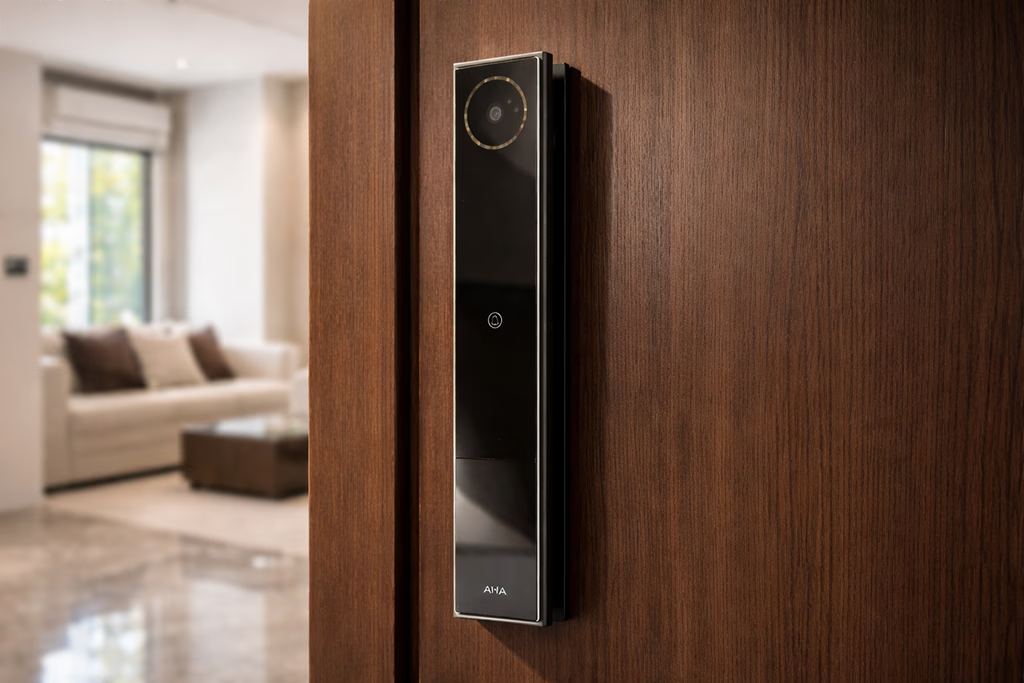
| Access and security | Smart locks, one-time codes, presence and door sensors, alerts | Spare keys, and never knowing who came in when |
| Entertainment and audio | Music in any room, and the TV drawn into a scene | A Bluetooth speaker carried from room to room |
| Sensing and scenes | The layer that triggers the other five, by time, motion, presence or arrival | You, remembering to do all of it |
AHA supplies the intelligence in each layer rather than the furniture around it: the driver inside your light fitting, the motor on your curtain track, the controller for your AC. You still choose your own fixtures and fabric from whichever vendor you like. As the team puts it, this is a smart home company, not a lighting or fabric company.
How does a home automation system actually work?
Three pieces, and the third is the one people miss.
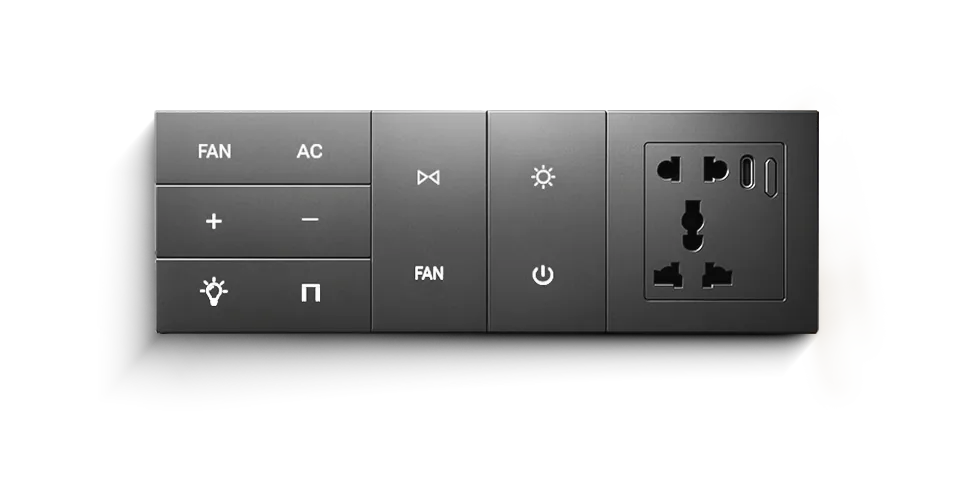
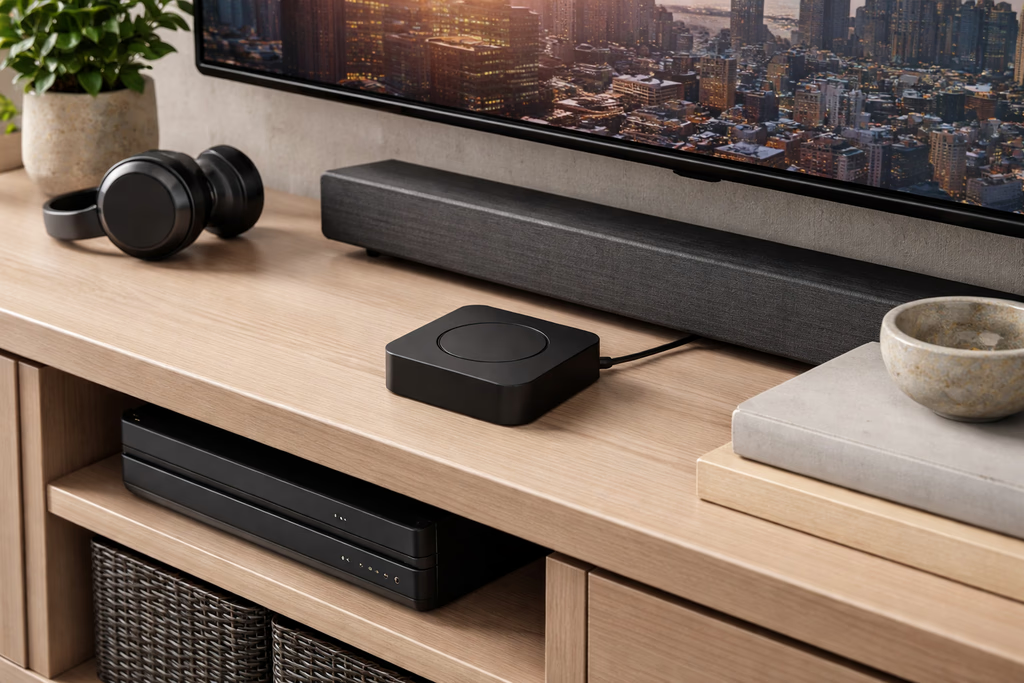
The devices. A driver sits inside each light fitting and gives that light its own dimming and colour temperature. An infrared controller in the room speaks to the AC and the TV the way their remotes do. Motors sit on the curtain tracks. Keypads replace your existing switch plates, using the wiring already in the wall.
The network. The devices talk to each other on Zigbee, a low-power mesh where every mains-powered device also passes messages along, which is why coverage improves as you add more. AHA's system is Zigbee 3.0, Matter and Thread certified. The Connectivity Standards Alliance describes Matter as one protocol to connect compatible devices and systems with one another, built on Internet Protocol and running over Wi-Fi and Thread. That network is separate from your home Wi-Fi, so it does not eat bandwidth or slow the router.
The hub. Every scene is programmed on a hub inside the flat, and the hub makes the decisions locally. That is what lets the house keep working when the internet is down, and it is the difference between a home that depends on a data centre and one that does not. More in does a smart home work without internet.
Because Zigbee is an open global standard rather than a private one, the hardware is not tied to one supplier's survival: another Zigbee-capable company could service the system. It is a small point that matters a great deal fifteen years into owning a house.
Should the system be centralized or distributed?
A centralized system routes everything through one brain: simple to operate, but a single point of failure. A distributed system puts intelligence in each device: resilient, but harder to keep coherent.
Most AHA homes run a hybrid. The hub gives you one place for day to day control and scenes, while individual devices keep enough intelligence to respond instantly and to carry on if one part of the system is unavailable. You get the simplicity of one system without a single point that takes the whole house down.
The deeper comparison, including what each approach means for a flat under renovation, is in wired versus wireless home automation.
What are the everyday uses of home automation?
This is where the definition stops being abstract. A day in an automated home, with the scene that does each one:
- 7am. The bedroom curtains open ten percent every five minutes, so the room fills with daylight instead of an alarm going off. That is Goodmorning Mode.
- 9am. One press by the door as you leave, and every light, fan and AC in the flat goes off. No walking back to check. That is Goodbye Routine.
- 11am. House help arrives on a one-time code rather than a spare key, and a single button gives them bright white light with the fan off, which is what cleaning actually needs. That is Cleaning Mode.
- 7pm. The door recognises a face, the entrance lights come up and the AC is already at the temperature the household chose. That is Grand Welcome.
- 9pm. One press dims the room, drops the curtains and sets the TV for a film. That is Theatre Mode.
- 2am. Somebody walks to the kitchen and a low light follows them, bright enough to see, dim enough not to wake anyone. That is Midnight Walk.
None of those is a gadget doing a trick. Each is the same six layers, pointed at a moment the household actually has.
Mumbai homes built this way in more than six years, supported by an in-house team of over 80 technicians, with about 95% of issues resolved remotely in under 30 minutes.
What does an Indian home need for it?
Less than most people expect, with one honest exception.
Wiring. The drivers go inside the light fittings that are already there, and the keypads use the wiring behind your existing switch plates, so a finished flat does not need to be opened up. The exception is the neutral wire: a keypad needs a neutral at the switch box, and plenty of older Indian switch loops do not have one. Where that is the case, your electrician runs a neutral to the box first. We wrote the full explanation in do smart switches need a neutral wire.
Power and climate. The equipment is engineered for Indian power fluctuations and for humidity, and every batch is tested before it goes into a home. In a power cut the hub stops along with everything else and picks up when power returns; the smart lock still opens with its mechanical key.
What to demand of any device, not just ours. India publishes a free checklist for this. The Telecommunication Engineering Centre's Code of Practice for Securing Consumer Internet of Things (TEC 31318:2021) opens with no universal default passwords, keep software updated, and make systems resilient to outages. If a seller cannot answer those three, the brochure does not matter. More on that in is a smart home safe.
Who does what. Your electrician mounts and wires the hardware to AHA's plan. AHA designs the system, supplies the products, and configures and commissions everything on site. A single room can be done in a day; a full apartment usually takes 3 to 5 days.
What does it cost, and where should you start?
A complete system for a Mumbai 3BHK runs about 5 lakh rupees. That number moves with how many lights are on individual control, how many windows are motorised, and whether access and audio are included, which is why the useful conversation is room by room rather than per device. The full breakdown is in what should home automation cost.
You do not have to do all of it at once. Automating one room and expanding later is normal, and additions join the existing network and the existing scenes with no rework, because every mains-powered device on the mesh also extends it. There are no SIM cards, subscriptions or monthly fees, and app access is included for life. The first year of support is complimentary.
On timing: the easiest moment is before interior fit-out, when hub routing and switch positions can be planned alongside the electrical work, but it is not a deadline. The wireless system retrofits into finished homes, which is the whole point of the approach. Before or after interiors covers which decisions genuinely have a deadline, and how long home automation takes covers the calendar.
The system also works with Amazon Alexa, Google Home, Apple Home, SmartThings, Sonos and IFTTT, so the assistant your household already uses keeps working.
What do people ask us next?
What does home automation mean?
Home automation means running the parts of a home that used to be operated one by one, lighting, air conditioning, curtains, locks, security and music, as a single system. A hub coordinates them, so one button, one schedule or one phrase changes a whole room instead of you adjusting each device separately.
What is a home automation system?
It is the hub, the devices and the programming together. Drivers sit inside light fittings, motors sit on curtain tracks, controllers handle the AC and TV, keypads replace switch plates, sensors watch for presence, and a hub holds the scenes that tie them together. Remove the hub and you are left with separate gadgets again.
Is a smart home the same as home automation?
Not quite. A smart home usually means individual smart devices controlled separately through different apps. Home automation brings everything onto one platform so the devices act together. Smart devices give you control; home automation gives you scenes that run without being asked.
What are the main types of home automation?
Six layers cover almost every Indian home: lighting, climate (AC and fans), curtains and shading, access and security, entertainment and audio, and the sensing layer that triggers the rest. Most households automate lighting first, then curtains and climate, then access.
What are examples of home automation in a house?
Curtains that open a little at a time at a set hour instead of an alarm. One button by the door that switches off every light, fan and AC as you leave. A passage light that comes on dimly when someone walks at 2am and goes off by itself. The AC and lights set to a film in one press. House help let in on a one-time PIN rather than a spare key.
Does home automation work without internet?
Yes for the parts you touch. Lighting, curtains, locks and scenes run on the hub inside the house, so keypads and schedules keep working with the router unplugged. Internet is needed only for remote access from outside, camera viewing and voice assistants. A power cut is different: the hub stops with everything else and resumes when power returns.
Can an existing flat be automated without breaking walls?
Usually. The lighting drivers sit inside the fittings you already have, an IR controller brings the AC and TV in, and curtain motors go onto tracks. The one common exception is the keypad, which needs a neutral wire at the switch box; where an older Indian switch loop has none, your electrician runs one before the keypad goes in.
What does home automation cost in an Indian home?
A complete system for a Mumbai 3BHK runs about 5 lakh rupees, and a single room is a far smaller commitment because the system is designed to be added to later. What moves the number is how many lights are on individual control, how many windows are motorised, and whether access and audio are included.
The short version: home automation is not a shelf of clever products, it is one system that already knows what the hour and the household need. If a definition has to fit in a sentence, use this one: smart devices give you control, home automation gives you a house that acts.
Both our experience centres, in Santacruz West and Lower Parel, are laid out as real flats rather than showrooms, open 11am to 7pm (Santacruz West is closed on Tuesdays). Walk in, or book ahead and bring your electrical plan.
Book a free consultation →