Motorised vs Manual Curtains: Are They Actually Worth It?
Yes, for the windows you use every day or cannot easily reach: motorised curtains are cordless, open and close on a schedule, and cost about ₹17,000 to ₹25,000 per standard window with AHA. For a window you rarely touch, a manual curtain is still fine.
Yes, worth it for most homes. A full motor and track setup runs ₹17,000 to ₹25,000 per window, cordless (safer for homes with young children), with real energy savings when the schedule is actually used. No subscription on top.
Motorised curtains have moved from a luxury add-on to one of the most practical upgrades in a modern home. They're safer, more convenient, and can genuinely lower your energy bill, and the price gap with manual curtains is smaller than most people expect.
- Best for Hard-to-reach or oversized windows, homes with children, daily-use rooms, and anyone building a connected home
- What it costs ₹17,000 to ₹25,000 per window with AHA, configured and commissioned
- Why it's catching on Cordless by design, and a university study found automated shading cut energy use by roughly a quarter
The case for motorising a curtain isn't just convenience anymore. It's a cordless, safer design and a measurable drop in your energy bill. Convenience is simply what comes with it.
How does the technology actually work?
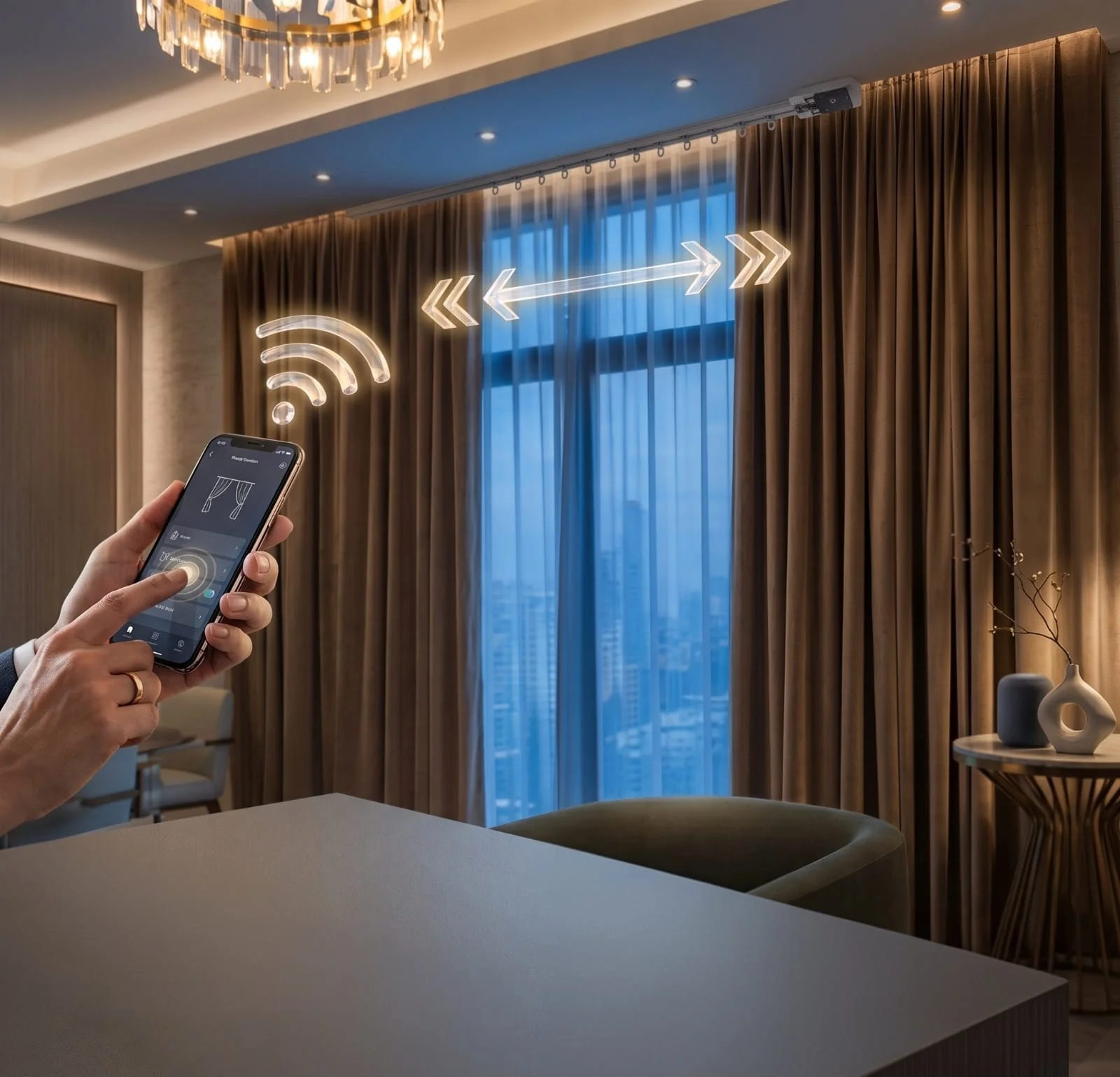
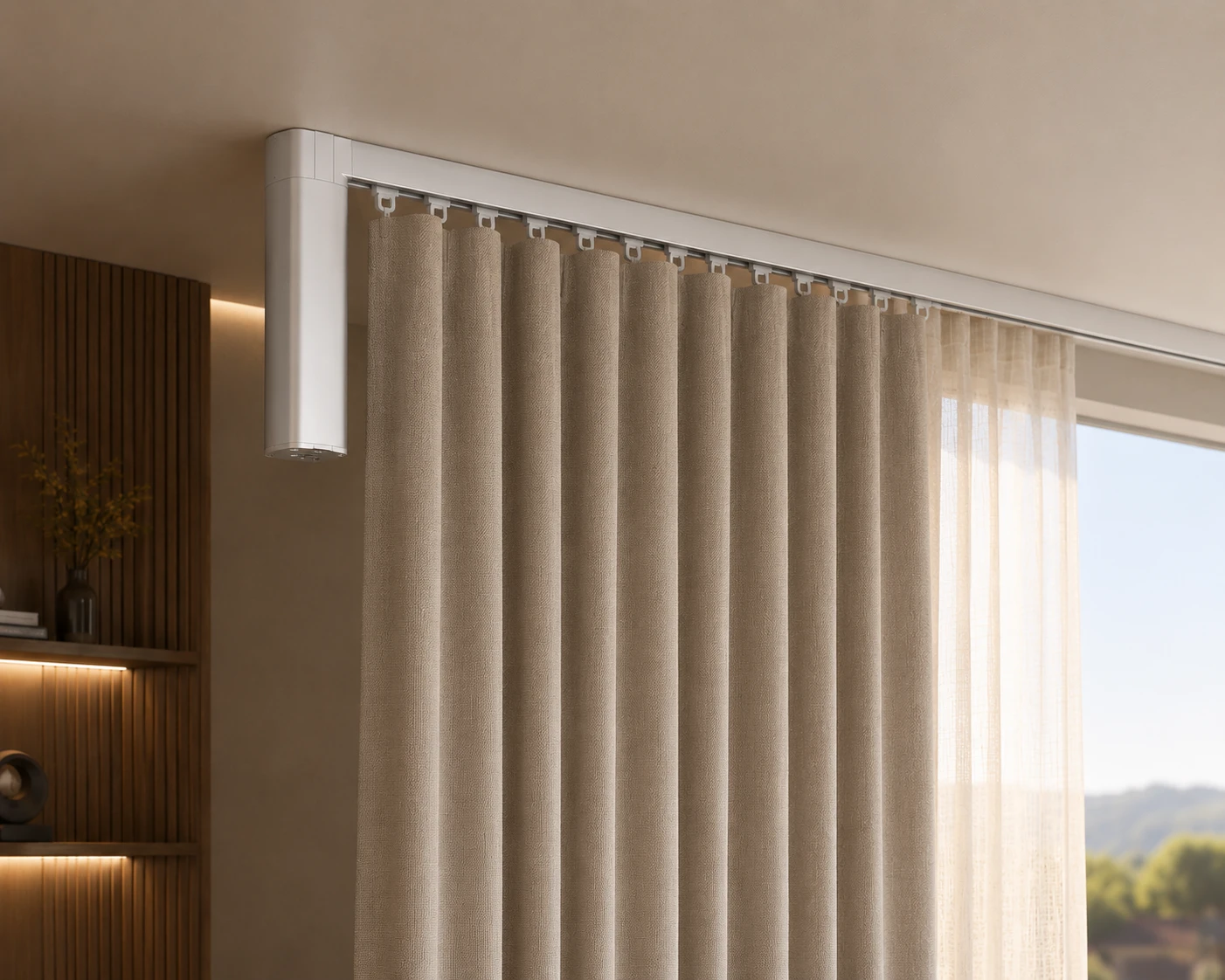
There are three broad approaches on the market. Track-based motorised systems, AHA's own included, drive the curtain along its track directly, usually fitted as part of a proper automation setup rather than as a standalone gadget. Retrofit clip-on units attach to an existing rod without replacing anything, a lighter-touch way to automate a single window. Motorised blinds and shades build the motor into the roller or headrail, a different product solving a similar problem for a different window treatment.
Control ranges from a basic handheld remote to a full app, voice and schedule setup through a smart-home hub, and that last part is where the real value shows up: a curtain that opens on a schedule or reacts to a sensor is doing something a remote never could, running the room whether or not anyone remembers to.
What do motorised curtains actually cost?
A full motor and track setup with AHA runs ₹17,000 to ₹25,000 per window, in line with what quality motorised tracks cost across the market, configured and commissioned in the same visit as the rest of a room rather than sold as a separate gadget you have to figure out yourself. There's no subscription on top of that.
Set against what you're already spending on curtains, fabric, a track, stitching and fitting, the smart layer is a modest addition for what it replaces: opening and closing every window in the house by hand, every single day, for as long as you live there.
Motorised or manual: how do they compare?
| Factor | Manual | Motorised |
|---|---|---|
| Hard-to-reach or oversized windows | Awkward, often needs a pole or steps | Full-height and skylight windows become genuinely usable |
| Cord safety | Cords need care around young children | Cordless by design |
| Daily convenience | A manual pull, every time | App, voice, schedule, or one remote for the whole home |
| Energy behaviour | Only helps if someone remembers to open and close it | Scheduled or sensor-driven, the behaviour that actually delivers savings |
| Power source | None needed | AHA's motors run on mains power, not batteries, no recharge routine to remember |
Are motorised curtains safer, and do they really save energy?
One quiet advantage of motorised curtains is that they're inherently cordless. Corded curtains and blinds are a documented strangulation risk for young children, and the US Consumer Product Safety Commission puts its advice plainly: "The safest option when young children are present is to go cordless." A motor-driven curtain has no operating cord to begin with.
The energy case is just as strong. Curtains do real work insulating a room from heat and light, but only if someone actually opens and closes them on schedule, which is exactly the part manual curtains rely on a person remembering to do. A 2023 study by the Illinois Institute of Technology, run at Chicago's Willis Tower, found that automated insulating shades cut energy consumption by roughly a quarter across a 10 month test, in both the heating and cooling seasons, with the cost of installation recouped in 3 to 5 years. Eighty percent of the building's occupants preferred the automated shades to what they'd had before. Results vary home to home, but the direction is consistent: automated beats remembered, every time.
Which windows should you motorise first?
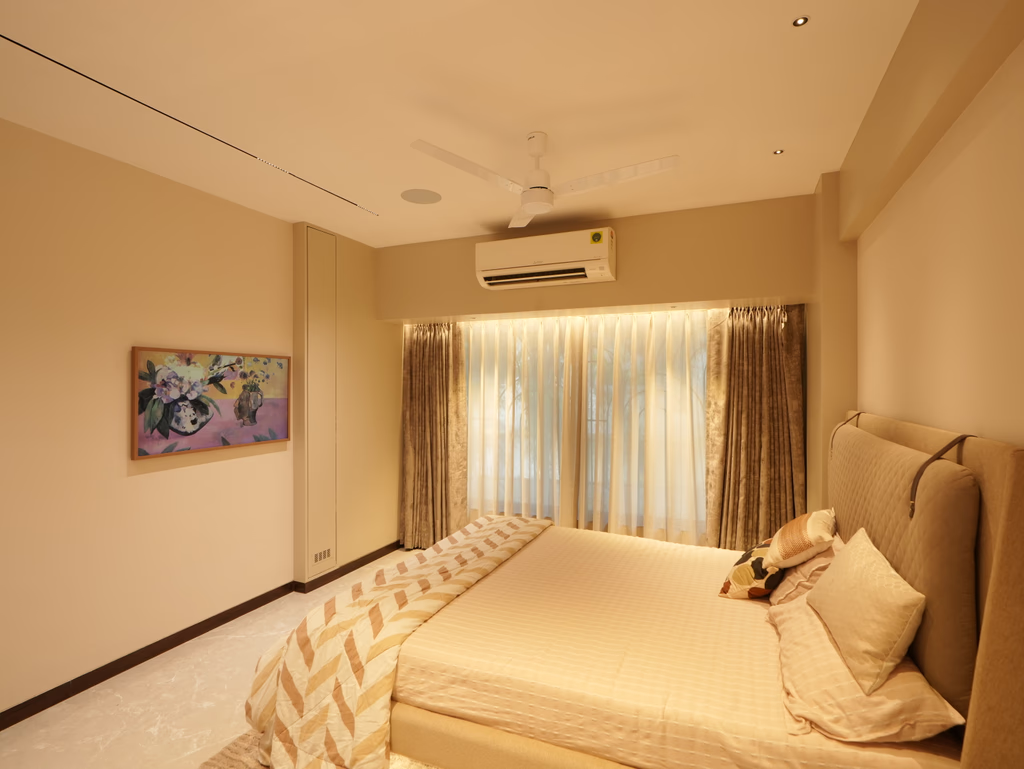
Motorising earns its keep fastest on windows taller than about 2.5 metres, rooms you use every day, a main bedroom, the living room, a home office, and anything genuinely hard to reach without moving furniture. It's also the clear choice for skylights, floor-to-ceiling glass, homes with young children, and any room you're already building a routine around, entertaining, movie nights, a morning wake-up.
Most homes start with the rooms that matter most, and end up expanding from there once they feel the difference day to day.
What else do people worry about?
Do I need to worry about batteries?
Not with AHA. Our curtain motors run on mains power, 100 to 240V AC, so there's no recharge routine or battery swap to plan around, unlike many battery-powered systems on the market.
Will it lock me into one ecosystem?
No. AHA runs on ZigBee 3.0 and is Matter and Thread certified, open standards backed by Apple, Google, Amazon and hundreds of other companies, so a curtain motor bought today keeps gaining compatibility over time instead of getting stranded. More in our wired versus wireless comparison.
Is it noisy?
Not at AHA's spec. Our curtain motor runs at 27 decibels, quieter than many well-known names in the category, which commonly run closer to 35 decibels. In a bedroom at night, that's a difference you actually notice.
Where do curtains fit inside a real smart home?
A motorised curtain that only opens and closes from an app is still, functionally, a slightly fancier remote control. The real payoff shows up once it's built into a scene alongside everything else in the room. Goodmorning Mode opens the curtains by 10% every 5 minutes, letting natural light reach the room gradually instead of all at once. Goodbye Routine closes them automatically on the way out, alongside the lights switching off and the doors locking behind you, one exit, not three separate habits to remember.
That's the real case for buying a curtain motor from a whole-home automation company rather than a standalone one: the curtain doesn't have to be the whole system. It just has to be one more thing the system already knows how to run. See AHA's own motorized curtains for the full spec and pricing.
How do you get started?
- Start with the rooms that matter most. Tall, oversized, or hard-to-reach windows, and any room you use every day, see the fastest payoff.
- Ask about the power source. Mains-powered means no battery routine to remember, worth asking any vendor directly.
- Think in scenes, not switches. The real value shows up once your curtains move together with your lighting and AC, not as a separate app.
- One room is a perfectly good place to start. Curtain motors join an existing AHA mesh the moment they're powered on, so expanding room by room, whenever you're ready, is completely normal.
When is a manual curtain still the better choice?
- On a window nobody opens. A store room or a window that stays shut most of the year gets nothing from a motor. Spend the money on the windows you touch every day.
- Without a power point near the track. AHA's motors run on mains power, so each motorised track needs a power point at pelmet height. In a finished room that means a visible cable or some chasing, which is why it is best planned during the electrical work. Our electrical points checklist covers it.
- On a very heavy or very wide run, check the spec first. The standard motor handles up to 15 feet of width and 80 kg; heavier double-height curtains need the larger motor.
- If you expect the energy saving without the schedule. The saving in the study below came from shades that moved on their own. A motorised curtain opened and closed by hand, like a manual one, saves nothing extra. In a power cut, the motor stops, but you can still pull the curtain by hand.
What do people ask us next?
Are motorised curtains worth the extra cost?
Yes, especially on windows you use every day or struggle to reach. The cost difference is smaller than most people expect, and it's a one-time addition, not a subscription.
Do motorised curtains need batteries?
Not with AHA. Our curtain motors run on mains power, 100 to 240V AC, so there's no recharge routine or battery swap to plan around.
Are motorised curtains safer than manual ones for homes with young children?
Motorised curtains are cordless by design, which removes a safety consideration that's long been associated with corded window coverings, especially in homes with young children.
Do motorised curtains actually save energy?
Yes, when the schedule is real. A 2023 Illinois Institute of Technology study of automated insulating shades at Chicago's Willis Tower found roughly 25% lower energy use across a 10 month test, paid back in 3 to 5 years. Results vary home to home, but the direction is consistent.
What does motorising one window cost?
Motorising one standard window of about 4 to 5 feet, with the motor, track and wall control, configured and commissioned in the same visit as the rest of the room, runs about ₹17,000 to ₹25,000. It is an estimate rather than a quote.
Can I automate just one or two windows to start?
Yes. Curtain motors join the existing AHA mesh the moment they're powered on, as long as the current hub covers that room, so starting with one room and expanding later is completely normal.
Motorised curtains have quietly become one of the easiest upgrades to justify in a modern home: cordless, quieter, and genuinely useful every single day.
See it for yourself before deciding. Both experience centres run real curtain motors on real windows, in Santacruz West and Lower Parel, open 11am to 7pm (Santacruz West is closed on Tuesdays), walk-ins welcome, appointments also available.
Curtains rarely stay the only automated thing in a home for long. Our smart home solutions page covers the lighting, climate and entertainment layers they end up sharing scenes with.
Book a free consultation →