Can You Add Home Automation to a Finished Flat Without Breaking Walls?
Yes, for most of it. Lights, AC, fan, TV, door locks and motion sensors can all be automated in an already-finished flat with no chasing, because the smart part sits inside the light fitting or travels by radio. Motorised curtains and wall keypads are the two that can still need one wire.
The ceiling is open. The wall is closed. In a finished flat you can still reach inside a light fitting, above a false ceiling and behind a curtain pelmet. You cannot reach inside a plastered wall without cutting it. So the real question is not whether a device is wireless. It is where its electronics have to live. Anything that can live in a space you can still reach goes in without wall work. Anything that has to live inside the wall does not.
Most of the homes we work in are not building sites. They are flats people already live in, already painted, already furnished, where nobody is willing to reopen a ceiling that took three weeks to finish. So this is the question we get asked more than any other, and it deserves a straight answer rather than a brochure one.
What can be automated with no wall work at all?
More than most people expect, because the biggest part of a home automation job is lighting, and lighting is the part that needs nothing new.
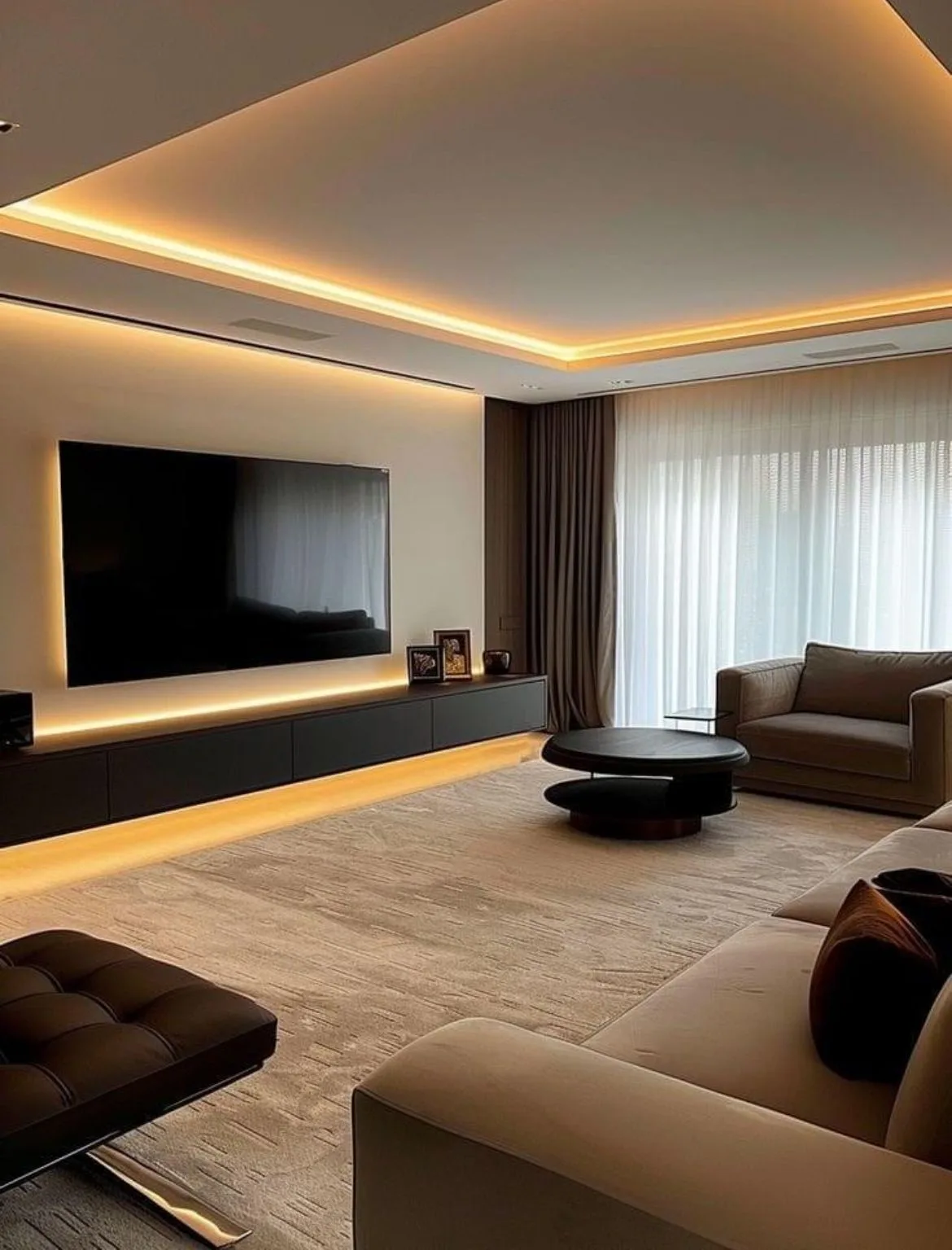
A smart driver is a small module that sits inside the light fitting itself, on the wires already feeding that fitting. Nothing new is run to the light. Once it is there, that one light can dim on its own curve and shift its colour temperature independently of every other light on the same circuit, which a wall dimmer cannot do. AHA's drivers work with roughly 90 to 95 percent of the lights sold in the Indian market, so the fixtures you already chose stay exactly where they are.
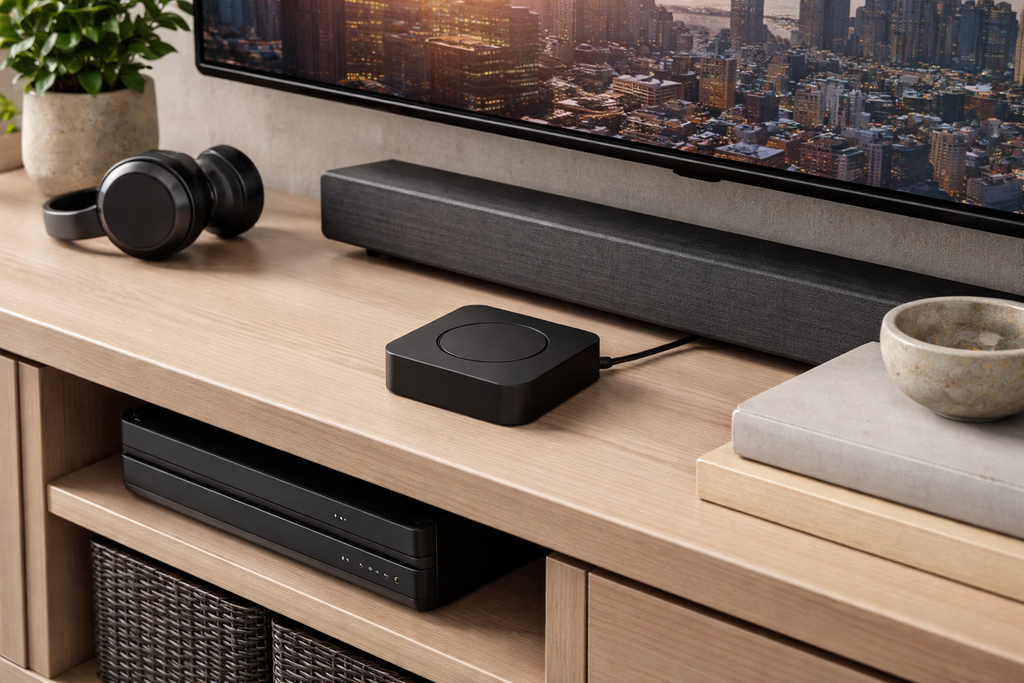
Your AC and your TV come on the same way they already take instructions: infrared. An IR controller in the room sends the same signal their own remotes send, and one unit can usually cover several devices in the same room. Door locks and motion sensors run on batteries, so they need no supply at all.
Where does the smart part go, if not into the wall?
This is the whole trick, and it is not unique to India. A smart wall switch needs a permanent live supply and a neutral to power its radio. A traditional Indian switch loop carries no neutral to the switch box, because a plain mechanical switch never needed one, so it was never run. That is the constraint everyone runs into.
The standard answer, in India and elsewhere, is to stop fighting the switch box and move the intelligence to where the neutral already is: the fitting. A UK retrofit guide describes the same move plainly, noting that the module "sits behind the fitting (or in a nearby accessible junction point), does the actual switching", while "your existing wall switch stays exactly where it is and keeps working as a manual trigger". You can read the full explanation in that guide to smart switches without a neutral wire.
AHA's architecture is the same idea, applied to lighting rather than to one relay: the driver lives with the light. That is why an AHA lighting retrofit does not involve a single new cable run to a single light, and why we can quote a finished flat at all. Our companion piece on whether smart switches need a neutral wire in India goes through the wiring itself in detail.
What still needs a wire, and how much wall does it touch?
Here is the honest inventory, device by device. Two rows need something. The rest do not.
| What you want automated | Where the electronics sit | Wall work needed |
|---|---|---|
| Ceiling lights, cove, spots, strip | A driver inside each existing fitting, on the wires already there | None. No new cable to any light |
| Air conditioner | An IR controller in the room, line of sight to the unit | None. Needs a power source for the controller |
| Television and media | The same IR controller, usually covering several devices | None |
| Ceiling fan | An RF controller at the fan. BLDC fans only, not induction fans | None, if the fan is a BLDC type |
| Door locks | In the lock body, running on AAA cells | None. No dedicated power wiring |
| Motion sensors | Battery only, mounted on a surface | None |
| Presence sensors (mmWave) | Needs a phase and neutral connection to run | A supply point at the mounting position |
| Motorised curtains | A motor on the track, running on 100 to 240V AC | One point at pelmet height, if there is not one already |
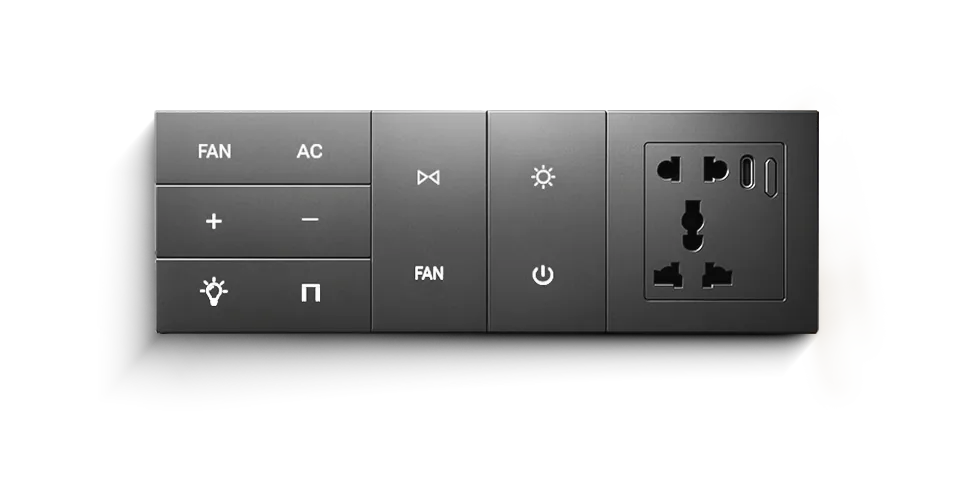
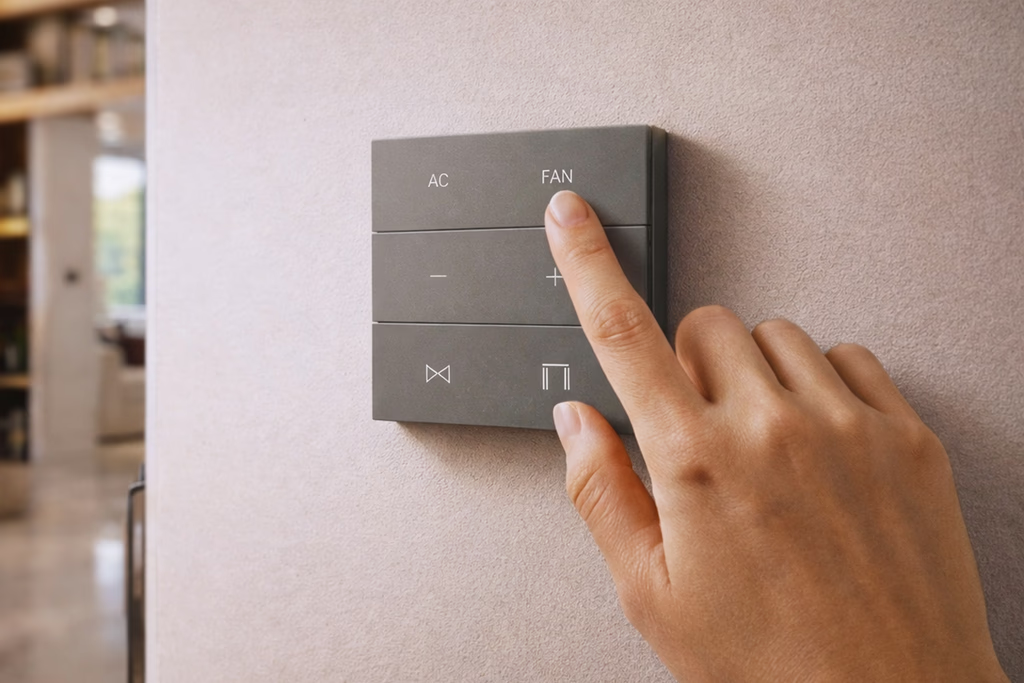
| Wall keypads | On the existing switch box, in place of the old plate | A neutral to that box, if the box does not already have one |
Two of nine rows need anything, and neither needs a channel cut across a room. A curtain point is one supply at one window. A neutral to a switch box is one wire to a box that already exists, on a circuit that already runs past it.
Why is the keypad the one part that can still need a chase?
Because a keypad is the only device in the list that has to live inside the wall. It replaces the plate on an existing switch box and uses the wiring already in it, which is why people assume it needs nothing. It needs one thing: a neutral at that box.
If the box has a neutral, the keypad goes on and nothing is cut. If it does not, and many older Mumbai flats do not, your electrician has to bring one to it. How disruptive that is depends entirely on where the nearest neutral is, which is a question about your flat and not about any product. Sometimes it is a short run inside an existing conduit. Sometimes it means opening plaster.
This is also why we would rather say it plainly than sell around it. A keypad is a convenience, not a requirement. The lights, the AC, the fan and the curtains all still run from the app, from a scene, from voice or from a schedule with no keypad on the wall at all. You can add keypads to the two or three rooms where a physical button genuinely matters, and skip the rest.
What does the Indian standard say about cutting into a finished wall?
It says, in effect, do not. IS 1905:1987, the Bureau of Indian Standards code of practice for the structural use of unreinforced masonry, sets out the rules in clause 6.5, and they are stricter than most people assume.
- Cut it while building, not after Clause 6.5.3.8: chases and holes "should be left (inserting sleeves, where necessary) at the time of construction of masonry so as to obviate subsequent cutting". If cutting is unavoidable, use tools that "depend upon rotary and not on heavy impact for cutting action"
- Only if it does not weaken the wall Clause 6.5.1: chases, recesses and holes are "permissible in masonry only if these do not impair strength and stability of the structure"
- Depth limits on load bearing walls Clause 6.5.3.2: vertical chases must not exceed one-third of the wall thickness, horizontal chases one-sixth
- Vertical, not horizontal Clause 6.5.3.1: services "should be planned with the help of vertical chases and use of horizontal chases should be avoided". Where a horizontal chase is unavoidable, clause 6.5.3.4 caps it at one metre long, two per wall, and a quarter of the wall length in total
- Never in a half-brick load bearing wall Clause 6.5.3.9: no chase, recess or hole at all, other than the minimum holes needed for scaffolding
UK trade guidance lands in the same place from a different direction. Professional Electrician reads Approved Document A as allowing "vertical chases... no deeper than 1/3 leaf of the wall, and horizontal chases... 1/6 of the leaf", which on a typical 100mm leaf is about 33mm vertically and 16mm horizontally, and separately rules out placing accessories back to back on masonry walls.
None of this makes chasing impossible. It makes it a structural decision rather than a cosmetic one, taken by your electrician for your specific wall, and in a Mumbai flat it usually also needs your society's written permission. We have written that up separately in our guide to drilling and rewiring rules in a Mumbai society.
What does "no wall breaking" not mean?
It is worth being precise, because the phrase gets stretched.
- It does not mean no electrician. Every driver goes into a fitting that has to be opened, powered down and reassembled. That is a licensed electrician's job, not a DIY one.
- It does not mean no drilling at all. Mounting a sensor, a hub or a curtain track still means a few fixings. It means no channels cut through plaster to pull new cable across a room.
- It does not mean the circuit can be switched off. When the smart part lives in the fitting, that circuit has to stay live for the light to answer a scene. This is exactly why the plate usually gets swapped for a keypad in the rooms you use daily.
- It does not mean no society permission. Work inside your flat that involves an electrician, materials coming up in the lift and debris going down almost always needs the committee told, and often a deposit.
- It does not mean no downtime. Rooms are worked on one at a time, but a room being commissioned is a room you are not using that afternoon.
What does AHA actually do in a flat that is already lived in?
The mechanics, stated as plainly as we can put them:
- Lights A driver goes inside each existing fitting, on the wires already feeding it. Three types cover most homes: COB for downlights, strip or profile drivers (one per 15 feet of strip) and PCB drivers for track lighting. Each light then has its own brightness and colour temperature, not a shared circuit dimmer
- AC and TV An IR controller per room, line of sight, replacing what the remote does. The AC unit is found automatically on power-up
- Fans An RF controller, for BLDC fans. Standard induction fans are not supported
- Curtains A motorised track and motor. This is the one item that needs a mains point at the track. Manual pull still works, and a hand nudge reports the curtain's real position back to the app
- Keypads The existing plate comes off and an AHA keypad goes on the same box, using the wiring already there. It needs a neutral at that box. Where there is none, one has to be run first
- The network A hub anchors a Zigbee 3.0, Matter and Thread mesh, and every mains-powered device on it repeats the signal. Scenes are processed locally, so they keep running when the internet does not
- Who does what Your electrician mounts and wires everything to our specification. Our own technicians then come on site to pair the devices, configure the hub, program the scenes, test it and hand it over. We do not do the mounting and wiring ourselves
As a rough scope estimate, the lighting control layer alone runs around ₹45,000 for a bedroom and ₹65,000 for a living room, and a fully automated bedroom including switches, hub, climate control and one curtain set is around ₹85,000. These move with the number of light points and rooms, so treat them as ranges rather than quotes. Our full breakdown of what home automation should cost goes room by room.
Where does this approach genuinely fall short?
- Induction ceiling fans. The RF controller is built for BLDC fans. If your fans are standard induction fans, fan speed is not coming onto the system without changing the fan.
- Infrared needs line of sight. An AC behind a bulkhead, or a TV inside a closed cabinet, will not see the controller. Placement has to be checked room by room, not assumed.
- Presence sensing is not free of wiring. The battery motion sensor needs nothing, but the mmWave presence sensor that detects a still person needs a phase and neutral where it is mounted.
- Placement is constrained, not free. On a live site you put a keypad where the room wants one. In a finished flat you work with the boxes that exist. That is the real cost of waiting, and it is a design cost, not a capability one.
- Very old wiring is its own question. If the flat's wiring is at the end of its life, the right conversation is a rewire, not a retrofit on top of it. We would rather say so than build on a circuit we do not trust.
If your interiors are still being planned, the sequencing question is a different one, and we have answered it in home automation before or after interiors. If you are weighing the underlying technology rather than the timing, wired versus wireless home automation compares them across ten factors. And the full picture of what a co-ordinated system does across a flat is on our whole-home automation systems page.
What do people ask us next?
Can home automation be added without breaking walls?
For most of what people want, yes. Lights, AC, fan, TV, door locks and motion sensors can all be brought onto a system in a finished flat with no chasing, because the electronics sit inside the light fitting, inside the appliance's own remote signal or inside a battery device. Motorised curtains and wall keypads are the two that can still need a wire.
Does retrofitting home automation need rewiring?
Not for the lighting, which is usually the largest part of a home automation job. A driver goes inside each existing light fitting, on the wires already feeding that fitting, so no new cable is run to any light. Rewiring only comes up if a switch box has no neutral and you want an AHA keypad on it.
Do I have to change my existing lights, AC or fan?
Usually not. AHA's drivers work with about 90 to 95 percent of the lights sold in the Indian market, so the fixtures you chose stay. Existing ACs and TVs come on over infrared, the same signal their own remote uses. Fans are the exception: AHA's RF controller is made for BLDC fans, not standard induction fans.
What still needs a wire run in a finished flat?
Two things. A motorised curtain track runs on mains power, so it needs a point at pelmet height if there is not one already. And an AHA keypad needs a neutral at the switch box, which a traditional Indian two-wire switch loop does not have, so one has to be run to that box.
Will my existing wall switches still work?
Yes, and they have to stay on. When the smart part sits inside the light fitting, that circuit needs to stay live for the fitting to answer the app or a scene. In the rooms you use most, the plate is usually swapped for a keypad on the same box. Rooms you rarely touch can keep their existing switches.
Is a retrofit system weaker than one planned before interiors?
The control is the same. What changes is how much you can place freely. On a live site you can put a keypad where you want it, run a curtain point before the pelmet closes and decide light positions with the ceiling open. In a finished flat you work with the points and boxes that already exist, which is a placement constraint, not a capability one.
The short version: in a finished flat, seven of the nine things people want automated need no wall work at all, because the electronics go into the light fitting, into a radio signal or into a battery. Curtains need one point at the window. A keypad needs a neutral at a box you already have. Everything else is your electrician opening fittings, and our technicians commissioning what goes in them.
If you want to see it working before you decide, both our experience centres, in Santacruz West and Lower Parel, are open daily 11am to 7pm. Walk in, or book ahead and bring a photo of one of your switch boxes with the plate off.
Book a free consultation →