Made in India or Imported: What Changes in a Smart Home
Both work on day one, and anyone who tells you imported hardware is worse is selling. The difference shows up in year four, when one part fails and somebody has to find another one. That is a supply question, not a quality question.
It decides how a single failed part gets replaced, and almost nothing else. Made in India is not a quality claim and should not be sold as one. It is a claim about who you can reach, how fast, and for how many years.
This question usually gets answered with patriotism on one side and snobbery on the other. Both are useless to somebody deciding how to spend five lakh rupees.
What does it actually change?
Start by setting aside the thing it does not change. Imported hardware is not worse. Plenty of excellent electronics are made outside India, a great deal of what is called Indian is assembled here from components made elsewhere, and the country of final assembly tells you very little about how well a device is engineered.
What it changes is what happens on an ordinary Tuesday in the fourth year, when one driver in one ceiling stops working.
- Who holds a spare. Not whether a spare exists somewhere, but whether one is in the country, in the right variant, today.
- Whether the model still exists. Electronics are superseded quickly. A locally made part under continuous production is a different proposition from one discontinued two revisions ago.
- Who is answerable. A manufacturer who sold you the system and made the part cannot pass the problem to anyone else.
- Minimum order quantities. A supplier abroad who will not ship one unit is a very real reason a single replacement takes months.
None of that is visible on day one, when everything works. It is entirely visible in year four, which is why it belongs in the decision rather than after it.
Why does the driver matter more than the rest?
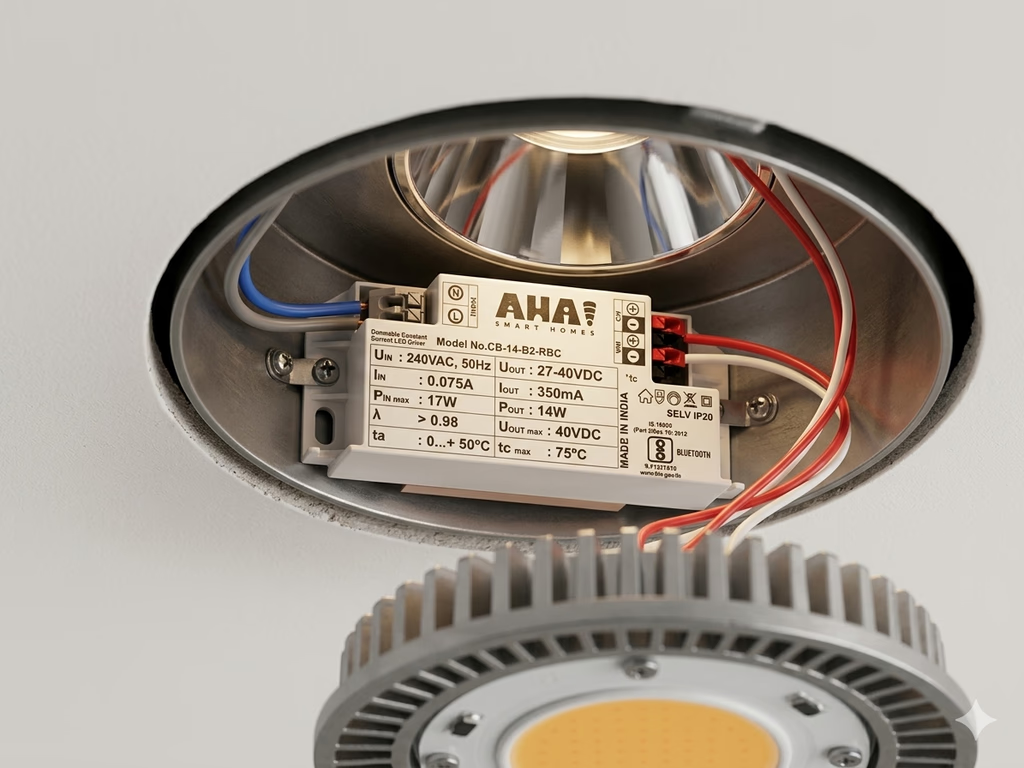
Because of how many of them there are and where they live. A hub is one box on a shelf. A keypad is on a wall and can be swapped in minutes. A driver sits inside each light fitting, and a flat has as many of them as it has controllable lights, often dozens.
So the driver is the component where supply and service genuinely bite. One failure means getting into a ceiling fitting, which is a different job from replacing something on a shelf, and it is the part most likely to be needed years after the original purchase.
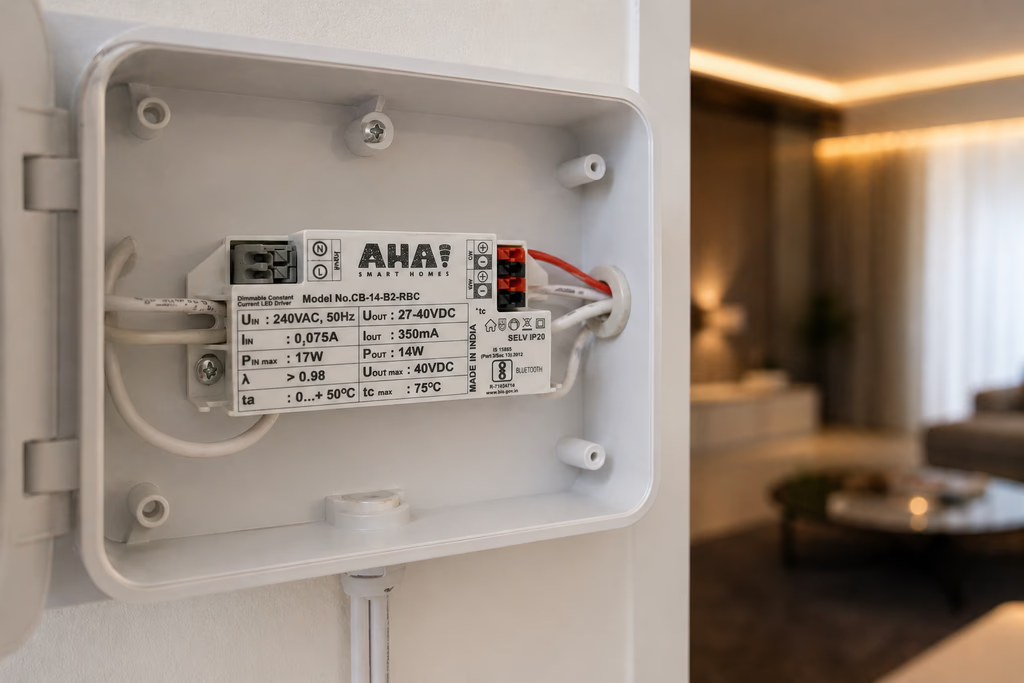
It is also the part AHA chose to manufacture. AHA's light drivers are made at its own BIS certified plant in India. Deliberately not the light fittings: AHA is a smart home company rather than a lighting company, so you buy whichever fittings you like from whichever vendor you like, and the driver works with the large majority of what is sold in the Indian market. That split is unusual enough to be worth naming, because it is the opposite of the usual arrangement where a company sells you its own fittings and the intelligence is locked to them.
What being specified for India buys in practice: 4kV surge protection and a power factor above 0.98, and batch testing before anything goes into a home. Indian mains fluctuates in ways a product designed around a stable temperate grid is not built for, and coastal humidity is harder on electronics than most climates. That is a specification decision, not a nationality one, and it is available to anyone willing to make it.
How do you check the claim instead of believing it?
This is the useful part, and almost nobody mentions it: "we manufacture our own" has a documentary answer.
An LED driver sold in India falls under the Bureau of Indian Standards' Compulsory Registration Scheme, which BIS operates under the Bureau of Indian Standards (Conformity Assessment) Regulations, 2018, with the stated purpose of protecting Indian consumers "from spurious and substandard products". The detail that makes it useful to a buyer is who holds the registration. BIS grants it to the manufacturer, the factory owner, not to a seller and not to an importer.
So the question stops being a matter of trust. Ask for the registration, the factory it names, and the Indian standard it is held against. A company that manufactures can produce it. A company that buys and rebrands will be registering somebody else's factory, which is perfectly legal and perfectly fine, but it is a different answer to the one being implied when somebody says "ours".
Four questions worth asking any smart home company, in this order:
| Ask | A solid answer | A weak answer |
|---|---|---|
| Who manufactures the drivers? | A named factory, and a registration you can see | "They are made to our specification" |
| What is the warranty, per line, and from when? | A term per product line, running from the date of invoice | One blanket number with no starting point |
| How long does a replacement actually take? | A commitment about when you will be told the timeline | "Quickly", or silence |
| Which protocol does it run on? | An open standard, named | "Our own system", described as an advantage |
For what it is worth, AHA's own answers: drivers made at its BIS certified plant in India; two years on automation parts from the date of invoice, three years on the AHA wardrobe lock, five on curtain motors; on a warranty claim the replacement timeline is communicated within seven days, which is a commitment about being told rather than a promise about the part arriving, and we would rather write it that way than overstate it; and the system runs primarily on ZigBee 3.0, with Matter and Thread certification.
What happens if the company disappears?
The sharpest version of this whole question, and the one where the answer has nothing to do with manufacturing at all. It depends on the protocol.
A system running on an open standard can be serviced by somebody else. Zigbee, published by the Connectivity Standards Alliance, is built as an open global standard whose stated point is the freedom to choose devices and vendors, and an AHA system runs primarily on ZigBee 3.0 with Matter and Thread certification. Which means that if AHA ever could not service it, any other ZigBee capable company could. The hardware does not become scrap because one supplier went away. That is a property of the standard rather than a promise from us, which is precisely why it is worth more than a promise.
A system built on a closed protocol that only its maker's hub understands is the one that turns into an expensive collection of parts nobody can talk to. It is a question worth asking before buying, in those words, and the answer is usually immediate and revealing.
Two related things worth knowing about who you are dealing with: AHA's service is done by an in-house team of more than 80 technicians who are employees rather than freelance contractors, and the company sits under a parent group, Aurus, that has been trading for over 25 years. Neither is a guarantee. Both are better than the alternative.
What should this argument not be stretched to mean?
We make part of our own hardware, so we have an obvious interest here. Four honest limits on the claim:
- Not everything in any smart home is made in one country. Components travel. A plant in India making drivers is buying chips from a global supply chain like everybody else, and saying otherwise would be false.
- Made in India does not mean better engineered. It means a different service and supply position. Those are not the same claim and merging them is the marketing move this article is arguing against.
- A brand that imports can still serve you well. If they stock depth in the country, honour a warranty and answer the phone in year four, the origin of the part is academic. Judge the arrangement, not the flag.
- AHA does not make light fittings or curtain fabric, on purpose. The driver and the curtain motor are ours. The light you hang and the fabric you choose are yours, from anyone.
If the underlying question is really how to pick a company rather than where parts come from, that is answered properly in who should build your smart home. If it is whether the whole thing is worth doing, we did that arithmetic honestly in is home automation worth it. The full system is described on whole home automation.
What do people ask us next?
Does it matter whether smart home hardware is made in India or imported?
Not for whether it works. Imported hardware is not worse, and anyone telling you otherwise is selling. It matters for what happens when a single part fails three or four years in, because that is a supply chain question rather than a quality question. A part made in the country can usually be replaced in days. A part that has to be reordered from a factory abroad, in a minimum quantity, for a model that may have been superseded, is a different wait.
How can you check whether a company actually manufactures its own products?
Ask who holds the BIS registration. An LED driver sold in India falls under the Bureau of Indian Standards Compulsory Registration Scheme, and BIS grants that registration to the manufacturer, the factory owner, rather than to a seller or an importer. So the question has a documentary answer rather than a reassuring one. Ask which factory, in which name, and under which Indian standard.
Does AHA manufacture its own hardware?
The light drivers are manufactured at AHA's own BIS certified plant in India. That is the part of the system that sits inside every light fitting in the home, so it is the part that most decides serviceability. AHA deliberately does not make the light fittings themselves, or curtain fabric, because it is a smart home company rather than a lighting or fabric company. You choose your own fittings from any vendor and the driver works with the large majority of what is sold in India.
What happens to my smart home if the company goes out of business?
It depends entirely on whether the system runs on an open standard or a proprietary one. An AHA system runs primarily on ZigBee 3.0, with Matter and Thread certification, all open standards, so any other ZigBee capable company could service it. The hardware does not become obsolete because one supplier disappears. A system built on a closed protocol that only its maker's hub can speak is the one that becomes an expensive set of unusable parts, and that question is worth asking before you buy rather than afterwards.
Is hardware made for India actually different?
In the ways that matter here, yes. Indian mains supply sees voltage fluctuation and surges that a product specified for a stable temperate grid is not designed around, and coastal humidity is harder on electronics than most climates. AHA drivers carry 4kV surge protection and a power factor above 0.98, and every batch is tested before it goes into a home. That is about what the hardware is specified against, not about where the components originate.
What should I ask a smart home company about its hardware?
Four questions. Who manufactures the drivers, and can you show the BIS registration. What is the warranty on each line, and from what date does it run. How long does a replacement part take, honestly, and who is told that timeline. And which protocol does the system speak, so I know whether anyone else could service it. The answers to those four tell you more than any specification sheet.
The short version: stop asking where it was made and start asking who answers in year four. Who manufactures the driver, what the warranty says and when it starts, how a replacement actually reaches you, and whether the protocol is open enough that somebody else could step in. Those four answers are checkable. A flag on a box is not.
If you want to hold a driver and read the warranty rather than take any of this on trust, both centres are laid out as real homes: Santacruz West and Lower Parel, 11am to 7pm, Santacruz West closed on Tuesdays.
Book a free consultation →