Smart Home vs Home Automation: What Is the Difference?
A smart home is a set of devices that are each clever on their own. Home automation is one system that runs them together. The gap between the two is not the hardware, it is whether anything coordinates it, and that decides what your home can actually do.
Smart devices give you control. Home automation creates experiences. One is a shelf of things you operate. The other is a house that responds. You can own a great deal of the first and have none of the second.
The two phrases get used as if they mean the same thing, including by people selling both. They do not, and the difference is the single most useful thing to understand before spending money.
What actually separates them?
A smart home is a collection of individual smart devices. Each one is capable, each one is controlled separately, and most arrive with their own app. Home automation brings them onto one platform so they work as a single coordinated system.
That is AHA's own definition, and it is worth quoting exactly because it is the sentence the rest of this article rests on: "A smart home typically consists of individual smart devices that are controlled separately through different apps. Home automation brings everything together on a single platform, allowing devices to work as one coordinated system. The difference is simple: smart devices give you control, while home automation creates experiences."
Put practically: a smart bulb is a smart device. A bulb that dims to thirty per cent when the television starts, while the curtains close and the air conditioner drops to its night setting, all from one press, is automation. The bulb did not change. What changed is that something is coordinating it.
Where the two differ, point by point
The same house, the same devices, with and without something coordinating them.
| What you are comparing | A smart home, devices only | Home automation, one system |
|---|---|---|
| How you control it | An app per brand, plus whatever voice assistant each one supports | One keypad on the wall, one app, one voice assistant, any of them |
| What one action does | One thing to one device | Several things at once, in a saved scene |
| Who else can use it | Whoever has the apps and the logins | Anyone who can press a switch, which is the point |
| When the internet drops | Cloud-dependent devices stop responding | A local hub keeps running the house |
| Adding something later | Another device, another app | Joins the existing network and the existing scenes |
| What it feels like | Operating a house | Living in one |
Nothing in that table is about the quality of the devices. You can buy excellent smart bulbs, an excellent lock and an excellent air conditioner controller and still be in the left column, because nothing joins them.
Why do most homes end up with devices instead of a system?
Because devices are bought one at a time, by different people, for different reasons. A smart bulb at a festival sale. A video doorbell after a delivery goes missing. A smart plug for the geyser. Each is a sensible purchase on its own, and none of them was chosen to work with the others.
The standards exist to fix precisely this. Matter, published by the Connectivity Standards Alliance, is an interoperability standard whose stated purpose is to let devices from different manufacturers work together across ecosystems. Zigbee, from the same body, is the low-power mesh radio a great many of those devices actually speak.
So the question worth asking of any device is not which brand made it, but which standard it speaks. A device that only talks to its own manufacturer's cloud and its own app is a device that will stay an island no matter what you buy next. AHA runs primarily on ZigBee 3.0, with Matter and Thread certification, on a dedicated local network rather than the home Wi-Fi.
How can you tell which one you have?
Two tests, and neither needs a technician.
- The app test. Count the apps you need to run your home on an ordinary evening. One or none is a system. Three is a set of devices with a good story attached.
- The other-person test. Can somebody who does not live in your house, a guest, a parent, the person who cleans it, work the lights without being taught anything? If the answer is no, the house is automated for exactly one person, and that is usually the person who installed it.
The second test is the one that matters in practice, and it is the one that catches most enthusiast setups. A house that only its owner can operate has not been automated, it has been personalised.
There is a third question underneath both, which is what happens when the internet goes down. A system that processes its automations locally keeps working; one that sends every instruction to a server does not. We cover that on its own in does a smart home work without internet.
When are devices genuinely enough?
Often, and it is worth saying so plainly rather than pretending every home needs a system.
A rented flat you will leave inside a year. Plug-in devices and a few smart bulbs move with you and cost little. Anything that touches a switch box does not belong in someone else's wall for twelve months.
One problem you actually have. If the only thing that irritates you is forgetting the geyser, a single device solves it. Buying a system to fix one habit is buying the wrong thing.
A home nobody is in. A flat used two weekends a month does not accumulate the repeated moments that make coordination worth paying for.
The case for a system is repetition. Every morning, every evening, every departure, every time guests arrive. Those are the moments that add up, and they are the reason the distinction is worth money rather than just being a definition.
What does it take to cross from one to the other?
Less than most people assume, and it does not mean throwing away what you own. A coordinated system needs three things: a hub that holds the logic, devices that speak an open standard so they can be coordinated at all, and a way to reach it that is not an app.
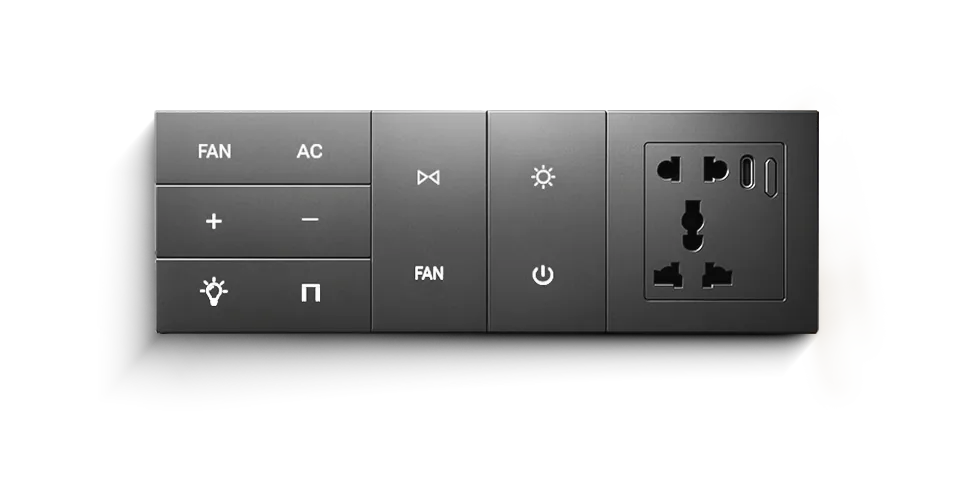
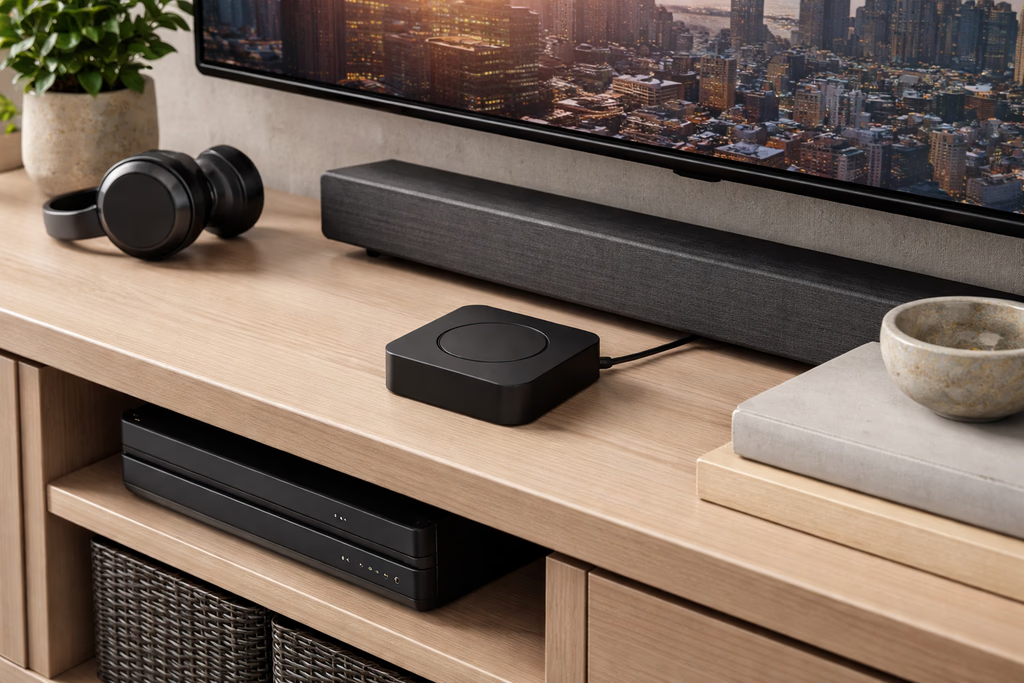
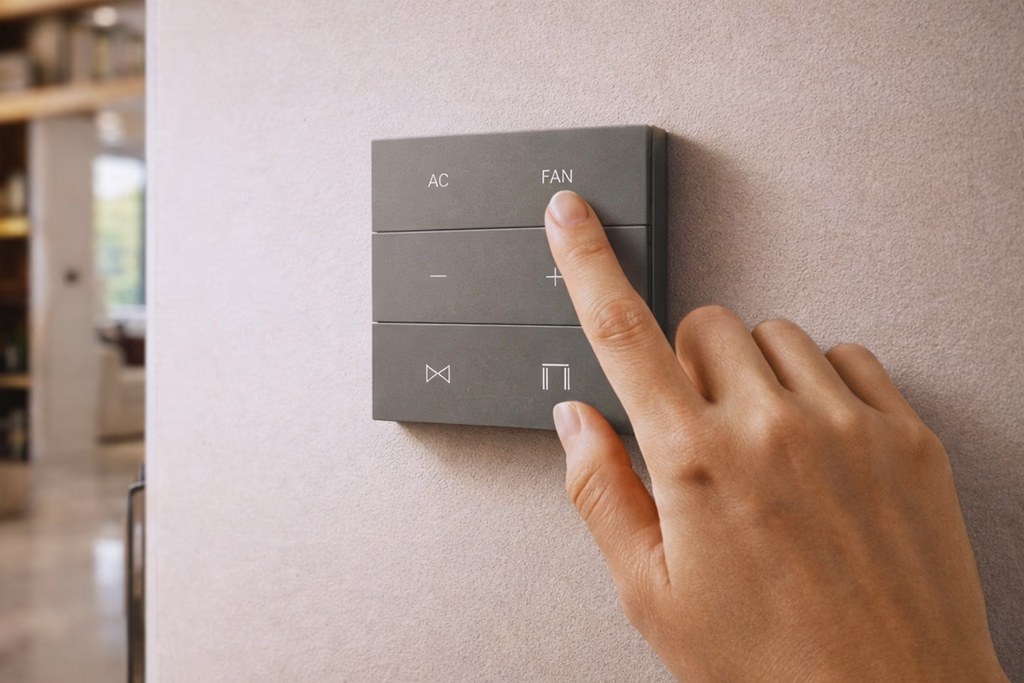
In an AHA home that means one hub for the whole home rather than one per room, a driver inside each existing light fitting, keypads that replace the switch plates already on the wall, motors on curtain tracks, and an infrared controller for the air conditioner and fan. Nothing needs walls broken. The one thing the keypad does need is a neutral wire at its switch box, which many older Indian switch loops do not have, and that is covered in do smart switches need a neutral wire.
- A typical 150 sq ft bedroom₹80,000 to ₹1 lakh
- A living or media room, more circuits and sources₹1.5 lakh to ₹2 lakh
- A complete system, modern 3BHK in MumbaiAround ₹5 lakh
Those are room and project estimates rather than a price list, and they move with layout, room count and how much you choose to automate. What home automation should cost breaks the same numbers down room by room, and whole home automation is the full scope for an apartment.
What will a system not fix?
Bad devices. Coordination makes a poor light fitting easier to switch, not better to look at. The fittings are still a decision you make on their own merits.
A room with one light in the middle. No amount of control invents a place for light to come from. That is a wiring and ceiling decision, made before anything is automated.
Not knowing what you want. A system is only as good as the scenes someone sat down and defined. A house full of coordinated devices with no scenes set is just a more expensive set of devices.
What do people ask us next?
What is the difference between a smart home and home automation?
A smart home is a collection of individual smart devices, each controlled on its own, usually through its own app. Home automation is one system that runs those devices together on a single platform, so they respond to each other and to you without being operated one at a time. Smart devices give you control. Home automation creates experiences.
Is a smart bulb home automation?
No. A smart bulb is a smart device. It becomes part of home automation when it stops being something you operate and starts being something that responds: dimming as part of an evening scene, coming on when a sensor sees you, or switching off when you leave, without anyone opening an app.
Do I need to replace my smart devices to get home automation?
Usually not all of them. Devices built on open standards such as Zigbee, Matter or Thread can join a coordinated system, which is the point of those standards. Devices that only talk to their own manufacturer's cloud and app are the ones that tend to stay islands, so the question to ask about any device is which standard it speaks, not which brand made it.
How many apps should a smart home need?
One, or none. If running your home means remembering which app owns which device, you have a set of smart devices rather than an automated home. The usual test is whether someone else in the house, or the person who cleans it, can work the lights without being taught an app.
Does home automation work without internet?
It should. An AHA system processes automations on a hub inside the home, so lighting, curtains, locks and scenes keep working during an internet outage. Internet is needed for remote access from outside the home, camera viewing and voice assistants, not for the house to function.
Is home automation worth it for a small flat?
It depends on how many moments repeat rather than on square footage. A 2 BHK where four people come and go all day has more to automate than a large flat used by one person who is out all week. A single room is a reasonable place to start, and the system extends to the rest later because the hub is one per home rather than one per room.
If the underlying question is what home automation is in the first place, that is answered in full in what home automation is. To see a coordinated system running rather than read about one, both Santacruz and Lower Parel are set up as real flats.
The short version: the phrase you want is not the one on the box, it is whether anything is coordinating what is in your home. Devices give you control of things one at a time. A system gives you a house that responds, and that is what the money buys.
Both AHA experience centres, in Santacruz West and Lower Parel, are laid out as real homes rather than showrooms, so you can press a keypad and see the difference instead of reading about it. Open 11am to 7pm, Santacruz West is closed on Tuesdays.
Book a free consultation →