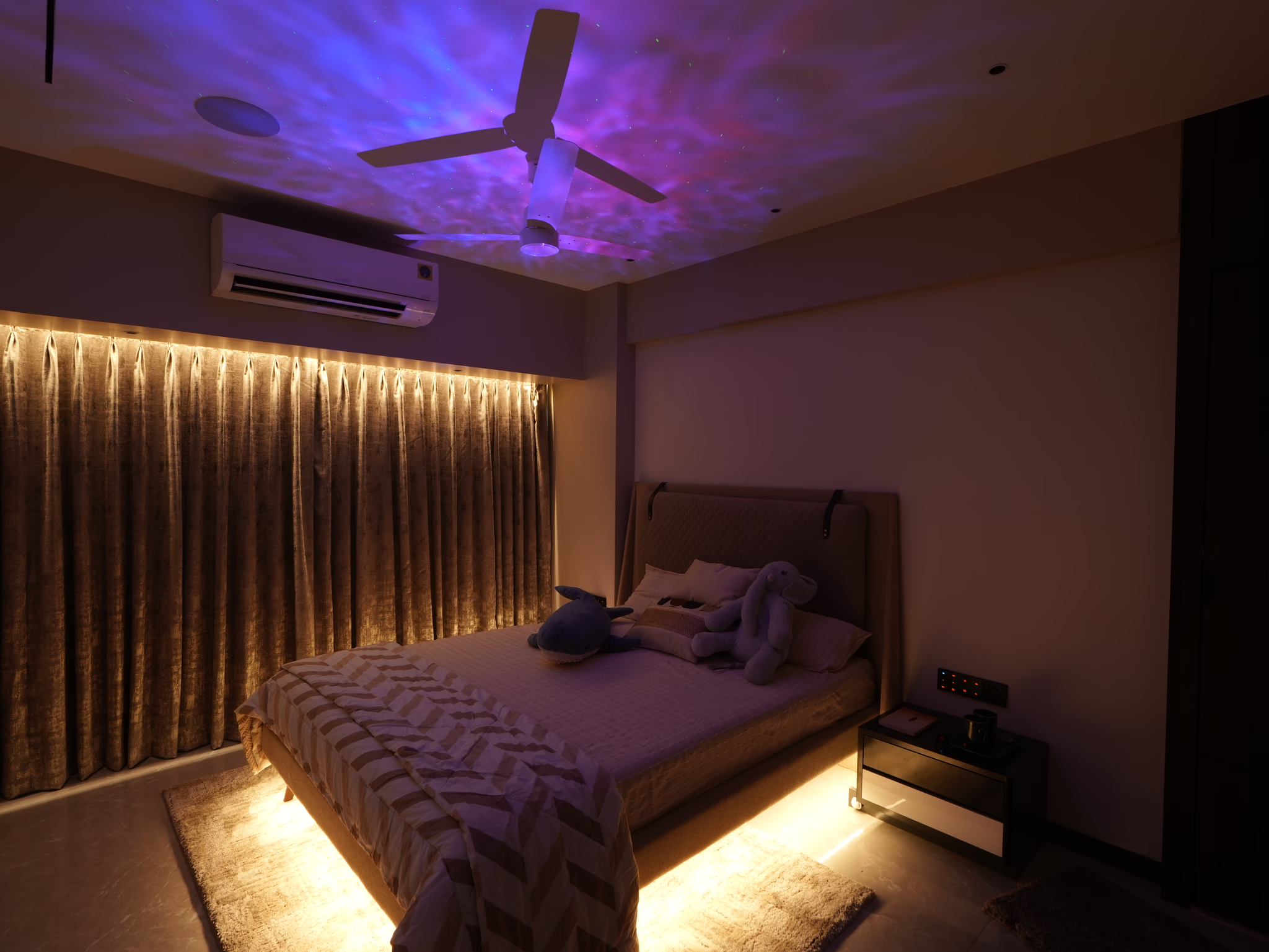
AC at 24 Degrees in Mumbai: Does It Save Power?
Yes. The Bureau of Energy Efficiency's own figure is about 6 percent less power for every degree above your usual setting, and in Mumbai, where an AC often runs 8 to 9 months a year, that adds up to real money. But 24 degrees is a floor, not the best number, Mumbai's humidity makes 26 degrees with a fan the better answer for most rooms.
Most Mumbai homes run the AC somewhere between 18 and 21 degrees, chasing a room that already feels cool the moment it drops below body temperature. The thermostat does not know that. It just keeps the compressor running until the room hits whatever number is set, so a lower number never cools faster, it only runs longer.
This is not a universal physics constant, it is BEE's own published estimate, and it holds up well for Mumbai specifically: a long cooling season and some of the steepest electricity slabs in the country mean the same percentage saving is worth more here than almost anywhere else in India.
What follows is the actual BEE guidance, what Mumbai's humidity changes about it, a real cost worked out on a verified Mumbai tariff, and how AHA's own automation holds the setting without anyone having to remember it.
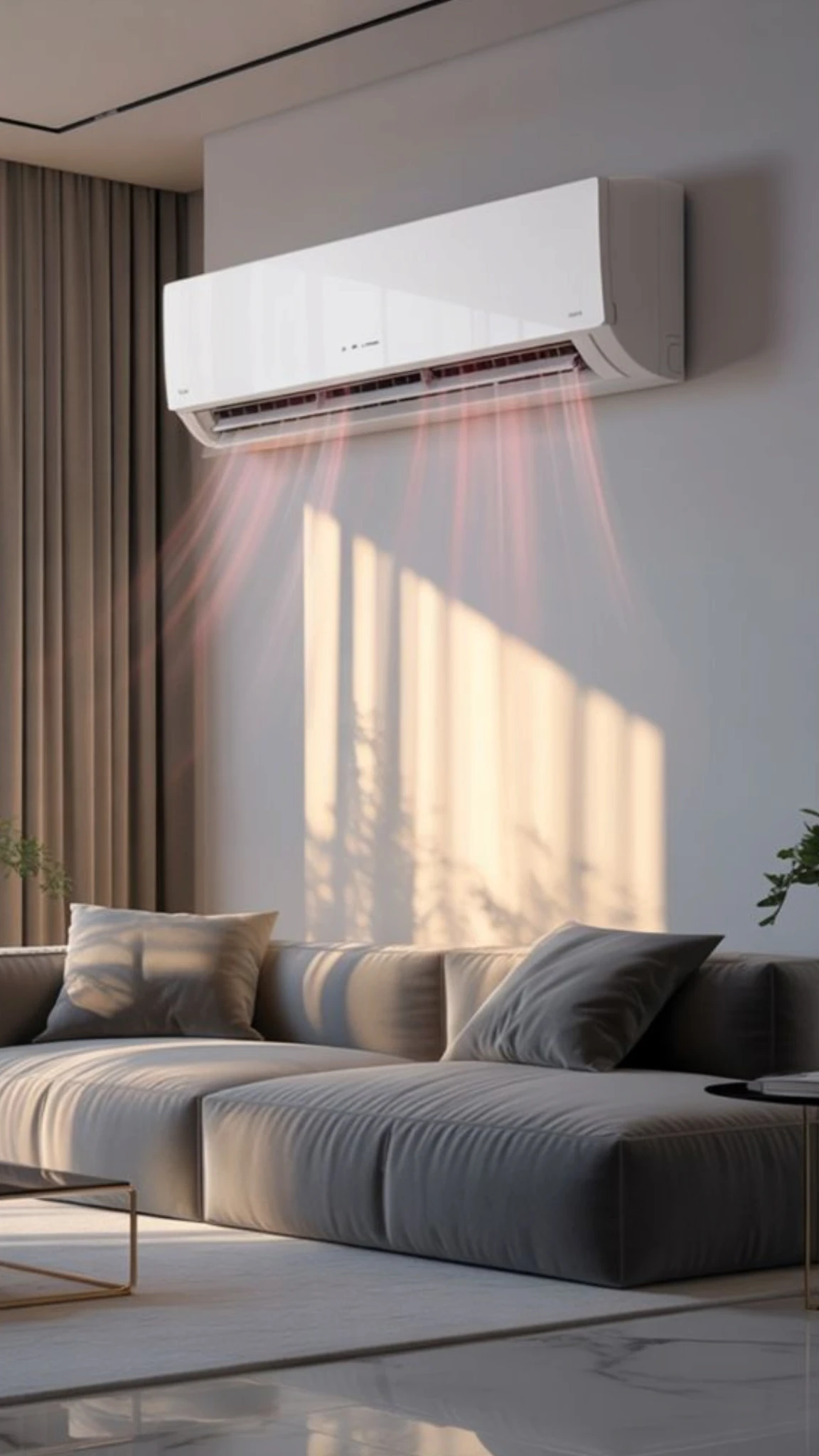
What does BEE actually recommend?
24 degrees Celsius, and the number is not a guess. The Bureau of Energy Efficiency's own FAQ on the subject says a new star labelled room AC now defaults to 24 degrees when switched on, and that raising the setting by 1 degree saves roughly 6 percent of the electricity the AC would otherwise use. Move from a typical 20 to 21 degree setting up to 24, and BEE's own arithmetic puts the saving at close to a quarter of what the AC was drawing before.
It is worth being precise about where this guidance came from. BEE's FAQ states the recommendation was made to major commercial establishments, airports, hotels, shopping malls, offices and government buildings, not as a residential rule. The 24 degree default setting on new ACs, in force since a notification effective 1 January 2020, applies to the appliance itself rather than to how you are allowed to use it at home. Nobody is required to run their bedroom at 24 degrees. The same physics simply means most homes are leaving money on the table by running colder.
Is the stricter 20 to 28 degree rule already law?
No, and this is the detail most re-reports get wrong. In June 2025 the Ministry of Power proposed restricting new AC thermostats to a 20 to 28 degree band nationwide, a tighter version of the existing 16 to 30 degree range. As of 2026 that remains a proposal under consultation, not a notified rule. Nothing on a Mumbai air conditioner is legally capped at 28 degrees yet, and any claim otherwise is out of date.
Why does Mumbai's humidity change the answer?
Most AC advice online is written for a dry climate. Mumbai is not one, and that changes what an air conditioner is actually working against.
A large share of what an AC does in Mumbai is remove moisture from the air, not just lower its temperature, engineers call this the latent load, as opposed to the sensible, purely thermal, load a dry city like Delhi is mostly fighting. That is why 24 degrees in humid, coastal Mumbai can feel less crisp than the same number in a dry city, and why the compressor may run longer to get there.
India's own comfort research backs up a different fix than simply chilling the room further. Field studies on Indian buildings (the IMAC research from CEPT University, drawn from thousands of responses across several Indian climate zones) found a comfortable indoor range far wider than the Western standards most air conditioners are tuned to, once air movement from a fan is added into the picture. In practice that means 26 degrees with a ceiling fan running is often just as comfortable as 24 degrees without one, for less power, which is the single most useful adjustment to make on top of BEE's own recommendation.
Through the monsoon, when heat is not really the problem, humidity is, switching the unit to its dry setting for a while instead of chasing a colder number tends to work better and draws less power doing it.
The number worth trying tonight. Not 24, though that is the honest floor. In Mumbai's humidity, 26 degrees with a ceiling fan on tends to feel as good as a colder setting without one, and uses meaningfully less power getting there. Try it before assuming you need the AC colder.
How much could this actually save on a Mumbai bill?
Mumbai's electricity slabs are telescopic and steep, which means an air conditioner's extra units rarely land in your cheapest slab, they land in your most expensive one. Under the MERC tariff order for Adani Electricity, applicable from 1 April 2025, a Mumbai home pays about Rs 6.38 a unit for its first 100 units, rising through the slabs to about Rs 11.98 a unit above 500, plus a fixed charge of Rs 90 to 160 a month. Those per unit figures are the energy and wheeling charges together, fuel adjustment and electricity duty come on top of that, which typically puts the real cost of a marginal, top slab unit somewhere in the Rs 12 to 15 range. Tata Power, BEST and MSEDCL each run their own slabs, so check your own bill for the exact figure.
Applying BEE's 6 percent per degree rule to a typical 1.5 ton inverter AC run about 8 hours a night gives a rough sense of scale, not a precise bill:
| Setpoint | Est. units a month | vs 22°C |
|---|---|---|
| 22°C | ~360 | starting point |
| 24°C | ~315 | ~45 units less |
| 26°C (with a fan) | ~270 | ~90 units less |
At a top slab rate of roughly Rs 12 to 15 a unit, that is somewhere around Rs 500 to 700 saved a month moving from 22 to 24 degrees, and close to double that at 26 degrees with a fan, over Mumbai's unusually long 8 to 9 month cooling season that is a genuinely large number, not a rounding error on the bill. These are illustrative estimates built on BEE's published percentage and a verified Mumbai tariff, not a substitute for reading your own bill.
Set it and forget it: how a smart home holds the number for you
All of the above assumes someone actually leaves the AC at the higher setting, and that is the part that usually breaks down. A guest turns it down for one hot afternoon, house help resets it to whatever it was before, and the discipline quietly disappears within a week. This is where automating the AC and fan, rather than just being told the right number, actually pays for itself.
On AHA's system, Grand Welcome turns the AC on and sets it to the temperature the household has already chosen, the moment the door unlocks, for whoever walks in. Nobody has to remember 24, or 26, or find the remote first. Cleaning Mode's double click briefly runs the AC to dry a room, for example after mopping, a specific, short job rather than leaving the AC running on a guess.
The fan half of this matters just as much as the AC half, and is easy to skip because a ceiling fan usually has its own separate switch that nobody automates. An IR and RF controller brings an existing air conditioner onto the system using its remote signal, and, separately, an RF controller built specifically for BLDC ceiling fans, not the older induction type, can cut what that fan draws by up to 60 to 65 percent. Put both on the same scene and the 26 degree plus fan combination this article recommends happens automatically, every time, instead of depending on someone remembering to reach for a second remote.
As a room estimate rather than a quote, adding AC and fan control to a room runs around ₹5,000, as part of a wider room fit-out. Our room by room cost breakdown for a 3BHK goes through the full numbers.

Questions Mumbai homeowners ask us
What is the ideal AC temperature for a Mumbai home?
24 degrees Celsius, per the Bureau of Energy Efficiency. BEE's own FAQ says a new star labelled AC now powers on at 24 degrees by default, and that most people who set it lower are trading comfort they will not notice for a bill they will. The guidance was originally written for large commercial buildings, but the same physics applies at home.
Does setting the AC lower than 24 degrees cool the room faster?
No. A thermostat is a target, not a throttle. The air coming out of the unit is the same temperature whatever number you set, a lower setting just keeps the compressor running for longer to chase a target it has already passed comfort at, which uses more power without cooling the room any quicker.
Is India's 20 to 28 degree AC rule already in force?
No. As of 2026 it remains a proposal from the Ministry of Power, under consultation, not a notified rule. Nothing on a Mumbai AC is legally restricted to that range yet. Treat any claim that it is already mandatory as out of date.
Why does Mumbai's humidity change the advice?
Because a large share of what a Mumbai AC does is remove moisture from the air, not just lower the temperature. Comfort research on Indian homes finds a much wider comfortable range than Western guidance assumes once a fan is running, so 26 degrees with a ceiling fan often feels as good as 24 degrees without one, and uses less power doing it.
Can a smart home hold the AC temperature automatically?
Yes. On AHA's system, Grand Welcome turns the AC on and sets it to the temperature the household has chosen the moment the door unlocks, so nobody has to remember the number. Cleaning Mode's double click briefly runs the AC to dry a room after mopping. An IR and RF controller brings an existing AC and a BLDC fan onto the same system, so a scene can hold both together rather than relying on someone to switch the fan on by hand.
What does it cost to add AC and fan control to a room?
As a room estimate rather than a quote, around ₹5,000 for the AC and fan control in a single room, as part of a wider room fit-out. The full room by room breakdown for a 3BHK is in AHA's cost guide.
24 degrees is the honest floor, not the best answer. In Mumbai's humidity, 26 degrees with a fan running usually costs less and feels no different, and the saving is worth more here than almost anywhere else in India because the season runs so long.
The part that actually makes it stick is not the number, it is not having to enforce it. Both AHA experience centres, in Santacruz West and Lower Parel, run Grand Welcome and Cleaning Mode live, so you can feel the AC and fan respond on arrival rather than take our word for it.
Book a free demo →See the full breakdown of what a 3BHK costs in our cost guide, or read more on planning a new home in Mumbai on our home automation company in Mumbai page.