AirPlay Ceiling Speakers in India: How AHA Speakers Work
Yes, an iPhone can play straight to speakers built into your ceiling. AHA Room Speakers have AirPlay and Spotify Connect built in, and the active speaker in each pair carries its own streamer and amplifier, so there is no box to hide. One pair covers a room, one amplifier runs up to four zones, and the music joins the same scenes as your lights.
Choose by the room, not by the speaker. A living room or bedroom takes a Room Speaker pair with its own amplifier. A bathroom takes the splash-rated speaker, which runs off an amplifier elsewhere. Several rooms on one plan is what the four-zone amplifier is for. All of it plays from an iPhone the same way.
Ceiling speakers used to mean a rack of equipment in a cupboard and a remote nobody could find. Most of that box now sits inside the speaker.
Can you AirPlay to ceiling speakers?
Yes, if the speaker, or whatever drives it, supports AirPlay. A passive ceiling speaker only turns a signal into sound. Something else has to receive the music from your phone and amplify it, and that something decides whether your iPhone can find the speaker at all.
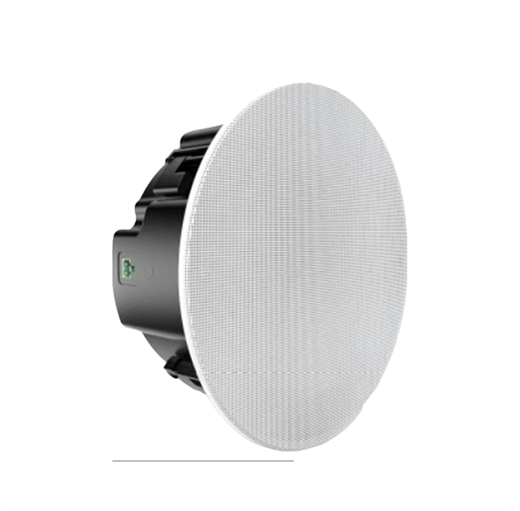
AHA Room Speakers put that part in the speaker. Each room gets a 6.5 inch pair built into the ceiling: an active speaker that carries its own streamer and amplifier, and a passive speaker that completes the pair. AirPlay and Spotify Connect are built in, so any app that supports AirPlay plays through it, YouTube Music on an iPhone included.
On the iPhone it behaves like any other AirPlay speaker. Apple sets out the steps in its iPhone guide, Play audio from iPhone on HomePod and other wireless speakers: start something in an audio app, tap the AirPlay control and choose where it plays. If a speaker does not appear in the list, the first thing Apple tells you to check is that it is "on the same Wi-Fi network" as the iPhone.
What does an AHA ceiling speaker setup include?
Three parts, each matched to a kind of room, rather than one speaker for everywhere.
| Part | Use it for | Good to know |
|---|---|---|
| Room Speakers, 6.5 inch pair | One room: a living room, bedroom or study | The active speaker has its own streamer and amplifier, and connects over Wi-Fi or wired LAN |
| Bathroom Speaker, 4.5 inch | Bathrooms and other humid areas | Rated IP44 for splashes, and runs off an external amplifier |
| Multi-Zone Amplifier | Several rooms from one unit | Up to 4 zones, up to 2 passive speakers per zone, 8 speakers in total |
One room: the Room Speaker pair
For most rooms this is the whole system. The active speaker receives the music over Wi-Fi or a wired LAN connection, amplifies it and drives its passive partner, so the room needs no separate streamer or amplifier anywhere else.
Bathrooms: the splash-rated speaker
A bathroom gets its own 4.5 inch speaker, rated IP44 for splash resistance. Unlike the room speaker it carries no streamer or amplifier of its own. It runs off an external one, which is where the Multi-Zone Amplifier comes in.
Several rooms: the four-zone amplifier
The Multi-Zone Amplifier drives up to four independent zones at once, each with up to two passive speakers, so up to eight speakers from one unit. Zones can play different things or the same thing at the same time. The common pairing is a bedroom and its bathroom on two zones of the same amplifier.
All three are on AHA speakers.
Do ceiling speakers need an amplifier?
Passive ones do. Active ones carry their own. A passive ceiling speaker needs an amplifier, and a streamer in front of it, before an iPhone can play to it. Buying passive speakers on their own and finding out about the rest later is an easy mistake to make.
In an AHA layout the question answers itself room by room. The active Room Speaker is the amplifier for its own room. The bathroom speaker, and any extra passive speakers for a larger space, run off the Multi-Zone Amplifier. Nothing in the plan is a speaker without something to drive it.
How does music fit into an AHA scene?
It runs through the same hub as your lights. Audio is usually the one system in a home that is bought separately, controlled separately and left out of everything else. AHA speakers run through the same hub as the lighting and climate, so one scene can dim a room and start the music, instead of two apps and two steps.
- Pooja Mode. The mandir lights come on by themselves each morning, and a preset scene on an AHA speaker in the room can start the day's bhajans at the same time.
- Kids Mode. Colour-changing light in one room, following whatever is playing through that room's AHA speaker.
- Party Time. Lights that move with the beat across the home. That part comes from the AHA Smart Driver behind the lights, which listens to the music over Bluetooth, not from the speaker.
Because every scene is programmed on the AHA hub rather than inside one person's phone, the morning bhajans do not depend on whoever set them up remembering to press play.
Wi-Fi or wired: how should ceiling speakers connect?
The AHA Room Speaker takes either, Wi-Fi or a wired LAN connection. What matters for AirPlay is that the speaker and the iPhone are on the same home network, the first thing Apple asks you to check when a speaker goes missing from the list.
The decision that cannot wait is where the speakers go. In-ceiling speakers belong on the ceiling plan for the same reason smart lighting drivers do: they need their cut-outs, power at the active speaker and a cable to its passive partner, and all of that is easy before the false ceiling is closed and awkward after. The timing question for the whole system is in home automation before or after interiors.
Your electrician runs the wiring. AHA designs the layout with the rest of the system and commissions it.
Can Android phones play to the same speakers?
Yes, through Spotify Connect. AirPlay is the Apple route, used from an iPhone, iPad or Mac. Spotify Connect is built into the same speakers and is chosen from inside the Spotify app, on Android as well as iPhone. Spotify explains how it works on its Spotify Connect page.
So a family split between both phones does not need two sets of speakers, and the rest of the home works the same way: see can Android use Apple Home.
Where does AHA fit?
AHA designs the speaker layout together with the lighting, curtains and climate, supplies the speakers and the amplifier, and configures and commissions them as one system. Your electrician does the wiring.
Every AHA product shows up in Apple Home, as does AHA work with Apple Home explains, and the same system is compatible with Amazon Alexa and Google Home, and with Sonos if you already own Sonos speakers. Audio is one part of the whole-home picture on AHA smart home solutions, and the hub everything runs through is on the AHA smart hub.
What will ceiling speakers not do?
- They will not move with you. Built into the ceiling, they belong to the room. A speaker you want to carry around is a different product.
- The bathroom speaker will not play on its own. It needs the external amplifier.
- AirPlay will not find a speaker on another network. Phone and speaker have to be on the same home network.
- Streaming will not work without the internet. Music services stream over it. The lights, curtains and scenes in an AHA home keep working without it, which is covered in does a smart home work without internet.
- A speaker will not make the lights dance. Music-synced colour comes from the AHA Smart Driver behind the lights.
For the rest of a smart entertainment setup, from movie scenes to blackout curtains, see seven must-have smart entertainment features.
What do people ask us next?
Can I play music from my iPhone on AHA ceiling speakers?
Yes. AHA Room Speakers have AirPlay built in, so any app that supports AirPlay plays through them: start the music, tap the AirPlay control and choose the room. Spotify Connect is built in too.
Do AHA ceiling speakers need a separate amplifier?
The Room Speakers do not, because the active speaker in each pair carries its own streamer and amplifier. The 4.5 inch bathroom speaker does, and it pairs with the AHA Multi-Zone Amplifier.
How many rooms can one AHA amplifier run?
The AHA Multi-Zone Amplifier drives up to four independent zones, with up to two passive speakers per zone, so up to eight speakers from one unit.
Can different rooms play different music?
Yes. Zones on the same amplifier can each play something different, or the same thing at the same time, for example a bedroom and the bathroom next to it.
Can a lighting scene start the music?
Yes. AHA speakers run through the same hub as the lighting and climate, so one scene can dim a room and start the music, the way Pooja Mode can start the morning bhajans as the mandir lights come on.
Can I put a ceiling speaker in a bathroom?
Use the speaker made for it. The AHA Bathroom Speaker is 4.5 inches and rated IP44 for splash resistance, and it runs off an external amplifier rather than carrying its own.
The short version: an iPhone plays to AHA ceiling speakers over AirPlay, and any phone plays to them over Spotify Connect. Room Speakers carry their own amplifier, the bathroom speaker runs off the four-zone amplifier, and the music runs through the same hub and scenes as your lights. Put the speakers on the ceiling plan before the false ceiling is closed.
Both AHA experience centres are laid out as real homes, where you can interact with lighting, security, climate and more: Santacruz West and Lower Parel, 11am to 7pm, Santacruz West closed on Tuesdays.
Book a free consultation →