Smart Living Room: What It Costs and How to Plan It
A complete smart living room in Mumbai typically costs around ₹1,20,000, and lighting alone about ₹65,000. What decides where you land is the wiring, and in a Mumbai flat that is usually the thing nobody checked.
A smart living room in Mumbai costs around ₹1,20,000 to do properly. Lighting on its own is around ₹65,000, and a full media room runs ₹1,50,000 to ₹2,00,000.
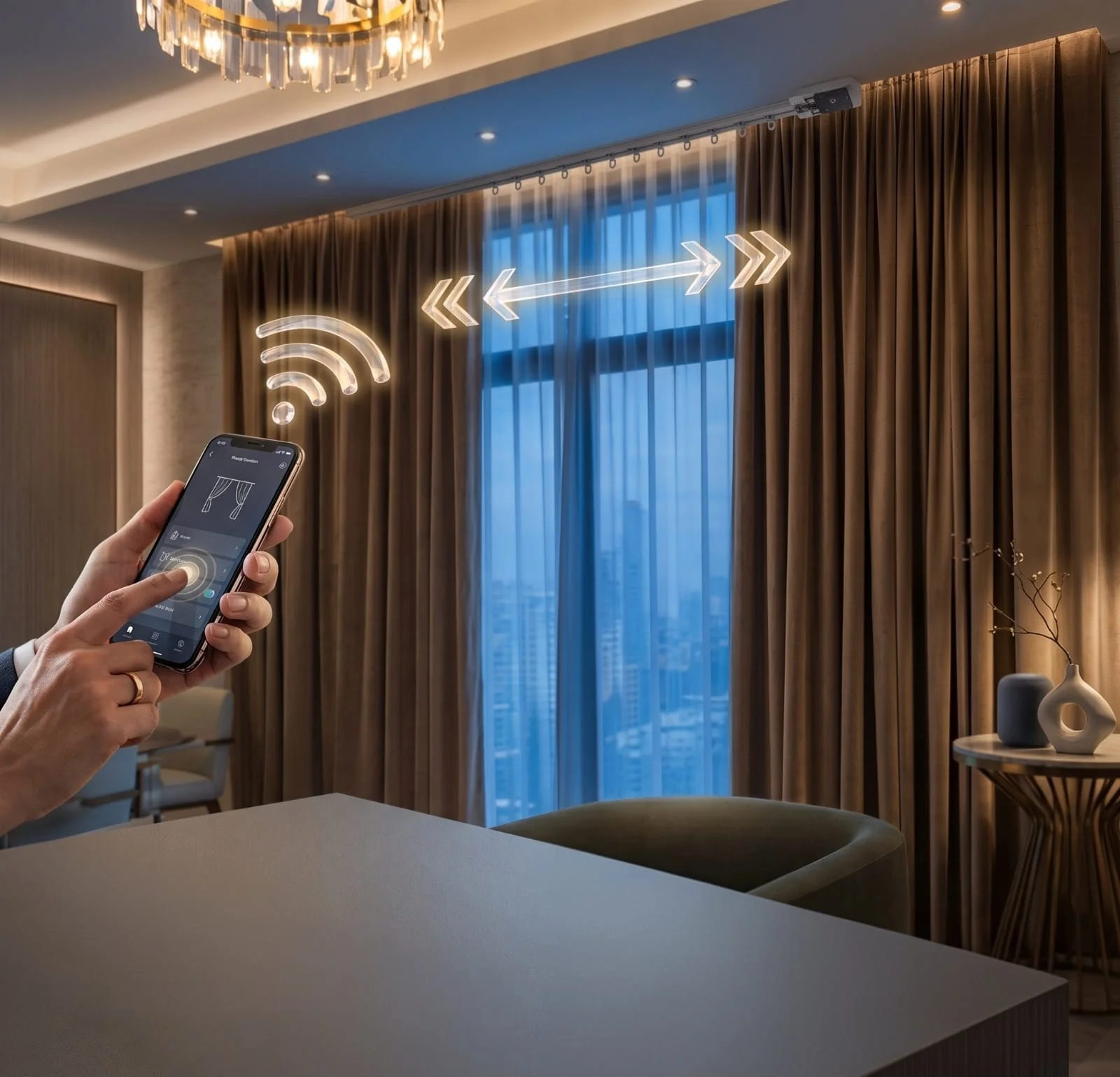
Those are the numbers most people come here for, so they are at the top rather than the bottom. What they buy is lighting control on every fitting in the room, a motorised curtain set, AC and fan control, three smart switches, and the hub that runs it all.
The rest of this piece is the part that actually saves money: why two quotes for the same room can differ by five times, the one wiring detail to check before you buy anything, and the five planning mistakes that cost the most. It is written for Mumbai flats specifically, because the room here is usually smaller, usually shared with the dining table, and usually already finished.
What does a smart living room cost in Mumbai?
Around ₹1,20,000 for a complete living room. Three realistic scopes, for a typical Mumbai living room:
| Scope | What it covers | Estimate |
|---|---|---|
| Lighting only | Two cove circuits, 10 to 12 spot and COB points, four decorative circuits. Every light in the room dimmable and scene-controlled. | ₹65,000 |
| Complete living room | Ten light points, one motorised curtain set, AC and fan control, three smart switches, and the home’s hub. | ₹1,20,000 |
| Media room | Everything above, plus entertainment integration, universal control and a scene keypad built around the screen. | ₹1,50,000 to ₹2,00,000 |
One detail in that middle row changes the economics of the whole project, and it is worth understanding before you compare quotes: the hub is one per home, not one per room. The living room estimate carries it because the living room is usually the first room done. Every room automated after this one is cheaper, because it joins a system that already exists. If you are pricing room by room and being quoted a hub each time, ask why.
For how the living room sits inside a whole flat, our room by room cost breakdown for a 3BHK in Mumbai prices the full system, which lands at roughly ₹5 lakh for a complete home.
If one quote is five times another for the same room, the two are almost never quoting the same thing, and the difference is usually architecture, not brand. A fully wired system needs cable pulled through walls and ceilings, so it has to be decided at the civil stage of a project. A wireless system works inside the wiring that is already there. Published Indian integrator ranges put wired systems at roughly ₹800 to ₹1,500 per sq ft against ₹200 to ₹600 per sq ft for wireless. Those are industry ranges rather than AHA figures, so treat them as directional. Before you compare two quotes, establish which architecture each one assumes. Our wired versus wireless comparison sets out where each genuinely wins.
What is actually in a smart living room?
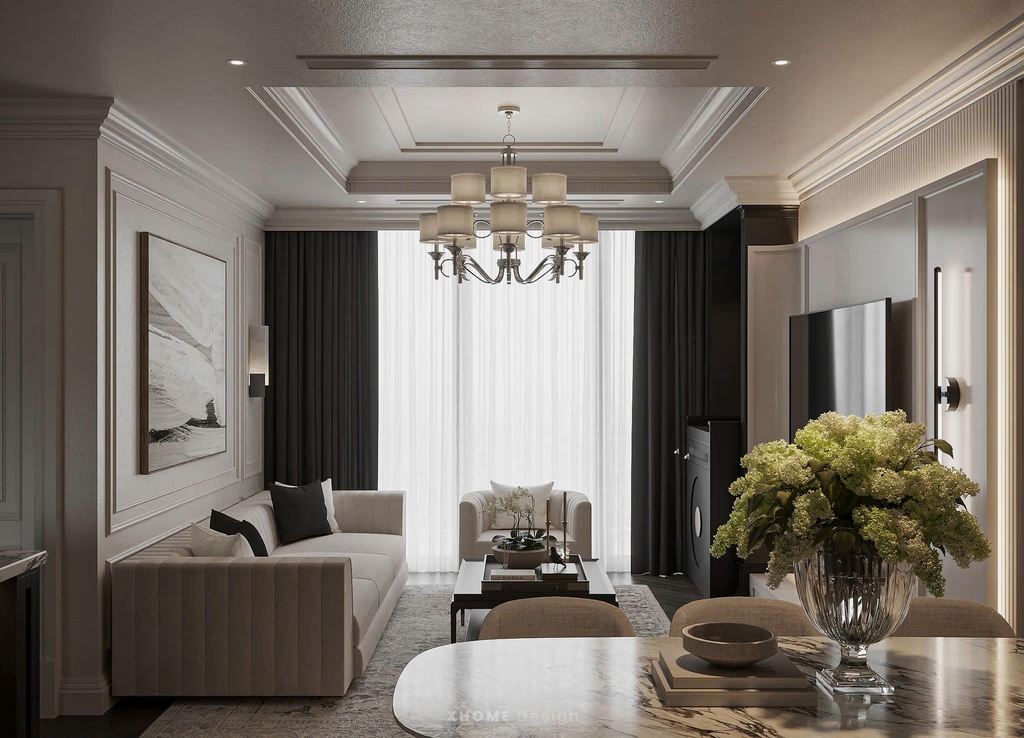
A smart living room is one where lighting, curtains, climate and media respond to a single instruction instead of four separate ones. That is the whole definition, and it is worth being precise about, because it is not the same as a room with smart devices in it.
A room with a voice speaker, an app-controlled bulb and a Wi-Fi plug has three products and three apps. Nothing in it coordinates. A smart living room has one system: a hub holding the logic, and devices answering to it. Press a scene called Movie and the lights drop to the level you chose, the curtains close, the AC steps down and the screen comes on, in one action.
The practical test is whether a guest can use the room. If operating the lights means knowing which app to open, the room is not automated, it is complicated. This is the most common gap between what people buy and what they wanted, and it is why the keypad on the wall matters more than the phone in your pocket.
How do you set up a smart living room, step by step?
Order matters more than budget. Doing these in the wrong sequence means paying twice for work already done, especially once the ceiling is closed.
- Lighting first. It is the layer used every single day, the hardest to retrofit once a false ceiling is sealed, and the foundation every scene you later build depends on. If the budget stretches to one thing, this is the one thing.
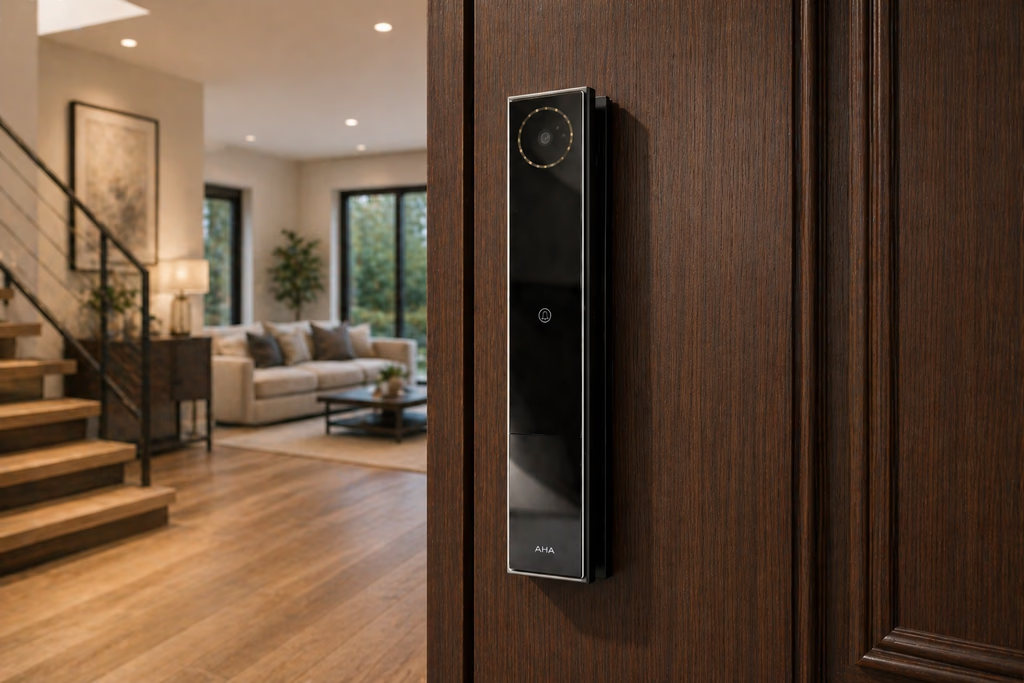
- Switches and keypads second. Decide where people actually stand: by the entrance, and beside the main seating. A keypad in the wrong place gets ignored, and the room quietly reverts to being run from a phone, which is worse than where it started.
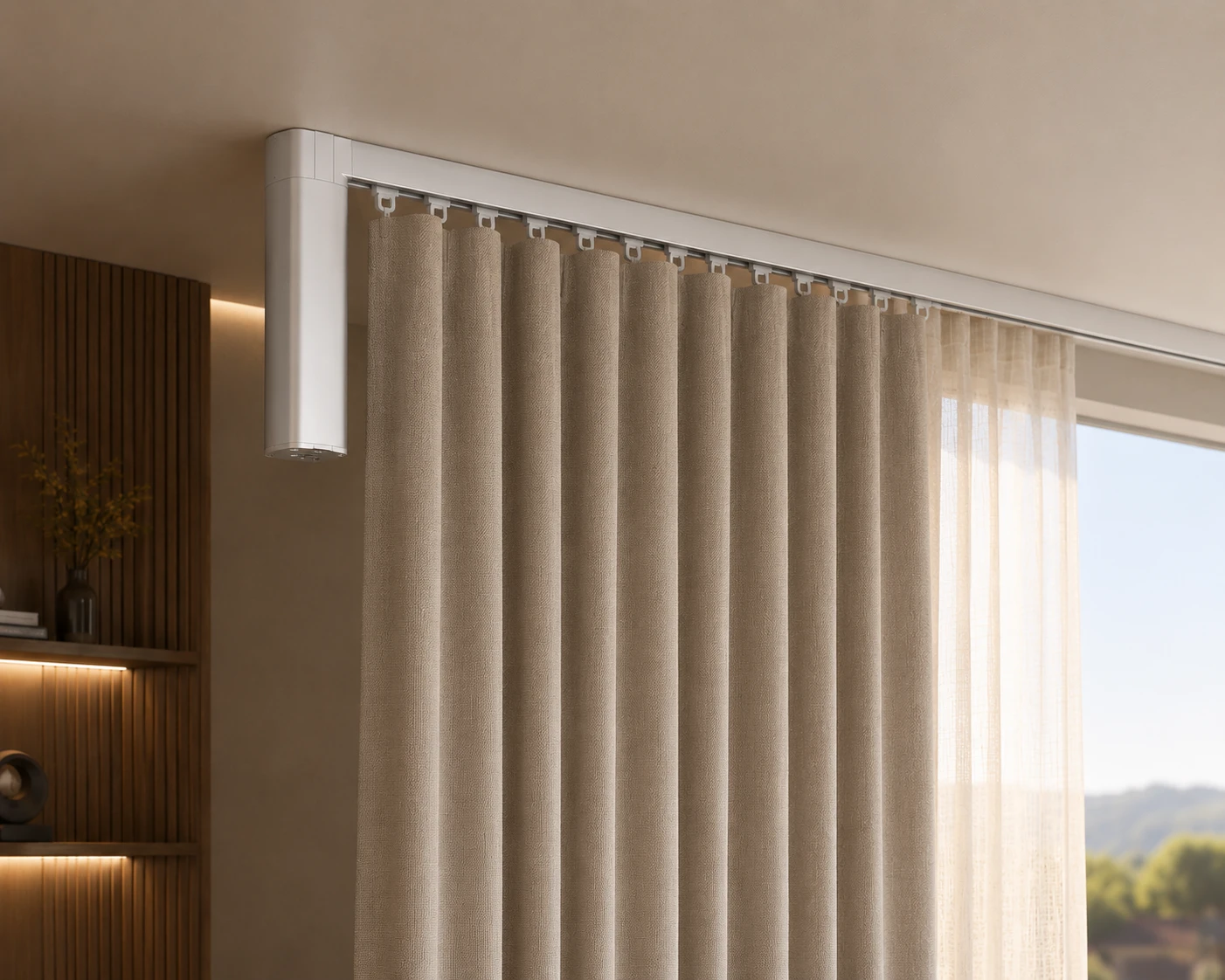
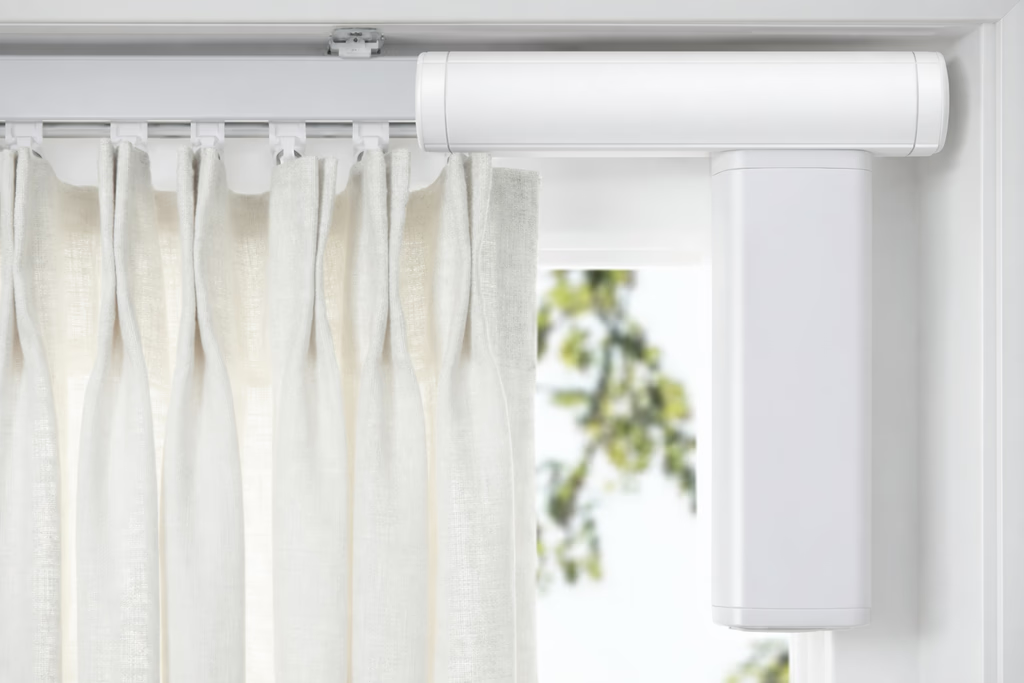
- Curtains third. A motorised set is what turns a lighting scene into a room-wide change, and on a west-facing or sea-facing Mumbai flat it does real work on heat and glare, not just ambience.
- Climate fourth. AC and fan control is inexpensive relative to its effect, because it is the difference between arriving to a cooled room and waiting twenty minutes for one.
- Media last. Entertainment integration depends on everything above it. A one-touch movie scene is only possible once there are lighting scenes and curtains for it to call.
If media is the priority for your room, our guide to the seven must-have features in a smart home entertainment setup covers what to insist on.
Does your switchboard have a neutral wire? Most smart switches need a neutral at the switch point to work, and a great many older Indian switchboards were wired without one, with only the live and the switched line running to the plate. It is the single most common thing that derails a living room retrofit, and it is discovered far too late, usually after someone has already chosen hardware. Check it before you fall in love with a product. A site visit answers it in minutes, and the answer shapes everything after it. Systems that put the intelligence in a driver inside the light fitting rather than in the switch plate itself are less exposed to the problem, which is one practical reason they suit older buildings.
Which living room lights should you automate first?
Not all of them, and not equally. A living room usually has three lighting layers, and they earn automation in a clear order.
Cove and ceiling lighting sets the mood of the whole room, so it gains most from dimming and tunable colour temperature: cool and bright in the afternoon, warm and low in the evening. It is also the layer that is genuinely painful to change later, because it lives inside the false ceiling.
Spots and downlights are the working layer. Automating these lets you light a reading corner without lighting the whole room, which is the difference between a room that feels considered and one with a single bright setting.
Decorative and accent circuits matter least functionally and most visually. They are what a guest notices, and they are cheap to include once the drivers are going in anyway.
Our smart lighting page covers the layering in more detail, and Theatre Mode and Party Time are two finished scenes built on exactly this, if you would rather see the result than the parts.
Do you need to rewire your living room?
No, not for a wireless system. This is the question that stops most Mumbai apartment owners from starting, and the answer is more encouraging than they expect.
A wireless retrofit works inside what already exists. A driver sits inside each light fitting. An infrared sensor handles the AC and the TV. Keypads replace the existing switch plates and need a neutral at each switch box. No walls broken, no false ceiling reopened, no fresh conduit pulled.
That matters disproportionately here. A large share of Mumbai homes sit in older, pre-redevelopment building stock where drilling, noise and contractor access are genuinely restricted by the society, and where the flat being automated is already finished and lived in. It is also exactly the housing stock most likely to have the neutral-wire problem above. Wired systems are the better answer when the decision is made at the civil stage of a new build. For everything else, wireless is usually the only realistic option.
Worth being clear about who does what, because this industry often is not. AHA does not install. AHA designs the system, supplies the hardware, configures it and commissions it in your home. The physical installation, mounting and wiring is done by your electrician, who is usually already on site during a fit-out. That keeps the electrical work with the person licensed and accountable for it.
Why plan around scenes rather than devices?
The most useful shift in planning a living room is to stop counting devices and start naming moments. Not "how many switches do I need" but "what are the four things this room does".
For most Mumbai living rooms the honest answer is: everyday evening, movie night, people over, and everyone out. Four scenes. Once those are named, the device list writes itself, and so does the budget, because you can see immediately which purchases serve a scene you will genuinely use and which serve one you imagined.
This is also where lighting and climate stop being two separate conveniences. An Evening scene can drop the cove lighting, warm the colour temperature, close the curtains against the glare and bring the AC down a step, from one keypad press. Nothing in that sequence is impressive alone. The combination is what people notice.
There is a practical reason the two belong together in this city. West-facing and sea-facing flats take a heavy afternoon heat load through the glass. Curtains that close on a schedule or a light sensor cut that load before the AC has to fight it, so the room reaches a comfortable temperature faster. A ten-month Illinois Tech study found automated insulating shades cut energy use by roughly a quarter across both heating and cooling seasons. That was an office tower in Chicago rather than a flat, so read it as a direction, not a promise. The AC has its own lever too: India’s Bureau of Energy Efficiency estimates that each degree you raise the set temperature saves about 6 per cent of its electricity, and a scene can hold it at 24°C without anyone having to remember.
How is a Mumbai living room different?
Almost every smart living room guide online is written around a large, single-purpose room. That is not what most people in this city are working with, and it changes the advice materially.
A Mumbai living room is usually compact and usually doing more than one job. It is the living room and the dining room, often with a work corner, sometimes with a folding bed at night. The pitch is not "automate everything". It is make a small number of points do a lot of work, because there is no room for a device that earns its place only occasionally.
Two consequences follow. First, scene control matters more here than in a big house, because the same six or eight light points have to produce genuinely different rooms at different hours. Second, anything that takes up physical space or adds another remote is working against you. The wall keypad is not a nice-to-have in a compact room, it is the thing that keeps the automation usable without adding clutter.
The other Mumbai-specific reality is the building itself. Society rules on drilling hours, lift access for material, and what may be opened in a shared wall are real constraints on a project, and they are much easier to plan around than to discover mid-way. For the local detail, our home automation company in Mumbai page covers how projects here actually run.
Which five mistakes cost the most?
- Treating automation as a bolt-on after the interiors are done. The cheapest moment to plan for it is while the false ceiling and switchboards are still open. Even if the visible smart layer is added later in phases, provisioning then, meaning the extra points, a sensible hub location and a neutral pulled where it is needed, is dramatically cheaper than retrofitting it afterwards.
- Choosing devices before checking the wiring. The neutral-wire question decides which hardware is even possible. Answering it second means either a compromise or a return.
- Automating everything at once. Two or three high-impact scenes, lived with for a month, teach you more about what your household actually uses than any amount of planning. Expand from there.
- No manual override. Power cuts happen, and so do app outages. Every automated circuit should still work as an ordinary switch on the wall, with no phone and no internet involved. If a system cannot do that, it is not ready for an Indian home.
- Leaving no room to scale. The living room is almost never the last room. A system chosen because it was cheapest for one room, with no path to the bedrooms, gets replaced rather than extended.
Does a smart living room work without internet?
Yes, for the parts that matter. This is the most common worry and the one most often answered dishonestly, so here is the real division.
Scenes, switches, sensors and schedules run locally on the hub inside your home. During a broadband outage your lights, curtains and climate keep working exactly as before. The keypad on the wall is not a remote control talking to a server, it is a switch talking to a hub in the same building.
What stops working is anything that has to leave the house: controlling the room from your office, notifications while you are away, and voice assistants that process commands in the cloud. Those are genuine losses, and they are temporary.
The honest summary is that an outage costs you remote access and voice, not the room. If an integrator tells you their system is unaffected in every respect, they are describing a system with no remote features at all.
What will a smart living room not fix?
Three things, stated plainly, because a guide that only lists benefits is marketing rather than advice.
It will not fix bad lighting design. Automation controls the lights you have. If a room has four downlights and no cove, dimming them changes very little, because there is nothing to layer. The lighting layout decision comes before the automation decision, and no amount of scene programming rescues a ceiling with the wrong points in the wrong places.
It will not fix a room nobody enjoys. If the seating faces away from the view, or the screen is on the wrong wall, a scene will not repair the layout. Automation makes a well-designed room easier to live in. It does not make a badly planned one good.
It will not remove the electrician. Every system, wired or wireless, needs licensed electrical work at some point. Anyone promising a whole-house system with no electrical involvement is describing plug-in gadgets, not automation.
There is also a buyer for whom this is genuinely not worth it yet. If you are renting short term, or the flat is due for a full renovation inside two years, wait and do it at the fit-out stage. It will cost less and the result will be better, because the lighting layout and the automation get planned together.
What do people ask us next?
What does a smart living room cost in Mumbai?
Around ₹1,20,000 for a complete living room, covering lighting control on every fitting, a motorised curtain set, AC and fan control, and three smart switches. Lighting alone is around ₹65,000. A media room with a full entertainment scope runs ₹1,50,000 to ₹2,00,000. These are scope estimates and move with the number of light points and the curtain span, which is why the figure is confirmed at a consultation rather than quoted blind.
Why do smart home quotes for the same room differ so much?
Because they are usually quoting two different architectures. A fully wired system needs cable pulled through walls and ceilings and has to be decided at the civil stage. A wireless system works largely inside the wiring already there, the one addition being a neutral at each keypad's switch box where it is missing. Published Indian integrator ranges put wired at roughly ₹800 to ₹1,500 per sq ft against ₹200 to ₹600 per sq ft for wireless. Before comparing two quotes, check whether they assume the same architecture.
Do you need a neutral wire for smart switches?
Most smart switches need a neutral at the switch point, and many older Indian switchboards were wired without one. It is the most common thing that derails a retrofit, and it should be checked before choosing any hardware. A site visit answers it in minutes. Systems that put the intelligence in a driver inside the light fitting rather than in the switch plate are less exposed to the problem.
Does a smart living room work without internet?
Yes for the parts that matter. Scenes, switches, sensors and schedules run locally on the hub, so lights, curtains and climate keep working through an outage. What stops working is anything that has to leave the house: control from outside the home, and cloud-based voice assistants. The physical switches always work, and any system worth buying keeps working as an ordinary switch if the automation layer is unavailable.
What should you automate first in a living room?
Lighting. It is the layer used every day, the hardest to add once the ceiling is closed, and what makes every other scene possible. Curtains come second, climate third, and media last, because media integration depends on the lighting scenes already existing.
Does AHA install the system?
No. AHA designs the system, supplies the hardware, configures it and commissions it in the home. The physical installation, mounting and wiring is done by your electrician, who is usually already on site during a fit-out.
A smart living room is not a room full of clever things. It is a room that does four jobs well, on one instruction, without anyone hunting for an app.
The two decisions that shape the budget both happen before any hardware is chosen: which architecture you are on, and what your switchboard is wired like. Both are answered at a site visit. If you want to see the end result first, both AHA experience centres are in Mumbai, in Santacruz West and Lower Parel, and you can run the scenes described here by hand. Bring your electrical plan if you have one, it makes the project cost far more accurate.
Book a free consultation →For the finished scenes, see Theatre Mode and Party Time, both running on AHA lighting drivers and smart switches, and the AHA smart home solutions process for how a room is planned end to end. This guide is about what to automate and what it costs. For the lighting layout itself, where each fixture goes and how the circuits are split, see living room lighting design. If the whole flat is being fitted out rather than one room, start with our guide for new Mumbai homeowners.