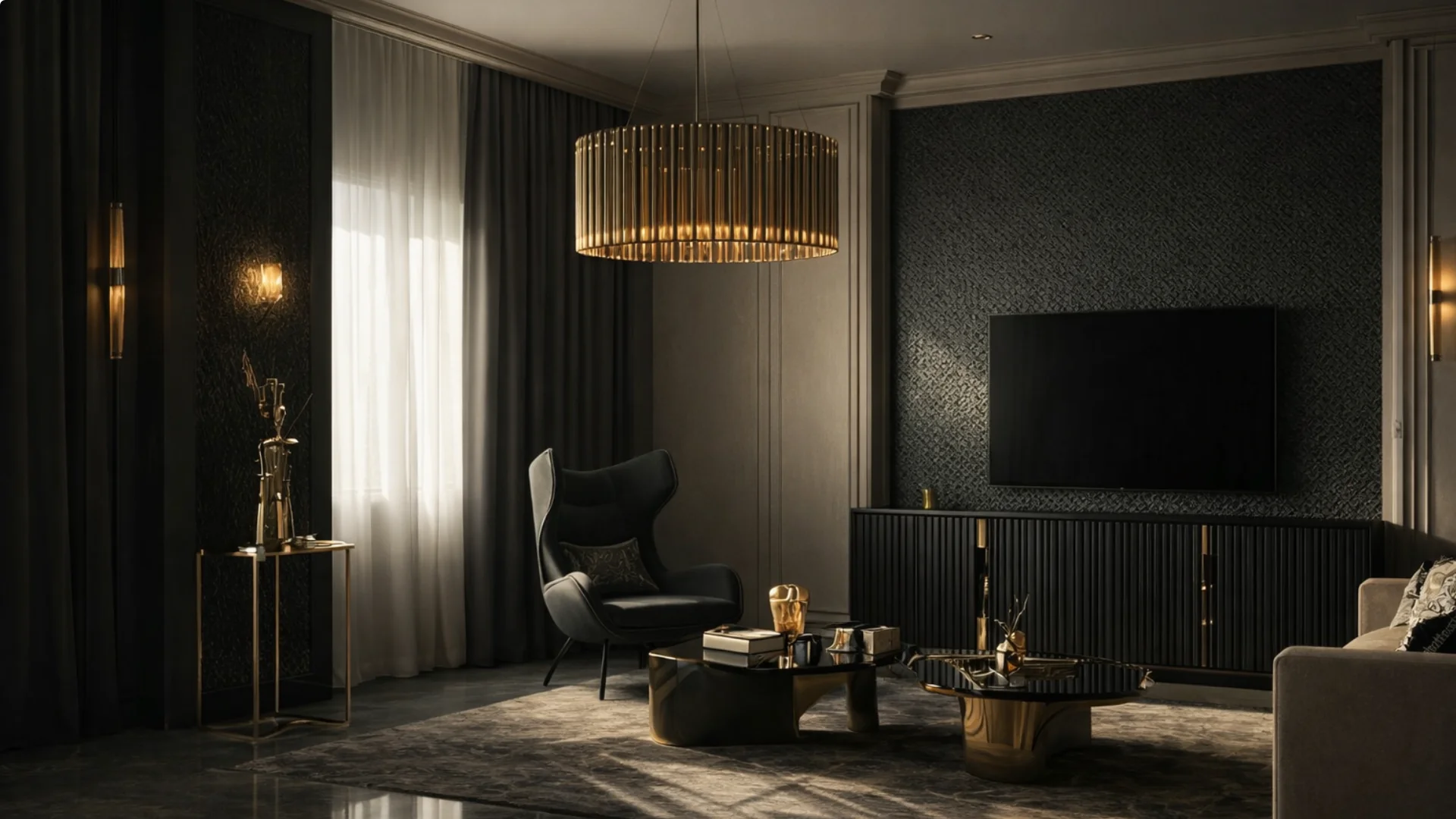
Curtains for the Living Room: Types, Fabrics and Ideas
For most Mumbai living rooms, the best set-up is a light sheer near the glass and a room-darkening or blackout panel on an outer track, hung floor to ceiling, in cotton, a cotton linen blend or a good matte polyester. Skip heavy velvet and thick unlined cotton, which hold monsoon damp.
The short answer, before the detail: for most Mumbai living rooms the right set-up is layered. A light, quick-drying sheer near the glass, a heavier room-darkening or blackout panel on an outer track, hung floor to ceiling on a track that runs well past the window, in cotton, a cotton linen blend or a good matte polyester.
That one combination answers four local problems at once. Humidity that sits near 86 percent in July and August. The western sun on a tower facade. Glare on floor to ceiling glazing. And neighbours close enough to read your television.
The climate is not a footnote here, it decides the fabric. Mumbai's relative humidity averages roughly 71 to 75 percent across the year and peaks around 86 percent in July and August on India Meteorological Department thirty-year data from the Santacruz observatory, and the city takes about 2,258 mm of rain a year, nearly all of it in the four monsoon months. Those two numbers are why the usual advice to buy heavy natural fabric is wrong here.
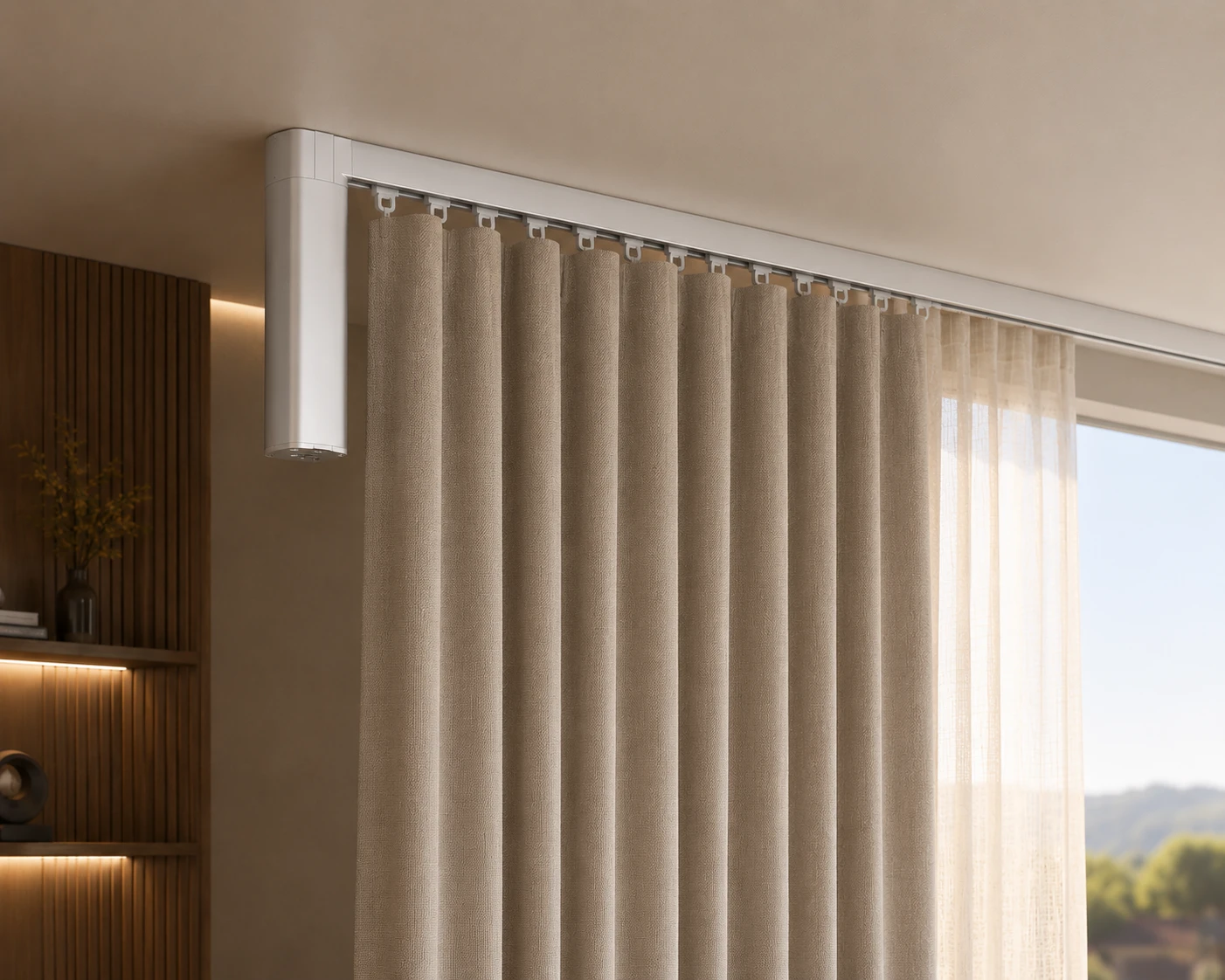
What are the different types of living room curtains?
Three questions decide the type: how it hangs, what it does to light, and how long it is.
By heading, which is how it hangs
Eyelet or grommet. Metal rings punched into the top slide straight onto a rod. The most common heading in India, easy to hang, easy to draw, and it falls into soft modern folds. Needs about 1.5 times fullness. The sensible default for an everyday living room.
Pencil pleat. A gathering tape pulls the fabric into narrow folds. It works on rods or tracks, takes pattern well, and is the most cost effective heading on a wide window.
Pinch pleat, double or triple. Permanently sewn pleats, tailored and hotel-like. It uses the most fabric, around 2.5 times the track length, so it costs the most, and it drapes the best. Right for a formal room.
Tab top. Fabric loops over the rod. Relaxed and charming, and slow to draw, so it suits a window you rarely close.
Rod pocket. The rod threads through a sewn channel. Cheap and simple, but it bunches and does not slide, so treat it as a fixed decorative panel.
Pelmet or valance. A box or fabric band that hides the track. In Mumbai it does real work rather than decorative work: it closes the light and hot air gap at the top of a west facing window.
By what it does to light
Sheer or voile filters light, gives daytime privacy and softens glare, and it is the fastest drying curtain you can own, which matters from June to September. Room darkening weaves cut most light without total blackout and are usually the right weight for a living room. Blackout is dense and often coated, generally overkill on its own in a living room but excellent as the outer layer, or in a room that doubles as a home theatre.
Lining adds body, drape, light control and fabric life, and roughly 30 to 60 percent to the fabric cost. On a bright west or south window a thermal or blackout lining pays for itself on the electricity bill. Unlined panels are cheaper, lighter and dry faster, which is friendlier to the monsoon.
By length
Floor length, stopping one to two centimetres above the floor, for a living room. It looks finished, and more usefully it makes the room read taller, which is worth a great deal in a compact flat. Sill length belongs on kitchen and utility windows.
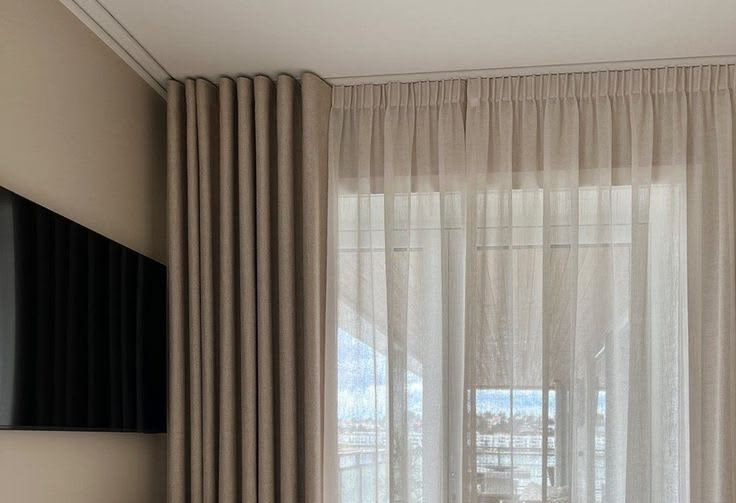
Which curtain fabric survives Mumbai?
The usual advice inverts here. Heavy naturals such as velvet and thick unlined cotton hold moisture and can mildew. Lighter, faster-drying weaves win. Mildew is not only a smell: the World Health Organization's indoor air guidelines advise that "persistent dampness and microbial growth on interior surfaces and in building structures should be avoided or minimized, as they may lead to adverse health effects." Add salt air near the sea, traffic dust, and strong western sun on tower glazing, and the shortlist gets short.
| Fabric | Humidity and mildew | Fade resistance | Cleaning |
|---|---|---|---|
| Cotton | Breathes and releases moisture well, but can mildew if left damp | Fades in strong sun | Machine wash |
| Linen and cotton linen | Good if aired, attracts mildew when damp | Good, but creases | Gentle wash or dry clean |
| Polyester | Mould resistant, does not absorb water, dries fast | Excellent | Machine wash or wipe |
| Velvet | Poor. Traps moisture and is mildew prone | Good | Dry clean only |
| Silk and faux silk | Poor for real silk, faux is better | Real silk fades fast | Dry clean |
| Jacquard | Medium. The woven texture allows some airflow | Good | Usually dry clean |
| Sheer voile and net | Excellent, the fastest drying option | Varies | Easy wash |
| Blackout coated | Surface does not absorb water, check the backing in damp | Good | Wipe or gentle wash |
| Solution dyed performance | Strong mildew resistance, quick drying | Best in class | Wipe clean, rinsable |
Everyday Mumbai living room: cotton, cotton linen or a good matte polyester. Polyester and light cotton voile are the coastal winners because they dry fast and resist mould.
Sea facing flat: favour synthetics and blends, and change the hardware, not just the fabric. Salt air corrodes ordinary steel, so specify marine grade stainless steel or aluminium rods, rings, brackets and tracks, and rinse them with fresh water occasionally.
Strong west or south sun: polyester and solution dyed performance fabrics hold colour. Cotton and real silk fade fastest. Put a thermal or blackout lining behind a decorative front fabric so the heat work is done by the layer nobody sees.
Avoid for full time use: heavy velvet and thick jacquard. In peak monsoon they can smell musty within days in a room that is not well ventilated.
Never re-hang or store a curtain damp. Moisture plus warmth plus fabric can start mildew within roughly 48 to 72 hours in a poorly ventilated room. Take curtains down for a full wash every few weeks, and between washes shake them out and air them in front of a fan, especially in the monsoon. A mild white vinegar rinse helps inhibit spores.
What changes in a Mumbai flat specifically?
Small living rooms, 1BHK and 2BHK. Hang the track at or just below the ceiling and extend it well past the window on both sides, with panels that just kiss the floor. It draws the eye up and out. Keeping the curtain within a shade or two of the wall colour blurs the boundary and makes the room read wider. Fewer, wider panels beat many narrow ones.
High rise flats with large glazing. Big windows mean big glare and big heat gain. Layered curtains on a wide track kill the afternoon glare without giving up the view. A pelmet or a ceiling recessed track hides the mechanism and closes the hot air gap at the top.
Older buildings against new towers. Older buildings have smaller windows and solid walls, so wall mounted rods are straightforward. New towers have floor to ceiling glass and false ceilings, which suit a recessed track and give a cleaner architectural line.
Balcony and sliding doors. Wide openings want a track rather than a rod, because a track slides more smoothly across a long span. Use floor length panels and a centre opening draw, and specify a track rated for the weight if the curtain is heavy.
Privacy in a dense neighbourhood. A sheer gives daytime privacy while keeping the room bright. After dark, with the lights on, it gives almost none. Draw the solid layer in the evening. That is the whole argument for layering in one sentence.
Do curtains actually reduce heat and AC load?
Yes, and this is the part with a real number behind it. The US Department of Energy has stated that medium coloured draperies with white plastic backings can reduce heat gain by about 33 percent when closed over a window receiving direct sunlight.
Three conditions have to hold for you to get that. The curtain has to cover the whole window with overlap at the sides. The backing facing the glass should be light coloured, so it reflects rather than absorbs. And the edges need sealing, against the wall or under a pelmet, or the hot air simply convects around the curtain and into the room.
On a west facing Mumbai living room in April, that is the difference between an air conditioner that cycles and one that runs. It is also the argument for automating the curtain rather than relying on somebody being home to close it, which is covered further down.
Which colours and styles actually work?
- Match the curtain to the wall, one shade lighter. The single most effective small room trick. It makes the wall read taller and the room bigger.
- Neutral base, colour in the cushions. Beige, greige or ivory as the backdrop, with the colour somewhere you can change seasonally.
- Layer in a tonal pair. A white sheer with a warm grey or teal front panel: soft by day, private by night.
- Pull the colour from the sofa or the rug rather than the wall, which reads more considered in an open plan flat.
- Go floor to ceiling, always. Track 15 to 20 cm above the frame or at the ceiling, and 10 to 20 cm wider on each side.
- Deep jewel tones for a formal room, emerald, navy, plum, but only in a lined or fade resistant fabric on a west window.
- Vertical texture or a subtle stripe to stretch a low ceiling upward.
- Warm metallic hardware for a richer scheme, brushed steel for a cooler one, and stainless or aluminium if you are sea facing.
- One feature fabric per room. Let the patterned curtain be the hero and keep everything else quiet.
- Mind the length. Kiss the floor. A curtain that stops halfway down the wall cuts the room in half visually.
If you follow Vastu, the commonly cited living room colours are yellow, green, blue and beige, with light pink or peach suggested for a west facing room, and black and very dark shades generally avoided. White, off white and cream are treated as safe in any direction. Treat it as one input among several: the light, the room size and the sofa matter just as much.
How do I measure, and what does it cost?
Fix the track first, then measure to it. Put it 10 to 15 cm above the frame, or at the ceiling, and 10 to 20 cm past the frame on each side. Measure the length from the top of the track, or from where the eyelets will sit, down to the floor. Measure the width across the track, not the window.
Fullness is where most people go wrong. 1.5 times the track width is the bare minimum and suits eyelet headings. 2 times is the sweet spot for a full, clean drape. 2.5 to 3 times is luxurious and right for sheers and pinch pleats. A 5 ft track at 2 times fullness needs about 10 ft of curtain across it, usually two 5 ft panels.
Standard Indian drops are 5 ft for a window, 7 ft for a door and 9 ft for a long door, with 8 ft also common, and window panels around 4 ft wide. Measure before assuming a standard size fits, because Mumbai flats vary more than the catalogue does.
Custom or ready made. Ready made is cheaper and instant and fine for a standard window. Custom earns its cost on floor to ceiling glass, odd sizes, a layered double track, and when you want a specific fabric, lining and fullness. Remember that two layers on one window means two fabrics and two sets of making up.
What fabric costs. Roughly 150 to 400 rupees a metre for basic polyester, 400 to 900 for good cotton, blends and sheers, 900 to 1,800 for heavier weaves, jacquards and quality blackout, and above 1,800 for linen, velvet and imported fabric. Lining adds around 30 to 60 percent to the fabric cost and repays it in drape, light control and heat resistance. Those are furnishing shop rates for the cloth itself, not an installed price.
Where do motorised curtains actually earn their place?
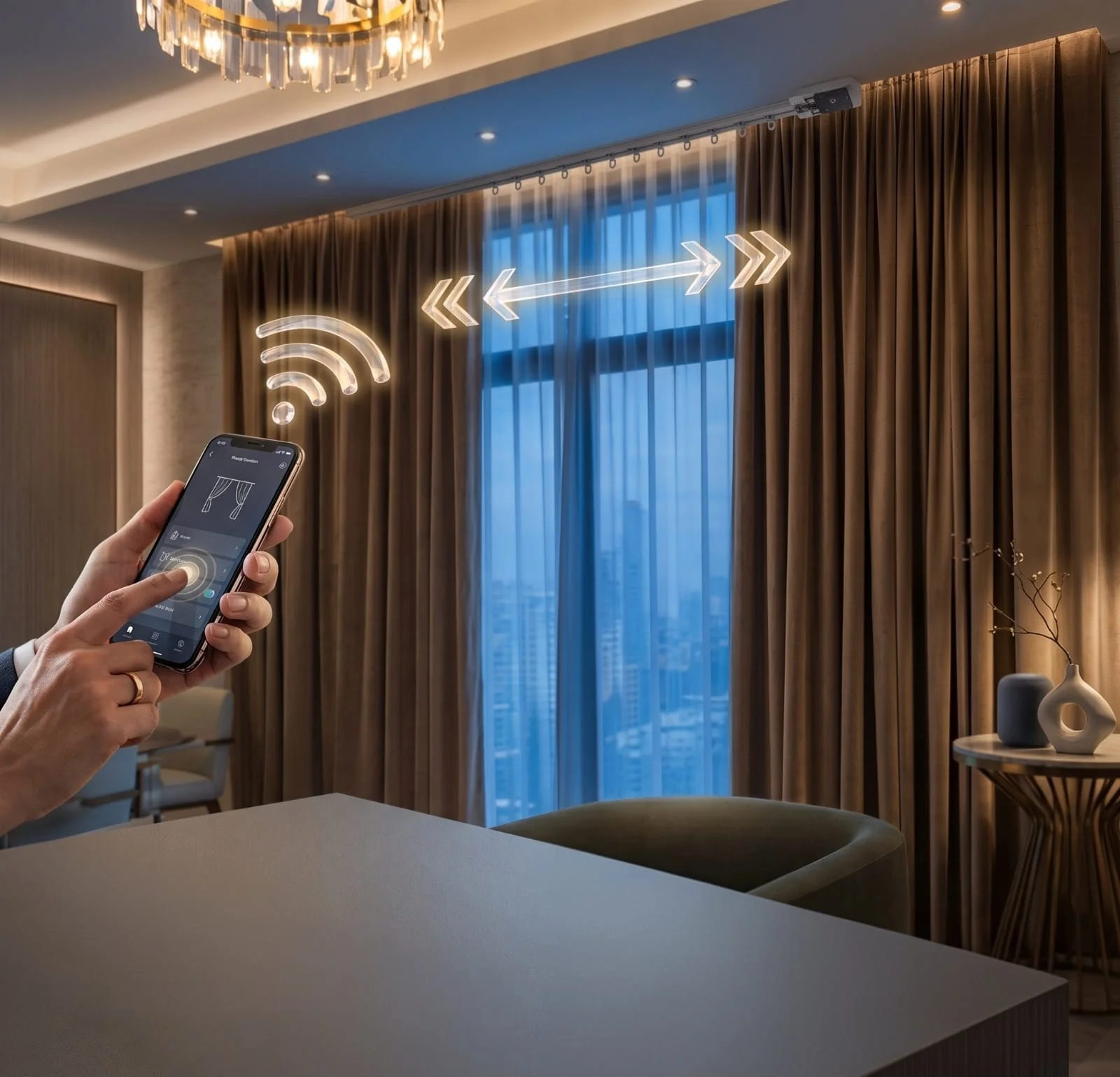
On the windows that are genuinely awkward. Wide sliding doors, floor to ceiling glazing, anything above a sofa you have to climb over, and anything you want closing against the western sun at three in the afternoon whether or not somebody is home. On a small window you walk past every day, a manual track is perfectly good, and we would tell you so.
A motorised track is not new hardware bolted onto a curtain. It is the same motorised channel that has been used for years, with app, voice and schedule control added. A slight tug still starts it, so nobody has to learn a new habit, and two way communication means a manual nudge updates the app with the curtain's real position rather than leaving the two out of step.
Two things matter more than the brochure. Weight, because a heavy blackout curtain on a three to four metre track is a serious load and needs a track rated for it, not a light retrofit motor. And the power point, because a motor needs one at pelmet height on the correct side, and almost no Indian home has a socket up there. That point costs almost nothing during first fix and means a chased wall afterwards, which is why it appears in our electrical points checklist.
If you are weighing the upgrade rather than planning it, motorised versus manual curtains works through whether it is worth it at all. If you have decided, our curtain motors run at 27dB, take up to 15ft width and 80kg on a standard motor, and handle centre opening, stacked and curved bay window tracks.
Who does what. AHA designs the system, supplies the track and motor, configures the scenes and commissions it with you. Your electrician installs, mounts and wires it, and your furnishing supplier makes the curtain itself. Motorised curtains are quoted per window as part of the system rather than sold as a part, because the width, the drop, the fabric weight and the power point all change the answer. Our guide to what home automation costs explains how that scoping works.
Curtains, blinds, or both?
Curtains win on insulation, room darkening and the softness that makes a living room feel like one, which is why they dominate Indian homes. Blinds are more compact, give slat level control and wipe clean, which suits kitchens, balconies and dusty traffic facing windows. In Mumbai's damp, fabric that is not dried properly breeds mildew, so a blind or a washable quick-drying curtain is the lower maintenance choice on the worst windows.
Most homes that get this right use both: curtains on the main picture window, a blind on the kitchen and the balcony.
What can curtains not do?
- Fix damp behind them. A curtain that smells musty is often telling you about the wall or the window seal. Treat the seepage first; new fabric over a damp wall mildews again.
- Cool a room they are not drawn across. A curtain left open through a western afternoon does nothing for the heat. The saving depends on closing it at the right time, every day, which is where a schedule helps.
- Stay safe with loose cords around small children. Corded tracks and blinds are a known strangulation risk; cordless or motorised tracks remove it. Our motorised vs manual comparison covers the trade-off.
What do people ask us next?
Which curtain is best for a living room?
A layered set-up: a light sheer plus a room darkening or blackout panel on a double track, in cotton, cotton linen or matte polyester, hung floor to ceiling. It handles glare, heat, privacy and humidity together.
Which colour curtain is best for the living room?
Neutrals are safest and make a room feel larger, especially within a shade or two of the wall. Jewel tones suit a formal room but need a lined or fade resistant fabric on a west window.
How do I stop curtains going mouldy in Mumbai humidity?
Quick drying fabrics, never re-hung or stored damp, aired in front of a fan during the monsoon, washed every few weeks, with a mild white vinegar rinse. Avoid heavy velvet for full time use.
Do blackout curtains reduce heat?
Yes, by around 33 percent on the US Department of Energy figure, if the curtain covers the whole window, the backing facing the glass is light coloured, and the edges are sealed.
Do sheer curtains give privacy at night?
No. With the lights on they are close to transparent from outside. Pair them with a solid layer.
What curtain fabric suits a sea facing flat?
Synthetics and blends, plus marine grade stainless steel or aluminium hardware, because salt air corrodes ordinary steel rods and rings.
What size curtains should I buy?
Standard drops are 5 ft, 7 ft and 9 ft. Buy floor length for a living room and order total width at about twice your track width.
How high and wide should curtains be hung?
Track 15 to 20 cm above the frame or at the ceiling, 10 to 20 cm wider each side, panels to the floor.
Are motorised curtains worth it?
On wide, tall or hard to reach windows, yes. On a small window you pass daily, a manual track is fine.
What is the short version?
Good living room curtains in Mumbai are less about a single best product and more about matching type, fabric and hanging to your particular flat: its light, its humidity, its size, and how close the opposite balcony is. Start layered, floor to ceiling, in a fabric that dries fast. Hang it high and wide. Choose a colour that expands the room rather than chopping it up.
Then, on the windows where reaching the curtain is genuinely a nuisance, look at motorised tracks. Not because a curtain needs an app, but because a west facing window wants closing at three in the afternoon, and nobody is home at three in the afternoon.
Fabric, lining and track are far easier to choose standing in a real room than from a swatch. Both AHA experience centres, in Santacruz West and Lower Parel, are laid out as real homes rather than showrooms, open from 11am to 7pm (Santacruz West is closed on Tuesdays).
Curtains are usually one layer of a larger plan rather than a standalone purchase. Our smart home solutions page covers how the curtain, lighting and climate layers are designed to share scenes instead of working against each other.
Book a free consultation →