Bedroom False Ceiling With Profile Light: How to Plan It
A bedroom is the only room in the house you look at from lying down. Every other ceiling is designed for someone standing. That single difference decides where a downlight can sit, what a profile run is actually for, and why most bedroom ceiling lights end up switched off.
Keep points of light out of the view from the pillow, and put the brightness on a line instead. A recessed profile run lights the room by bouncing off the ceiling or wall with the source hidden. Downlights go where people stand, not over the bed.
Most bedroom ceilings are drawn the way a living room ceiling is drawn, in plan, from above, by someone imagining the room from the doorway. Then people lie down in it.
Why is a bedroom ceiling different from every other ceiling?
Because it is the only one you spend hours looking directly at. In a living room, a kitchen or a hallway, your eyes are roughly horizontal and the ceiling sits above your field of view. In a bedroom, for a good part of the time you are in it, the ceiling is your field of view.
That changes one thing and then everything follows from it: a bare light source in your line of sight is glare. A downlight directly over the pillow is, from the point of view of someone in bed, a small very bright object aimed at the face. It is the reason an enormous number of well designed bedrooms end up being used with the ceiling lights permanently off and two bedside lamps doing all the work.
So the planning question for a bedroom is not "how do I light this room" but "where can light come from that nobody has to look at". Hidden sources, bounced light and a low night layer. That is what a profile run is good at, and it is why this room suits it more than most.
What makes profile light suit a bedroom?
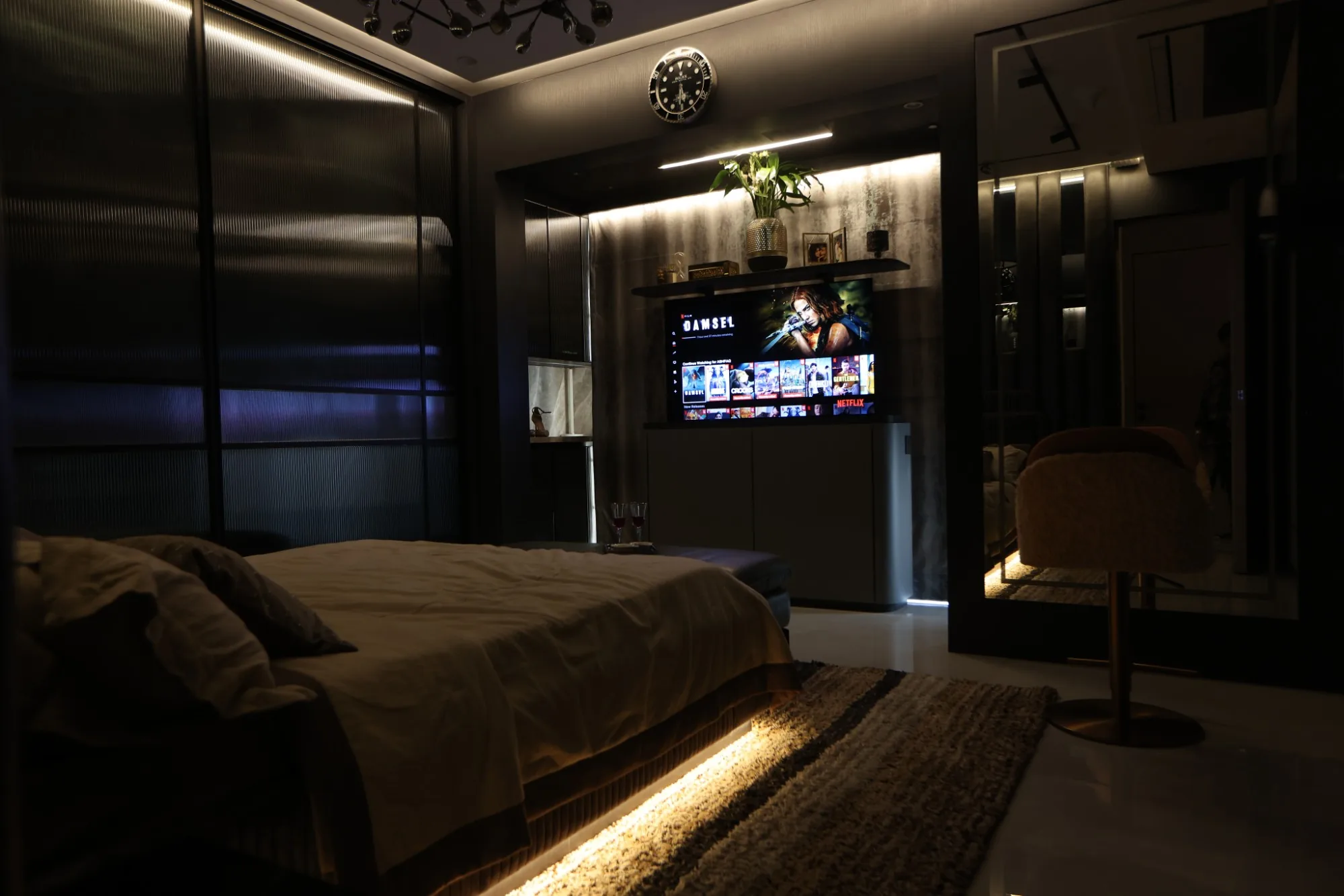
A profile light is an LED strip running inside an aluminium channel, usually with a diffuser over it, so what you see is a continuous lit line rather than a row of dots. In a bedroom that matters for three reasons.
- It is a line, not points. A line at low brightness reads as the edge of the room glowing. A row of points at low brightness reads as a row of points. Lying down, the second one is distracting and the first one is not.
- The source hides. Recessed in a ceiling channel or a cove, aimed at the ceiling or down a wall, the strip itself is out of sight from normal head height and from the pillow.
- It dims as one thing. A single run on one driver goes down together, so there is no stepping or patchiness across a wall the way there can be across separately driven points.
The practical number to know at the drawing stage: one driver covers up to 15 feet of strip. A typical bedroom perimeter run is one or two drivers, and the count follows the metres of strip rather than the number of walls, so it is worth settling on the drawing rather than discovering on site. If you want the difference between profile, cove and COB explained properly, that comparison lives in the cove and false ceiling guide rather than being repeated here.
One thing a profile run is not: a substitute for a reading light. It is a soft general layer. Anyone who reads in bed still needs a directed light on their own side, which should switch on their own side too.
Where should each light actually go?
Mapped against what the person in the room is doing at the time, which is the only test that matters in a bedroom.
| What is happening | What lights it | Where it goes |
|---|---|---|
| Lying in bed, evening | The profile run, low | Perimeter or a single run on the wall behind the bed, source hidden |
| Reading in bed | A directed light per side | Wall mounted or pendant beside each pillow, switched from that side |
| Dressing, using the wardrobe | Downlights | Over the wardrobe front, about a foot and a half out, so the doors are lit and you are not in your own shadow |
| Walking in and out | Downlights | Over the route from the door, never over the pillow |
| Getting up at 2am | A very dim floor level layer | Under the bed or in the skirting, on a sensor, never on a switch |
| Mirror or dressing table | Light from the sides | Either side of the mirror at face height, not a downlight above it |
The row that gets ignored most often is the fourth one, and it is the cheapest to get right: when the ceiling is marked out, stand where the bed will be, lie down if you can, and look at where the downlights are pencilled. If any of them are above the pillow, move them. This is a thirty second check on site and it is close to impossible to fix afterwards.
How do you get up at night without waking the other person?
This is the problem a bedroom has that no other room has, and it is the one worth spending on. Two people, one awake, one asleep, and a route to the bathroom in the dark.
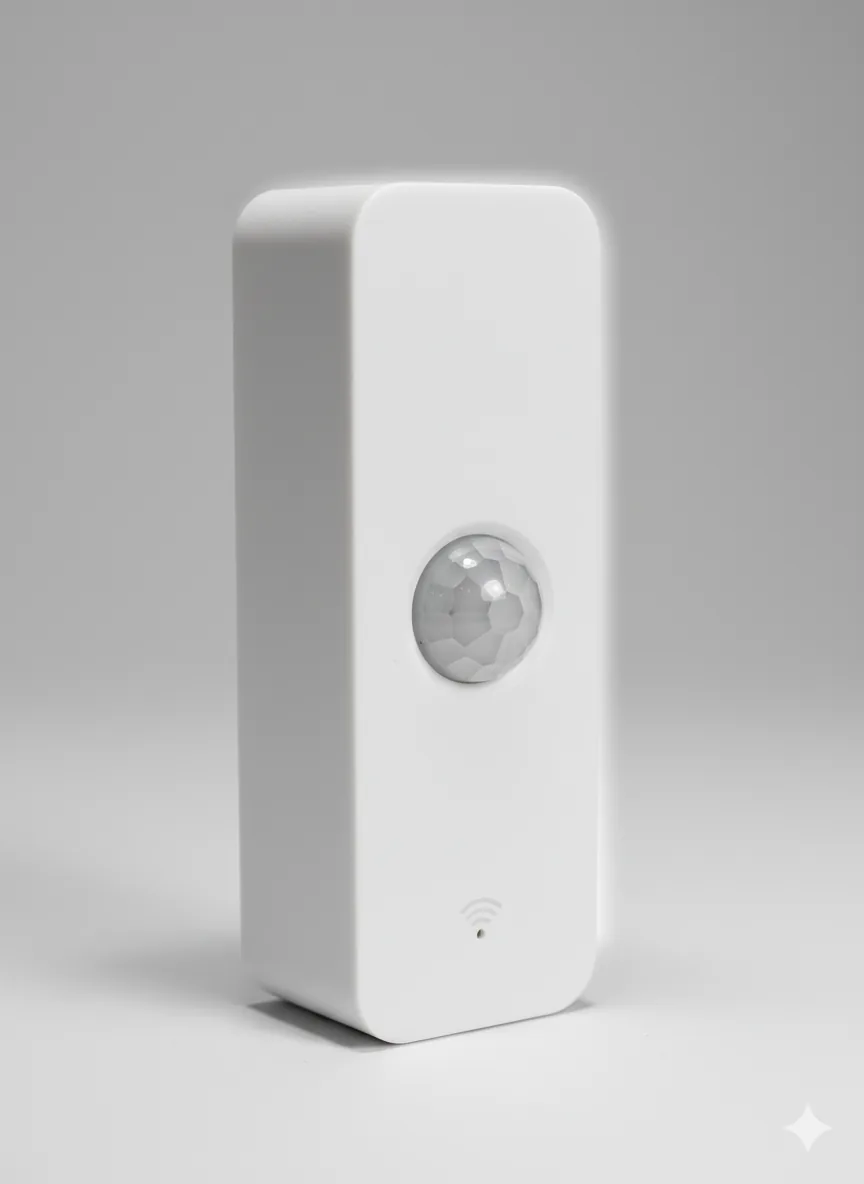
The answer is a separate layer that is much dimmer than anything else in the room, placed at floor level, and triggered by movement rather than by a switch. A battery motion sensor is the right device here: it detects passing movement across roughly 7 feet in a 120 degree field, it needs no phase or neutral so it can go where it is useful rather than where there is wiring, and a light it triggers holds for up to four minutes and then switches itself off.
Do not use a presence sensor for the bed area. A presence sensor uses millimetre wave radar and detects true stillness, down to the rise and fall of breathing. That is exactly right for a walk-in wardrobe or an attached bathroom, where standing still should not make the light give up. Pointed at a bed, it does its job correctly and reports that the room is occupied all night, which is not what you want attached to a light. The distinction matters enough that it is worth naming the two devices separately on a drawing.
On an AHA system that layer runs as Midnight Walk, and the same sensor can hold the rest of the room off while it does so, which is the part a standalone night light cannot manage.
What should a bedroom do for two people on different schedules?
Almost every bedroom is shared and almost every bedroom is wired as though it is not. One switch plate by the door, controlling everything, usually on the side nearest whoever gets up first.
Three things fix most of it:
- Reading light switched from its own side. Obvious, frequently missed, and it needs deciding before the wall closes because it is a wiring decision rather than a fitting decision.
- A control at the bed, not only at the door. Whether that is a keypad on the wall beside the bed or a control on the phone, the test is whether the last person into bed has to get up again. Worth knowing before you plan it: an AHA keypad needs a neutral wire at its switch box, and many older Mumbai switch loops do not have one, which is covered in do smart switches need a neutral wire.
- One press that ends the day. Everything in the room down and off except the night layer, without walking the room switching things. That is the single thing people who have it mention most about a bedroom.
None of that needs a false ceiling. It needs the circuits split sensibly, which is a decision taken at the same time as the ceiling and almost never revisited afterwards.
How dark should a bedroom actually get?
Darker than most Mumbai bedrooms manage, and the obstacles are usually not the lighting design.
The reason to care is well documented rather than a matter of taste. The body clock is set largely by light, and the US National Institute of General Medical Sciences describes circadian rhythms as responding primarily to light and dark in an organism's environment. Harvard Health's summary of the research on evening light exposure goes further on the specific effect of blue wavelengths, noting that blue light suppresses melatonin for roughly twice as long as green light at comparable brightness.
What that means practically in this room:
- Warm and low in the evening, not just low. Dimming a cool white fitting gives you a dim cool light. AHA drivers carry per fixture control of intensity and colour temperature rather than one shared dimmer per circuit, so the same fittings can be bright and neutral for dressing and warm and low at night.
- Count the standby lights. A television, a set-top box, a router, an air purifier, a charger. Four small glowing points is not a dark room, and no amount of ceiling design fixes it.
- Curtains do more than lights. Mumbai streetlight through a sheer is brighter than anything you will leave on deliberately. Blackout fabric is the lever, and whether to motorise it is covered in motorised versus manual curtains.
What will a bedroom ceiling not fix?
Four things, said plainly, because they come up after the ceiling is closed and that is the expensive time to hear them.
- A room with one point in the middle. If the ceiling is already finished with a single central point and nothing else, no control system invents somewhere else for light to come from. That is a wiring decision and it is taken before any of this.
- Fittings you do not like. AHA supplies the driver behind the light, not the light. We are a smart home company rather than a lighting company, so the fittings stay your choice from whichever vendor you prefer, and the driver works with the large majority of what is sold in India.
- A chandelier that will not dim. If the bulbs in it are not dimmable, the driver cannot make them so. In practice most decorative fittings end up on or off, and the decision belongs at the moment you buy the fitting.
- Noise, and the neighbour's balcony light. Worth saying because people expect a well designed bedroom to solve sleep, and lighting is one input among several.
Timing is the other thing that cannot be recovered. Drivers go into fittings and keypads replace switch plates, so the system itself does not need the wall broken, but the decisions about where points go have to happen before the ceiling closes. The order is set out in home automation before or after interiors, and the whole room by room picture is on smart lighting.
What do people ask us next?
Should a bedroom have a false ceiling with profile light?
It suits a bedroom better than most rooms, for one reason: a profile run is a continuous line of light rather than a set of points, and a bedroom is the one room you look at the ceiling from. Points of light in your field of view while lying down are what make a bedroom ceiling uncomfortable. A recessed line that throws light at the ceiling or the wall, with the source itself hidden, avoids that. Whether you need the false ceiling at all is a separate question, and a flat ceiling with surface profile can do most of the same work.
Where should downlights go in a bedroom?
Anywhere except directly above the bed. A downlight over the pillow is aimed at the face of someone lying down, which is why so many bedrooms end up with the ceiling lights never switched on. Put them over the circulation route, the wardrobe front and the dressing area, where someone is standing. The area above the bed is better served by light that bounces off the ceiling or the wall.
How many drivers does a bedroom profile run need?
One driver covers up to 15 feet of LED strip, so a typical bedroom perimeter run usually needs one or two. The count follows the metres of strip, not the number of walls. Worth confirming at the drawing stage rather than on site, because the driver has to sit somewhere accessible for service.
How do you light a bedroom for getting up at night?
With a separate, very dim layer that is not the ceiling light, triggered by a sensor rather than a switch. A battery motion sensor covers roughly 7 feet across a 120 degree field, needs no phase or neutral, and holds a triggered light on for up to four minutes before switching off by itself. Pointed at the floor beside the bed and wired to a low under-bed or skirting light, it lights the route without anyone reaching for a switch and without waking the other person.
Is a presence sensor or a motion sensor right for a bedroom?
For the bed area, neither, because a presence sensor that detects stillness will see a sleeping person and hold a light on. Use a battery motion sensor for the night route, where passing movement is exactly what you want to detect. Presence sensors, which use millimetre wave radar and need a phase and neutral connection, belong in a walk-in wardrobe or an attached bathroom, where being still should not read as the room being empty.
What colour temperature should a bedroom be?
Warm in the evening, and the exact number matters less than being able to change it. AHA drivers give per fixture control of intensity and colour temperature rather than one shared dimmer per circuit, so the same fittings can be cool and bright for dressing in the morning and warm and low at night. The reason to care is that light in the evening affects the body clock, which is well documented, and a bedroom is the room where that matters most.
The short version: plan this ceiling from the pillow rather than from the doorway. Keep bare sources out of that view, put the general light on a hidden line, send the downlights to where people stand, and give the room a floor level layer that comes on by itself at 2am. Everything else is detail.
If you want to stand in a bedroom running exactly that and press the keypad beside the bed, both centres are laid out as real homes: Santacruz West and Lower Parel, 11am to 7pm, Santacruz West closed on Tuesdays.
Book a free consultation →