Warm White vs Cool White: The Honest Guide for Indian Homes
Warm white, about 2700K to 3000K, is right for living rooms, bedrooms, dining and the pooja room; neutral white, about 4000K, suits kitchens, bathrooms and desks. The colour makes no difference to your electricity bill, the wattage does, so choose by room, not by what the tube light used to be.
The short answer is both. Warm white at 2700K to 3000K in the living room, the bedrooms and the pooja room. Neutral or cool white at 4000K to 6500K in the kitchen, the bathroom and over a study desk. The Indian habit of putting 6500K cool daylight in every room of the house is not a design decision, it is what happened when LEDs replaced fluorescent tubes at the same colour.
Two things are worth knowing before any of the detail. Colour temperature does not change your electricity bill. Watts and lumens do. And lower Kelvin does not mean dimmer. A 2700K and a 6500K bulb can put out identical lumens; cool light only looks brighter because the eye responds strongly to blue.
What is colour temperature, actually?
Colour temperature is measured in Kelvin and describes the tone of white light, from amber at the low end to blue white at the high end. It says nothing about how hot the bulb runs or how bright it is. Brightness is a separate number: lumens.
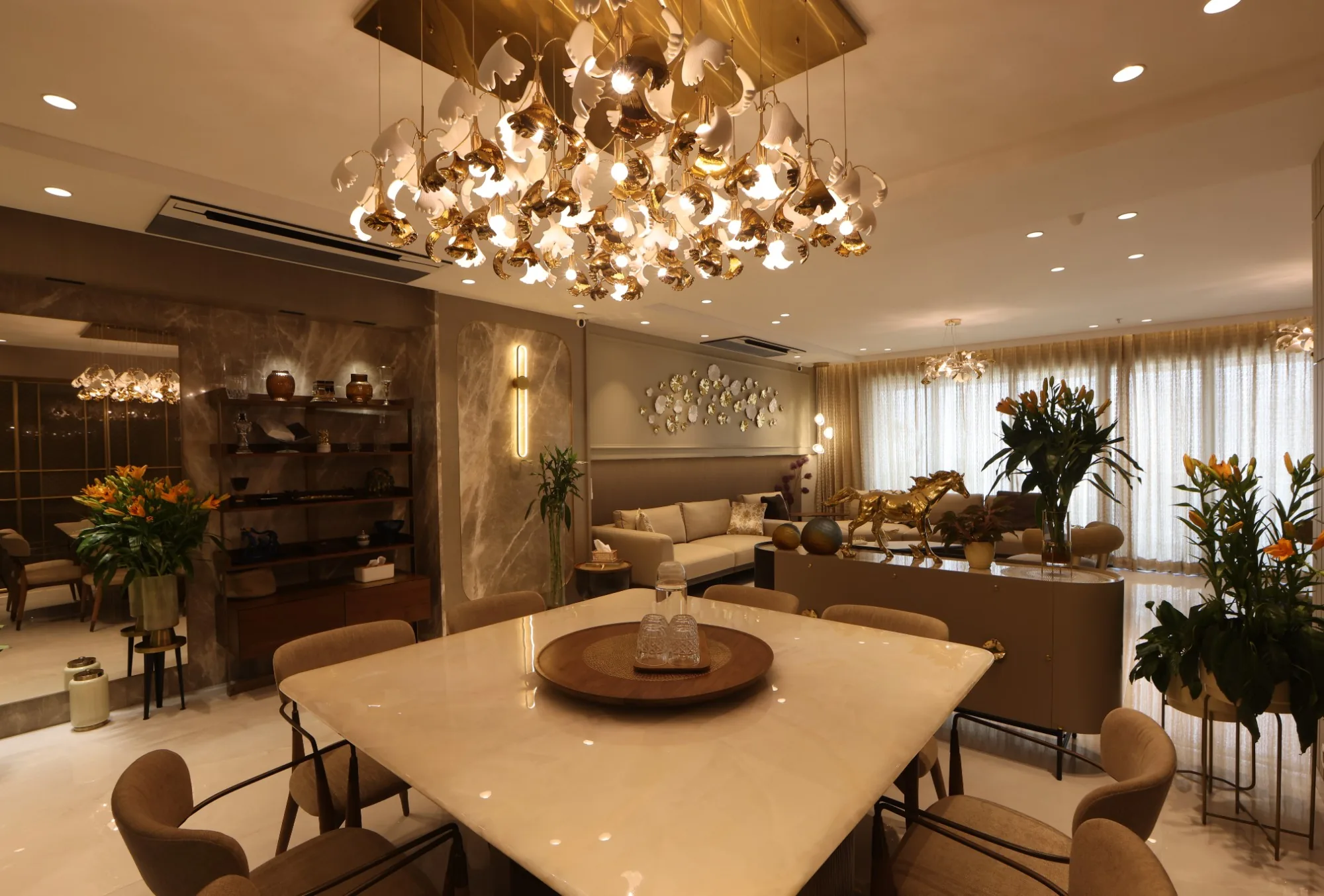
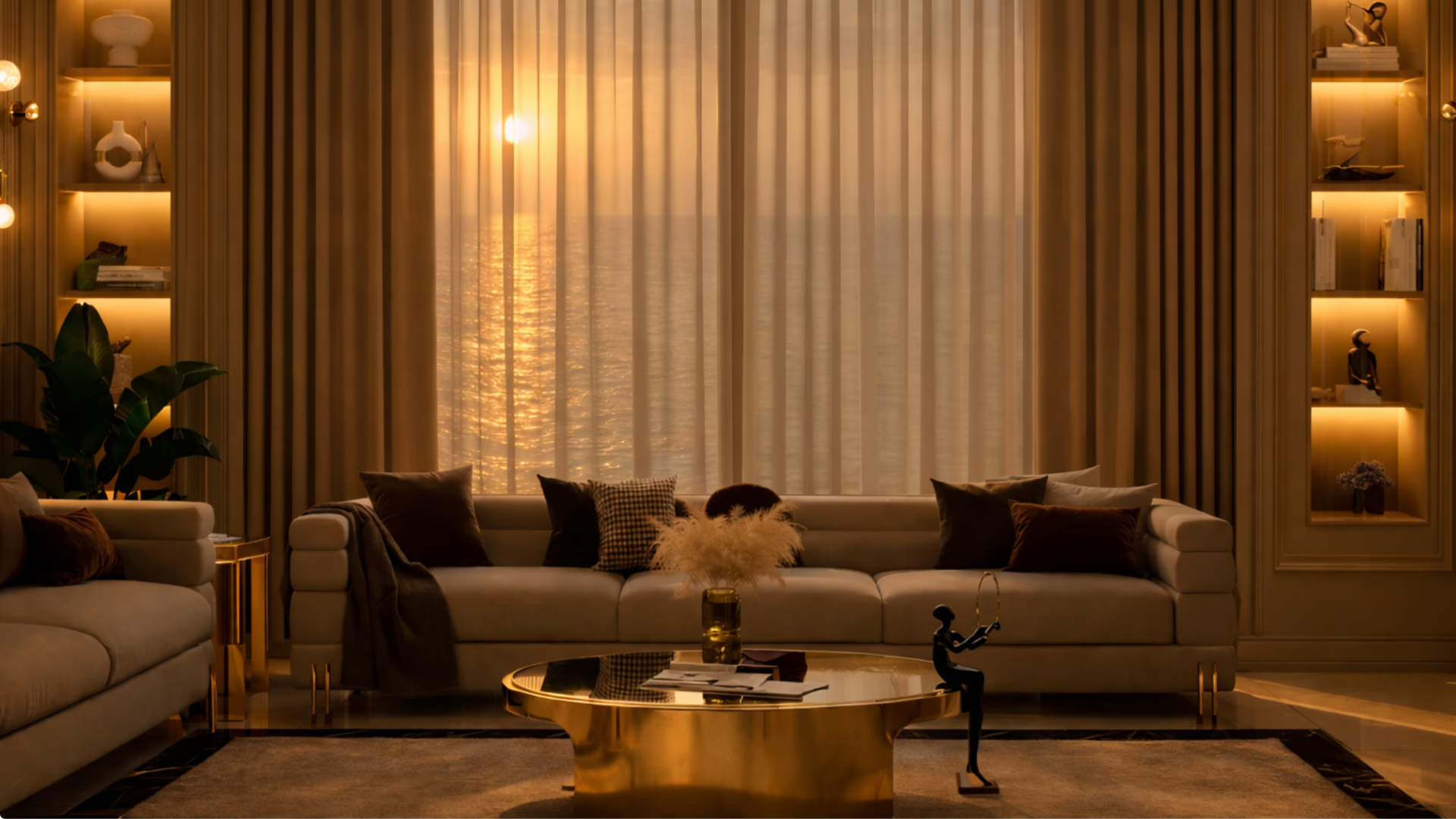
Warm white, 2700K to 3000K. A soft golden glow, close to an incandescent bulb, a candle or a diya. Relaxing, kind to skin, and it makes wood, brass and warm interiors come alive.
Neutral or natural white, around 4000K. A clean balanced white, neither yellow nor blue.
Cool white or cool daylight, 5000K to 6500K. Crisp and blue white, like midday sky or an old tube light. Alert, and slightly clinical.
How Indian boxes are labelled, and why it confuses people
Indian packaging generally runs on three shades: Warm White at 2700K, Neutral or Natural White at about 4000K, and Cool Day Light at 6500K. The trap is that Cool White is used loosely. In Western convention it means about 4000K, but plenty of Indian listings put it on a 6500K bulb.
Trust the Kelvin number on the box. The words are inconsistent between brands, and sometimes within one brand.
The three digit code is the other reliable tell. 827 means CRI in the 80s at 2700K. 865 means CRI in the 80s at 6500K. First digit is the colour rendering band, the next two are the colour temperature.
So why is 6500K the runaway best seller here? For decades Indian homes ran on cool daylight fluorescent tubes. When LEDs arrived they replaced tubes at the same colour, and the association stuck: bright white reads as clean, modern and good value, while warm yellow reads as dim or sleepy. Nobody chose it. It was inherited.

Why does this matter more in Mumbai?
Rooms are small. A Mumbai 1BHK is often 380 to 500 sq ft carpet and a 2BHK 550 to 750. In a compact room, 6500K flooding every corner feels stark and tiring rather than bright. Warm light softens edges and makes a small living room feel considered.
The monsoon is long and grey. Mumbai gets roughly 2,584 sunshine hours a year, but they are wildly uneven. May, the sunniest month, gets about 296 hours, nearly ten a day. July gets about 73 hours, roughly 2.4 hours of sun a day. From June to September your artificial light carries the entire mood of the home, and a one note 6500K flat feels cold for four months.
Flats sit close together. Lower floors, north facing units and any room looking at a tower a few metres away get very little direct sun. West facing flats get the opposite problem. Both cases argue for light you can change rather than light you install once.
One room does several jobs. In a compact flat the bedroom is also the office and sometimes the dining room. That is the strongest argument for tunable lighting anywhere in India.
On the idea that cool light makes a hot room feel cooler. There is a real effect here, the hue heat hypothesis, but the evidence is weaker than the folklore. A 2024 study in Scientific Reports on the validity of the hue heat effect found it less reliable than assumed, and reviews note that older studies contradicted each other because light and temperature were poorly controlled. Cool light may make a humid room feel marginally fresher. It will not lower the temperature or the air conditioning bill, and it is not a good enough reason to light a whole home at 6500K.
Does colour temperature change your electricity bill?
No. Not at all. This is the most expensive myth in Indian lighting, so it is worth being blunt about. Running cost depends on watts drawn and on how efficiently the bulb turns those watts into lumens. Colour temperature is not in the equation. A 9W warm white and a 9W cool daylight bulb of equal efficiency cost the same to run, to the paisa.
For scale, in rupees. Under the MERC tariff order for Adani Electricity, applicable from 1 April 2025, a Mumbai home pays about 6.38 rupees a unit for its first 100 units, rising through the slabs to about 11.98 rupees a unit above 500, plus a fixed charge of 90 to 160 rupees a month. Those per unit figures are the energy charge and the wheeling charge together; fuel adjustment and electricity duty come on top. Tata Power and BEST have their own regulated slabs. Check your own bill, and note that tariffs are revised.
Now apply it. A 9W bulb run five hours a day uses about 1.35 units a month. That is roughly nine rupees a month at the first slab and sixteen at the top one, before duty. Changing its colour temperature changes that by exactly zero. If you want a smaller bill, look at wattage, at the BEE star rating, and at switching off lights nobody is under. Not at the colour.
What does the sleep science actually say?
Light is the strongest signal your body clock receives, and the active ingredient is blue. The wavelengths that suppress melatonin sit in the 460 to 500 nm range, with the eye's melanopsin cells most sensitive around 480 nm. That blue is abundant at 6500K and scarce at 2700K.
In the evening it works against you. Harvard Health reports an experiment in which, after 6.5 hours of exposure, blue light suppressed melatonin for about twice as long as comparable green light and shifted circadian rhythm twice as far, 3 hours against 1.5. Harvard also notes that even dim light counts: about eight lux has an effect, which is less than most table lamps.
In the morning it works for you. The same blue rich light that hurts at night helps during the day, lifting alertness and focus. Cool light is genuinely right for a morning routine, a kitchen and a study desk.
One honest caveat. This is about timing and dose, not about cool light being bad. A single warm bulb will not fix insomnia, and ordinary room lighting is far dimmer than daylight. But the direction of the evidence is consistent: cooler and brighter by day, warmer and dimmer at night. That is the whole idea behind adaptive lighting.
Which colour temperature suits each room in an Indian home?
| Room | Colour temperature | Why |
|---|---|---|
| Living room | 2700K to 3000K warm, plus a 4000K task lamp if you work there | Layer it: ceiling, lamps and cove. Warm cove light is what reads as expensive |
| Bedroom | 2700K to 3000K warm | Protects sleep. Add a bedside reading light rather than brightening the ceiling |
| Kitchen | 4000K neutral, up to 5000K over a prep counter | Colour accurate for cooking. Under cabinet task light changes the room more than any ceiling fitting |
| Bathroom | 4000K neutral | Light beside the mirror, not only above it. CRI 90 or better for grooming |
| Pooja room | 2700K to 3000K warm | Close to diya light, and it makes brass, gold and marble glow. Never cool white here |
| Study or office | 4000K to 5000K | Alert light for focus. A tunable desk lamp is the ideal |
| Dining | 2700K to 3000K warm | Flatters food and faces. A pendant over the table beats a ceiling flood |
| Children's room | 4000K at the desk, 2700K to 3000K by the bed | Split by activity. This is the room tunable bulbs were invented for |
| Balcony | 2700K warm, low level | Cosier, and warm light draws fewer insects than blue rich light |
| Entrance and passage | 3000K to 4000K | Welcoming but practical |
One hard rule: never let two colour temperatures fight in the same line of sight.
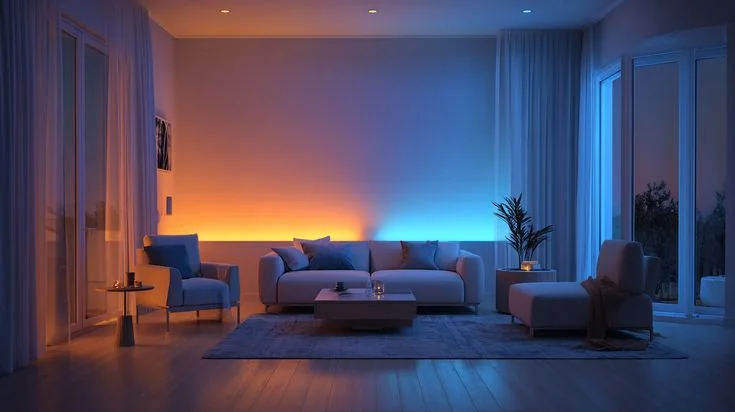
Pairing 3000K ambient downlights with a 4000K light under a kitchen cabinet is fine, because they are different layers doing different jobs. Putting warm and cool bulbs in the same ceiling is not fine. It reads as a fault, and it is the single most common lighting mistake in Indian homes.
If you are planning a room rather than replacing bulbs, our living room lighting design guide covers the layers, mood lighting ideas covers the scenes those layers make possible, and false ceiling and cove lighting covers the part that has to be decided before the plaster goes on.
Does tunable white end the argument?
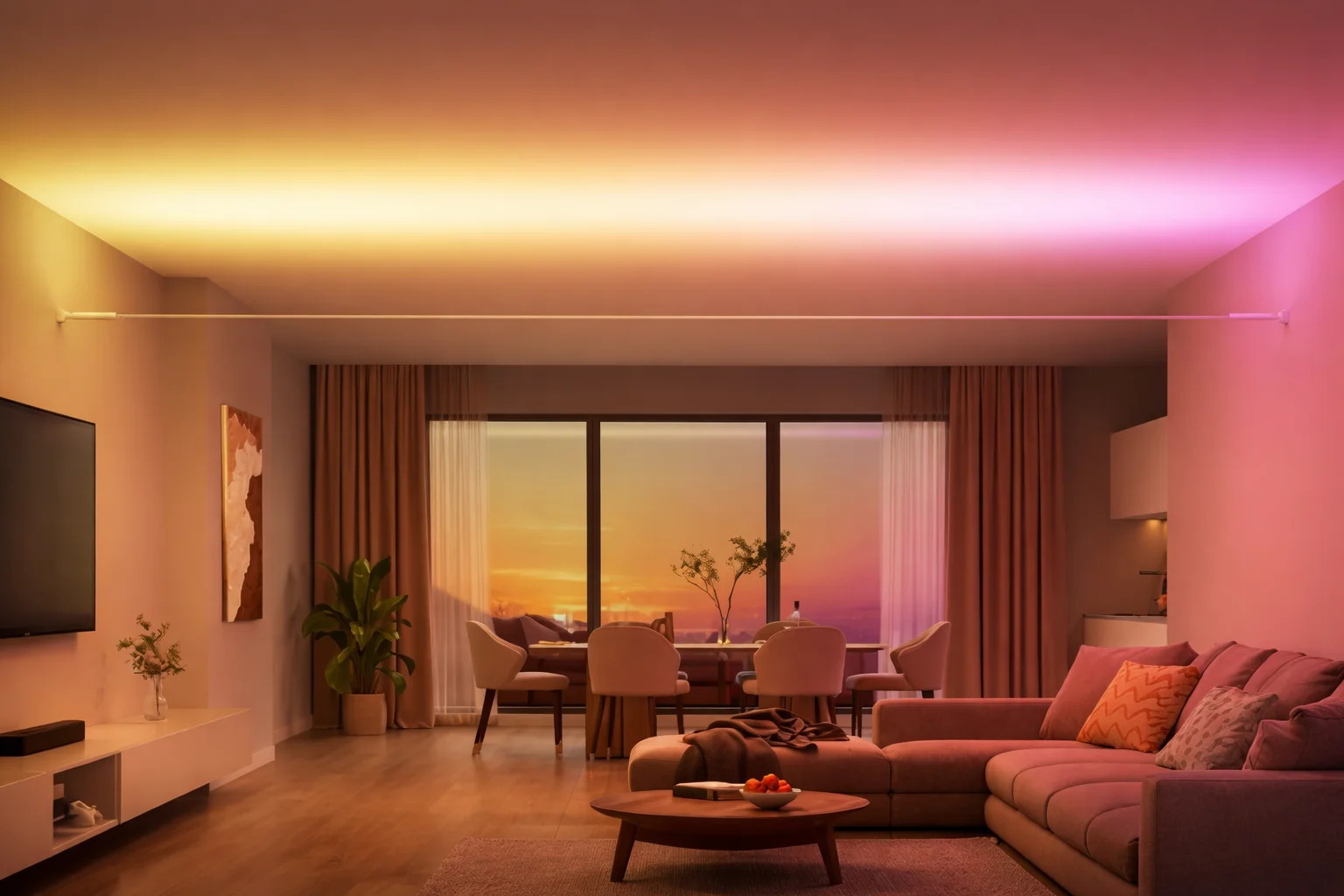
The whole warm against cool debate disappears with a tunable white fitting. One light covers 2700K to 6500K, so the room is cool and bright for a working afternoon and warm for the evening, on a schedule or by voice.
The feature that matters is not the colour range, it is scheduling. Set it once so the house runs cooler and brighter through the morning, neutral at midday, and warms down through the evening to a soft 2700K before bed. After that nobody thinks about it again, which is the point.
Where it earns its keep: rooms that change job. A living room that is also an office. A bedroom with a desk in it. A child's room that is homework at six and sleep at nine. In a compact Mumbai flat that is most of the rooms.
Where it does not: a pooja room, a bathroom, a utility. Fixed purpose, so a good fixed bulb is the right answer and the cheaper one.
Two honest caveats about the cheap Wi-Fi bulbs sold for this. They depend on your router, they can be fiddly to pair, and flipping the wall switch cuts them dead, so you lose app control until somebody turns the switch back on. That last one is the reason a system built around drivers inside the fittings and keypads on the wall behaves differently from a house full of smart bulbs: the switch stays a switch.
What we actually run, and why. AHA lighting drivers run at 4000K, the setting most commercial spaces use, with individual intensity and colour temperature control per fitting rather than one dimmer per circuit. 4000K is chosen deliberately: it does not push the light to full power, which lengthens working life. That is a specification decision rather than a taste one, and it is worth knowing that per fitting control is what makes a single ceiling able to do both jobs at different hours.
How should you buy bulbs?
- Read the Kelvin, not the marketing word. 2700K and 3000K are warm, 4000K is neutral, 6500K is cool daylight. Ignore any box that says Cool White without a number.
- Lumens are brightness, watts are consumption. A good LED gives roughly 90 to 120 lumens per watt. A 9W LED at about 800 to 900 lumens replaces an old 60W incandescent.
- Check CRI. Colour Rendering Index measures how true colours look against sunlight, out of 100. Aim for 80 plus generally, 90 plus in the kitchen, the bathroom mirror, the wardrobe and the pooja room.
- Look for BIS and BEE. Every LED bulb sold in India must carry BIS certification under IS 16102 for safety and performance, and a BEE star label for efficiency. More stars means more light per rupee.
- Check dimmable, if you want to dim. Most inexpensive Indian LEDs are not, and will flicker or buzz on a dimmer. Buy one marked dimmable, or go tunable and dim in the app.
The five mistakes that come up most often: 6500K in a bedroom because it looks brighter, buying by watts, ignoring CRI, one harsh central light instead of layers, and cool white in the pooja room.
What can the right colour temperature not fix?
- Too little light. Colour temperature changes the tone, not the amount. A dim room stays dim in any shade of white; lumens decide brightness.
- Poor colour rendering. A warm bulb with a low CRI still makes skin and food look dull. Check the CRI on the box as well as the Kelvin.
- Screens at night. Warm lamps help, but Harvard Health's advice is to "avoid looking at bright screens beginning two to three hours before bed". The phone in bed undoes a lot of good lighting.
What do people ask us next?
Which is better, warm white or cool white?
Neither, universally. Warm in the rooms you relax in, cool in the rooms you work in. Well lit homes use both.
Is 3000K or 6500K better for an Indian bedroom?
3000K. Warm light is gentle on melatonin. 6500K is blue rich and can delay sleep.
Does cool white use more electricity?
No. Cost depends on watts and efficiency. Colour temperature is not part of the calculation.
What does cool daylight mean on an Indian box?
6500K. It is the default best seller because LEDs replaced 6500K tubes, which is a habit rather than a decision.
Which light is best for a pooja room?
Warm white, 2700K to 3000K. It is close to diya light and makes brass, gold and marble glow.
Can I mix warm and cool in one room?
By layer yes, in one line of sight no. Two colours in the same ceiling reads as a fault.
Are tunable bulbs worth it?
In a room that changes job through the day, yes. In a fixed purpose room, a good fixed bulb is fine.
What CRI should I buy?
80 plus generally, 90 plus where colour accuracy matters.
What is the short version?
Warm in the living room, the bedrooms, the dining table and the pooja room. Cool in the kitchen, the bathroom and over a desk. Never two colours in one line of sight. Buy on lumens, CRI and BEE stars rather than on watts or on the word printed on the box. And ignore anyone who tells you cool white saves electricity, because it does not, and the arithmetic above shows by exactly how much: nothing.
If a room has to be two rooms at different hours, which in a Mumbai flat is most of them, that is where tunable light stops being a gadget and starts being the answer. Our smart lighting page covers how that is planned as a system rather than bought a bulb at a time.
Warm against cool settles itself in about a minute once you stand in a room and switch between them. Both AHA experience centres, in Santacruz West and Lower Parel, are laid out as real homes rather than showrooms, open from 11am to 7pm (Santacruz West is closed on Tuesdays).
Book a free consultation →