Kitchen Lighting: Why Your Counter Is Always in Shadow
The shadow on your worktop is your own. You stand between the ceiling light and the surface you are chopping on, so the brightest part of the room ends up being the floor behind you. That is a geometry problem, and no amount of extra brightness solves it.
Put a light in front of you instead of behind you. A continuous strip under the front edge of the wall cabinet lights the counter from the side you are facing. That one layer is the difference between a kitchen that works and a bright kitchen you still cannot see in.
Nearly every complaint about kitchen lighting is the same complaint, and nearly every attempted fix is the wrong one, because the problem is not how much light there is.
Why is your kitchen counter always in shadow?
Because you are in the way. Stand at a worktop and the arrangement is always the same: the ceiling light is behind you, roughly over the middle of the room, and the counter is in front of you against the wall. Your own body sits directly on the line between the two. The light reaches your back and the floor behind you, and the surface you are actually looking at gets whatever is left.
This is why the usual responses do not work. A brighter bulb makes the shadow darker by contrast, not lighter. More downlights down the centre of the ceiling adds more sources in the same wrong place. A bigger ceiling fitting spreads the same problem wider.
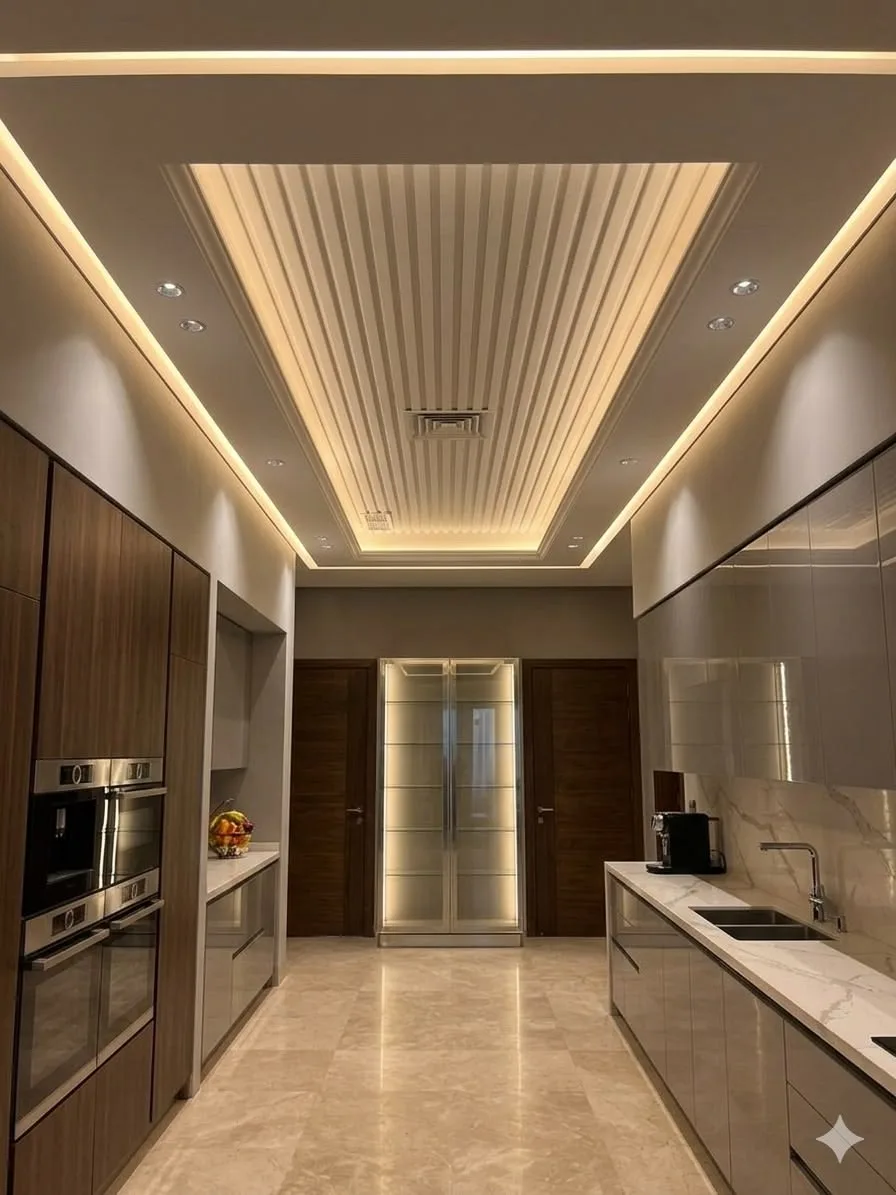
The only fix is a light that is already past you when it reaches the counter. In a kitchen with wall cabinets, that place exists and it is free: the underside of the cabinet, directly above the work surface and in front of where you stand.
What should under-cabinet light actually do?
Three decisions, and getting the first one wrong is the most common mistake in an otherwise well planned kitchen.
- Front edge, not the back. Fit the strip at the front underside of the wall cabinet. There it washes the whole depth of the counter and the source stays hidden from anyone standing at it. Pushed to the back against the tiles, it lights the splashback beautifully, leaves the front half of the counter dim, and shines straight into your eyes the moment you step back.
- A line, not dots. A continuous strip or profile gives an even wash. Separate puck lights give scallops, alternating bright pools and dark gaps along a surface where you are moving a knife. If the run is long, note that one LED-strip driver covers up to 15 feet, so a full galley wall is usually one or two.
- Its own control. The under-cabinet layer should switch separately from the ceiling. Most actual kitchen work is done with this layer alone, and being able to use it without lighting the whole room is half its value.
One detail that is easy to miss on a drawing: the strip needs a cable route and the driver needs somewhere accessible to sit. Both are trivial while the modular kitchen is being made and awkward afterwards, so it belongs on the kitchen drawing rather than being added as an afterthought.
Where does each layer belong?
Mapped to what is happening, which is the test that catches bad placement before it is built.
| Job | Layer | Where it goes |
|---|---|---|
| Chopping, prepping, reading a recipe | Under-cabinet strip | Front underside of the wall cabinet, continuous |
| General light, moving around | Downlights | Over the front edge of the counter and the walkway, not the centre line of the room |
| The hob | Whatever the chimney carries, plus a downlight ahead of it | In front of the hob, so the shadow of the chimney hood does not land on the pan |
| The sink | One dedicated downlight | Directly over the bowl. There is rarely a wall cabinet above a sink, so it has no under-cabinet layer |
| Tall units and the pantry | Strip inside the unit | On the inner front edge, ideally on a door switch or a sensor |
| Breakfast counter or island | Pendants, dimmable | High enough to clear sightlines across the counter |
| Walking in with full hands | Sensor driven | Covering the doorway and the first stretch of walkway |
The sink row is the one people are surprised by. It is the single most used spot in an Indian kitchen and it is usually the worst lit, because the spot where a cabinet would be is a window or open wall, so it misses the under-cabinet layer entirely and needs its own ceiling point.
Does a kitchen need a sensor?
Of all the rooms where a sensor gets suggested, this is the one where it is least of a gimmick, for a very ordinary reason: you arrive in a kitchen with your hands full, wet, or covered in something. A switch is the one thing you cannot easily use at exactly the moment you need the light.
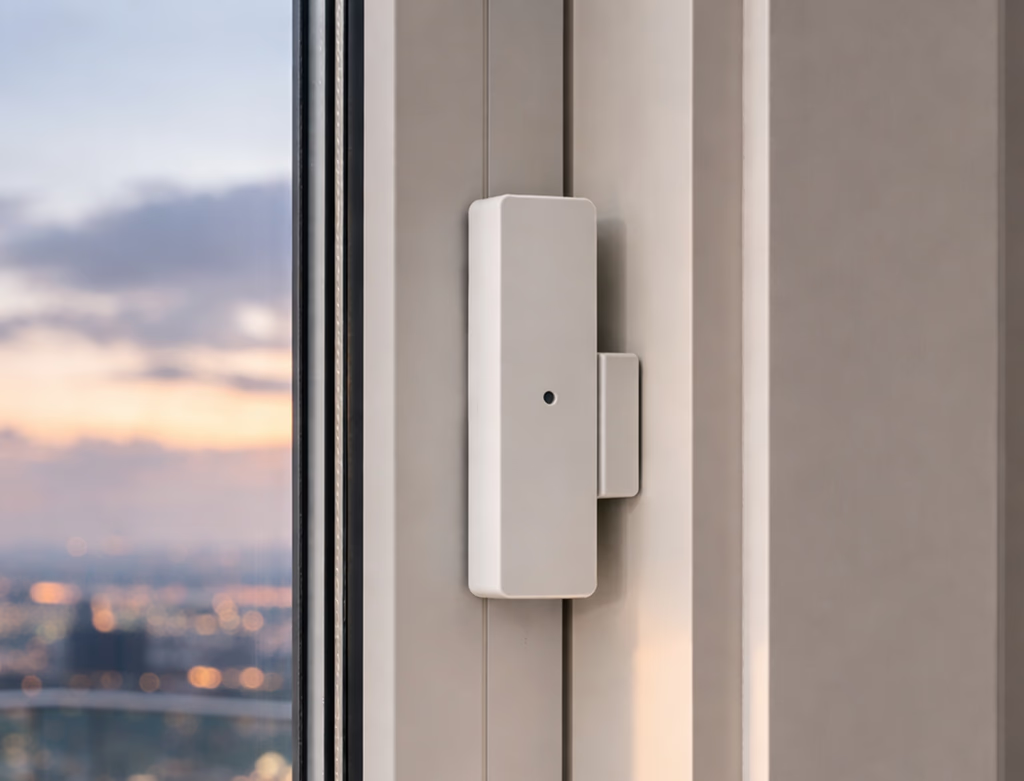
The right device here is a motion sensor rather than a presence sensor. It detects passing movement across roughly 7 feet in a 120 degree field, runs on a battery so it needs no phase or neutral and can sit wherever it is actually useful, and a light it triggers stays on for up to four minutes and then switches off by itself. Walking in, putting the bags down and walking out again never involves a switch.
A presence sensor, which uses millimetre wave radar to detect stillness down to the rise and fall of breathing, is the wrong tool for a walkway and the right one for a pantry or a walk-in store, where standing still reading a label should not make the light give up. It needs a phase and neutral connection and sits flush in the ceiling, so it is a wiring decision rather than a stick-on one.
Where a sensor is genuinely worth it inside the cabinetry is the tall pantry unit. A strip on a door trigger is the difference between seeing what is at the back of a deep shelf and not.
What colour temperature does a kitchen want?
Neutral on the worktop, and adjustable everywhere else.
The argument for neutral rather than very warm light on the counter is practical rather than aesthetic: cooking involves judging colour. Whether an onion has gone golden or brown, whether meat is done, whether something has turned. Under a strongly warm light everything is already golden. AHA drivers run at 4000K and give control of intensity and colour temperature per fixture rather than one shared dimmer across a circuit, so the counter and the rest of the room do not have to agree.
That split matters more in an open kitchen than a closed one. If the kitchen is visible from the living area it becomes part of the evening, and evening light has an effect that is well documented: Harvard Health's summary of the research notes that blue light suppresses melatonin for roughly twice as long as green light at comparable brightness. A kitchen that can drop to a warm, low setting once the cooking is done is doing something useful, not decorative.
What does a Mumbai kitchen add to this?
Heat, steam and grease, all of which land on the fitting nearest the hob. Two consequences worth planning for. First, anything in the hob zone should be something you are willing to clean, which argues against an intricate fitting right there. Second, the electronics matter: a driver in a kitchen lives in a warmer, more humid place than one in a bedroom, which is why AHA drivers carry 4kV surge protection and are tested per batch against Indian conditions rather than specified for a temperate climate.
It is also worth knowing what certification actually attaches to. An LED driver sold in India falls under the Bureau of Indian Standards' Compulsory Registration Scheme, which BIS operates to protect consumers "from spurious and substandard products" and which is granted to the manufacturer, the factory owner, rather than to a seller. So the honest question to ask about any smart lighting kit is who made the driver, not who put a brand on the box.
What will kitchen lighting not do?
Four honest limits, two of which get assumed in a kitchen more than anywhere else in the house.
- It does not control the geyser, the water pump, the hob or the chimney. AHA automates lighting, curtains, climate, locks and scenes. Geysers and water pumps are high load appliances on their own circuits and are not something a lighting driver or a keypad is for. If anybody offers you an app controlled geyser as part of a lighting package, ask exactly what hardware is doing the switching.
- It does not fix a kitchen with no wall cabinets. No wall cabinet means no under-cabinet layer, and the counter needs its light from somewhere else, usually a pulled-forward ceiling line or a slim surface profile on the splashback.
- It does not choose your fittings. AHA supplies the driver behind the light rather than the light itself, and it works with the large majority of what is sold in India. The fittings stay your decision, from whichever vendor you like.
- It does not survive being decided late. Under-cabinet strips, their cable routes and their drivers belong on the modular kitchen drawing. Added after the units are installed, the result is visible trunking.
If the kitchen is part of a wider plan, the order to do things in is set out in home automation before or after interiors, the points to fix before the wall closes are in the electrical points checklist, and the whole room by room picture is on smart lighting.
What do people ask us next?
Why is my kitchen counter always in shadow?
Because you are standing in the way. The ceiling light is behind you and the counter is in front of you, so your own body blocks the light from reaching the surface you are working on. It is a geometry problem rather than a brightness problem, which is why adding more ceiling lights or a brighter bulb never fixes it. The fix is a light source that is already in front of you, under the wall cabinet.
Where should under-cabinet lighting be fitted?
At the front edge of the underside of the wall cabinet, not at the back against the wall. Fitted at the front, the light falls across the whole depth of the counter and the fitting itself stays hidden from someone standing at the counter. Fitted at the back, it mostly lights the tiles and throws a visible bright line into your eyes when you step away. A continuous strip or profile is better than separate puck lights, which leave scallops of bright and dark along the worktop.
Where should ceiling lights go in a kitchen?
Over the front edge of the counter and along the walkway, not down the centre of the ceiling. A row of downlights centred in the room sits behind whoever is working, which is the arrangement that causes the shadow in the first place. Pulling the line out so it sits roughly above the front edge of the worktop means the light arrives past your shoulder instead of being blocked by it.
Does a kitchen need a motion sensor?
It is one of the rooms where it earns its place most, because people walk into a kitchen with their hands full, wet or dirty. A battery motion sensor detects passing movement across roughly 7 feet in a 120 degree field, needs no phase or neutral wiring, and holds a triggered light on for up to four minutes before switching itself off. That covers walking in, putting something down and leaving again without touching a switch.
What colour temperature is best for a kitchen?
Neutral rather than very warm for the work surface, because cooking involves judging whether food is cooked, which is partly a colour judgement. AHA drivers run at 4000K and give per fixture control of both intensity and colour temperature, so the task light over the counter and the general light in the room do not have to share a setting. In an open kitchen that also lets the room go warmer and lower in the evening when it reads as part of the living space.
Can smart lighting control the chimney, hob or water heater?
No, and it is worth being plain about it. AHA automates lighting, curtains, climate control, locks and scenes. It does not control geysers or water pumps, which are high load appliances on their own circuits, and it does not switch a hob or a chimney. What it controls in a kitchen is the light, including the under-cabinet layer and any sensor driven layer.
The short version: the ceiling is not the problem and more of it is not the answer. Put a continuous light under the front edge of the wall cabinets, pull the downlights forward off the centre line, give the sink its own point, and put a sensor where people arrive with their hands full. A kitchen lit that way needs less total light than one that is not.
Both AHA experience centres are laid out as real homes rather than showrooms, so you can see a counter lit properly instead of taking our word for it: Santacruz West and Lower Parel, 11am to 7pm, Santacruz West closed on Tuesdays.
Book a free consultation →