Smart Locks vs Traditional Locks: Is the Switch Worth It?
It is worth it if people other than your family need to get in, a cook, a driver, a tenant, or you travel and want to check the door from your phone. For a small household where nobody else ever needs a key, a good traditional lock is still hard to beat.
For a small household where nobody else ever needs to get in, a good traditional lock is hard to beat.
For an apartment with a cook, a maid, a driver, guests every week, and owners who travel, a traditional lock quietly creates work. Spare keys to cut. Keys to chase when someone leaves. No way to know who came in while you were out. No way to check the door from another city.
This piece compares the two honestly, so you can tell which situation is yours.
Is switching to a smart lock worth it?
For most urban Indian homes, especially apartments with domestic help, frequent guests, or owners who travel, a smart lock is worth the switch. It solves problems a traditional lock cannot: handing out spare keys, securing an empty flat, and knowing who entered and when. The higher upfront cost usually pays back within a year in saved time and worry.
| Traditional lock | Smart lock | |
|---|---|---|
| Everyday entry | Physical key only | Fingerprint, face, PIN, card or key |
| Spare access | Cut a copy, hope it comes back | Time-limited code, revoked from the app |
| Who entered and when | No record | Timestamped log, photo on some models |
| While the flat is empty | No status, no alerts | Away alerts, auto-lock, remote check |
| A lost or copied key | Rekey the whole lock | Delete the code in seconds |
| Power cut | Works, fully mechanical | Works on its own battery; only remote unlock needs Wi-Fi |
| Ongoing upkeep | Locksmith fee if keys are lost | New batteries every few months, with early warnings |
| Forced-entry resistance | Depends on the lock body and door | Depends on the lock body and door |
| Digital attack surface | None | Low, but not zero |
What does a traditional lock still do well?
It helps to start with the case for staying put, because it is a real one.
A traditional lock is fully mechanical. There is no battery to charge, no app to learn, no software to update, and nothing on it that can be attacked over the internet. It is cheap to replace, every locksmith in the city can service it, and everyone in the house already knows how to use it.
If your household is small, nobody outside it needs regular access, and your door and frame are solid, a good mortise lock does its job. The gap is not in how well it holds the door. It is in everything around the key.
Where does a traditional lock leave you exposed?
Keys copy silently. A key can be duplicated at any hardware shop in minutes, and you have no way to know it happened. In one case in Mumbra, Thane, reported by The Tribune, a flat was burgled with a duplicate key and "there was no sign of forced entry"; gold and cash worth ₹24.42 lakh were taken. With a traditional lock, the only way to be sure an old key no longer works is to change the lock.
There is no record. A traditional lock cannot tell you the maid arrived at 9:10 and left at 11:40, or that the door opened at 2pm on a day nobody should have been home. You find out what happened when you get back, if at all.
An empty flat is a blind spot. A flat that stays dark for a week looks empty, because it is. A traditional lock gives you no alert, no auto-lock, and no way to check the door from your phone while you travel.
Revoking access means rekeying. When a domestic worker leaves, or a tenant moves out, the safe assumption is that a copy of the key exists somewhere. The only real fix is a new lock or a locksmith rekey.
Why do so many Indian homes switch?
Access for staff, without a spare key. This is the strongest single reason Indian households switch. A cook, a driver, a housekeeper or a physiotherapist can be given a fingerprint or a PIN that works only during their hours, weekday mornings for example, and nothing outside them. A one-time code sent on WhatsApp lets a plumber or a delivery in once, then expires. Nobody holds a key you cannot take back.
Rentals and tenant turnover. In a city with as much moving as Mumbai, re-coding a PIN when a tenant leaves takes a minute. Rekeying a traditional lock every time, or trusting that the last tenant kept no copy, does not.
New doors make it easier. If you are moving into a newer building, ask your builder what lock the main door was made for. A door that already takes a mortise smart lock makes the switch a morning's work.
Where do smart locks fall short?
A one-sided comparison is not a useful one. Smart locks have real trade-offs.
Higher upfront cost. A smart lock costs several times what a traditional lock does. Whether that is worth it depends on how much the access problems above actually cost you in time and worry.
It runs on a battery. A smart lock is not mains-powered, so a power cut does not disable it, but the battery does run down over months. Good locks warn you well before it dies, on the app and at the door, and every smart lock sold for a home keeps a physical key or an emergency-power port as a backup. Still, it is one more thing to keep an eye on.
A learning curve for some users. An elderly parent who does not use a smartphone can use a fingerprint or a PIN without trouble, but the app side is for the family. If the lock is for a parent living alone, set it up so the phone is never required. Our guide to home automation for elderly parents covers that.
A small digital attack surface. Like any connected device, a smart lock is only as secure as its software and the account behind it. The UK's National Cyber Security Centre gives the same advice for every smart device: change any default password, turn on two-step verification and switch on automatic updates. The risk to any one home is low, but it is not zero, and a traditional lock has none.
Most smart locks sold in India are built for the mortise format, the cavity-style lock that is standard on Indian wooden doors, usually with a 60mm or 70mm backset. Older secondary doors often use a rim lock or night latch, and newer flats use deadbolts. Thickness matters too: flush doors run 30 to 35mm, solid wood 40 to 50mm, and heavy teak doors 55 to 65mm. Measure your door and confirm the fit before ordering. Our smart lock buyer's guide goes into this in detail.
How does the AHA lock fit in?
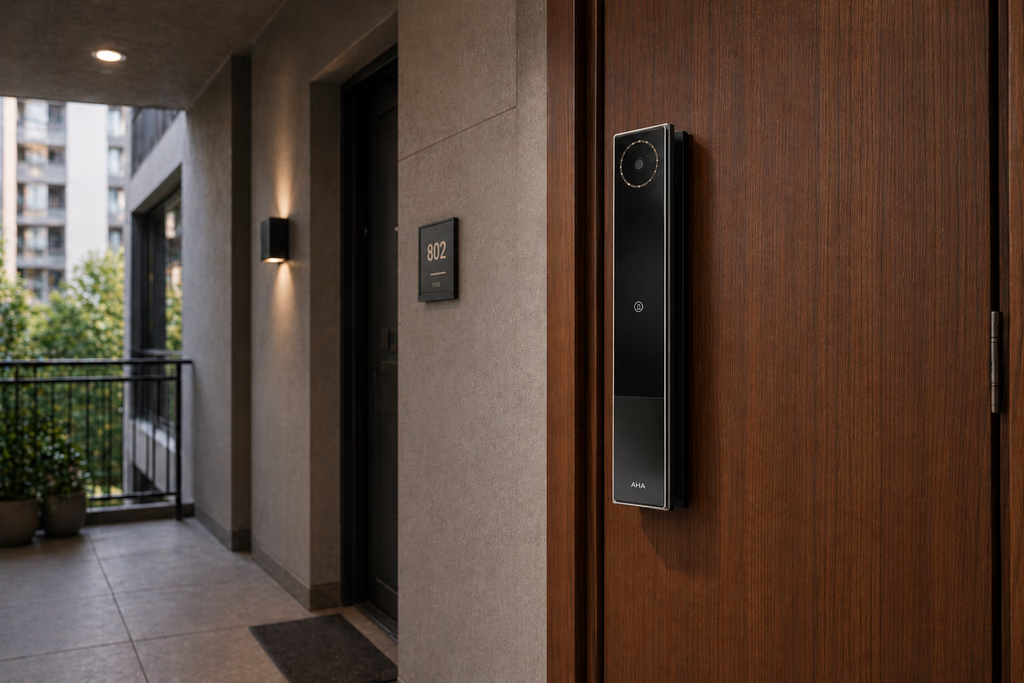
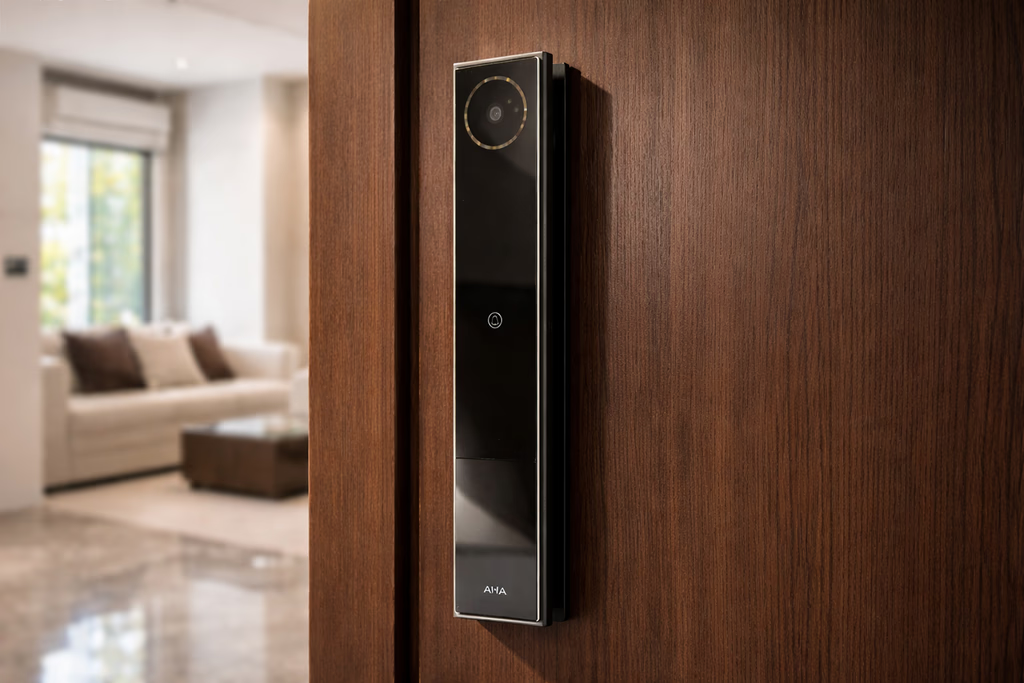
AHA does not sell a lock as a standalone gadget. It is one lock family, matched to three kinds of door, tied into the rest of the home.
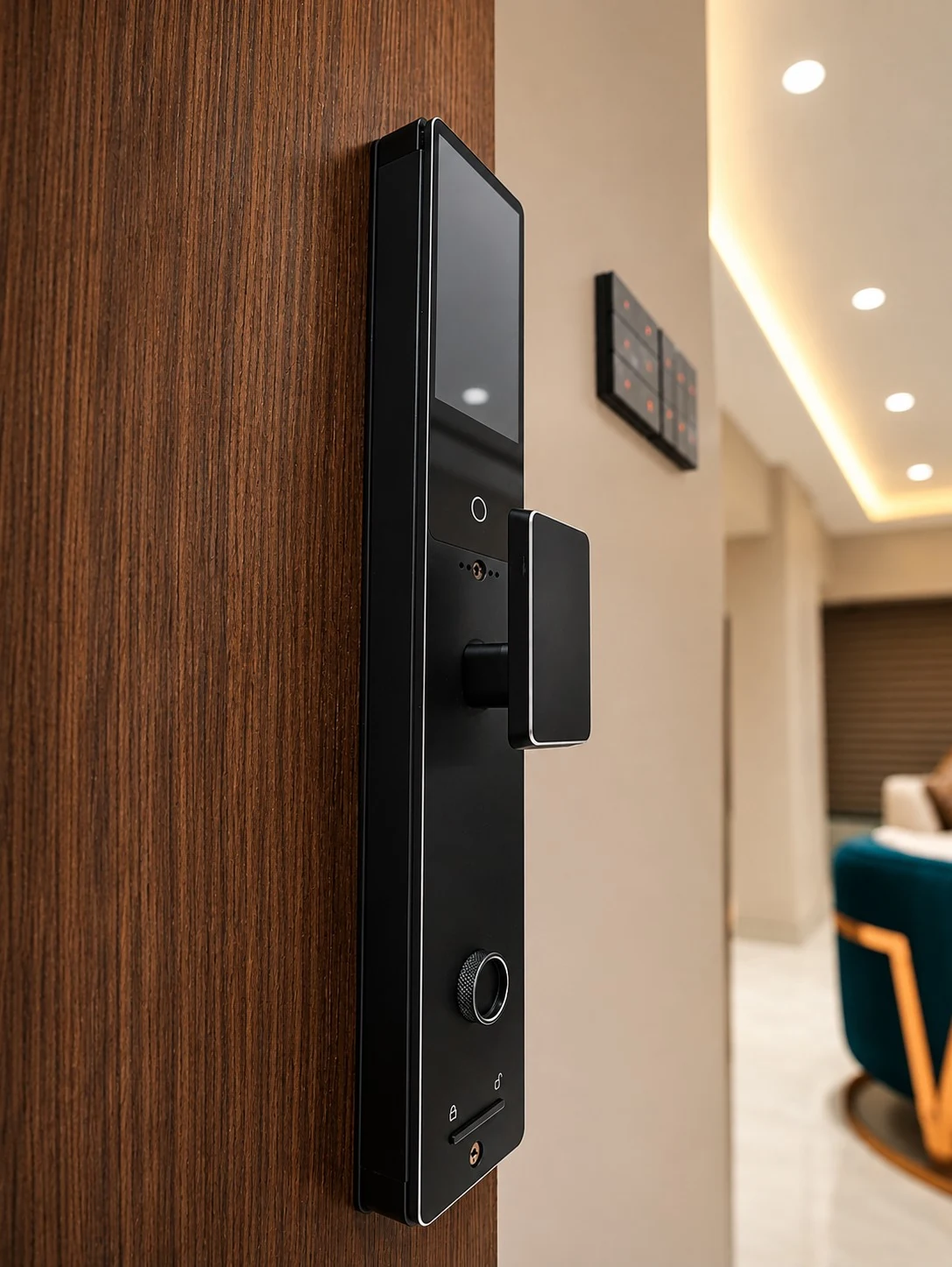
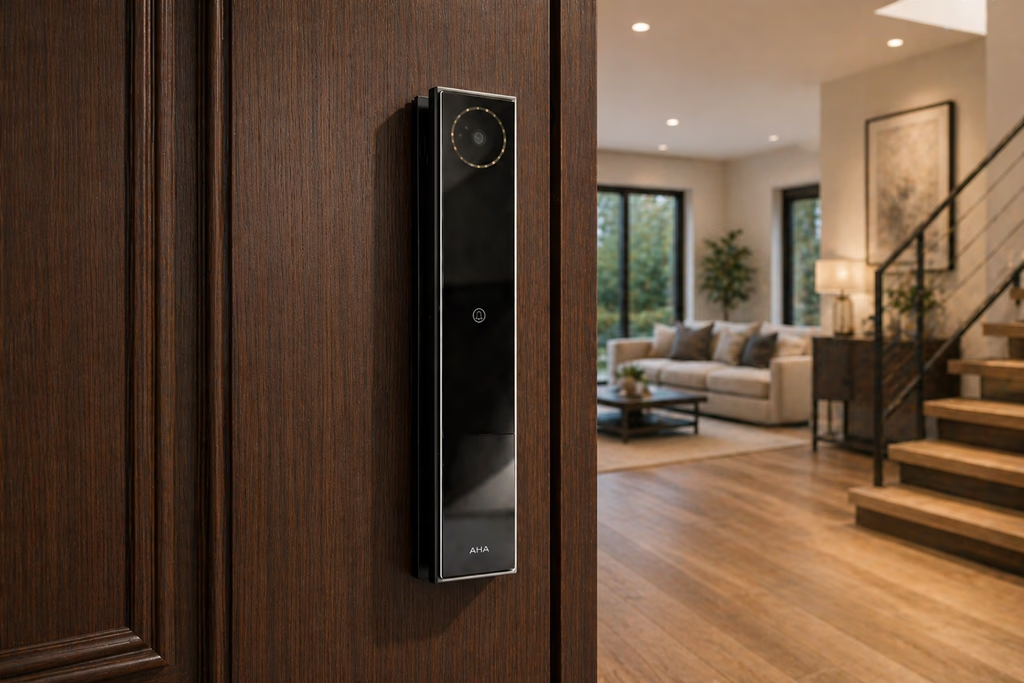
The front door opens on face recognition, fingerprint, palm scan or a keypad code, and takes a scheduled password or an NFC card for staff and regular visitors. Two physical keys come with it. When the bell rings, the camera turns on and the lights blink, and a timestamped photo is kept on the app for 14 days, never uploaded to the cloud. A tamper attempt sets off a 30-second alarm and messages your phone. Wardrobe and bedroom doors get lighter versions of the same lock, with fingerprint access and their own entry logs.
Because the lock is on the wider system, unlocking it can start a scene. The Grand Welcome routine brings up the lights, the AC and the curtains as you walk in. And when you travel, the lock is what makes the rest of the away setup work, covered in our guide to managing a Mumbai home remotely.
For a straight comparison of the Indian lock brands and how to choose between them, see our smart lock buyer's guide. To see the AHA lock in a working home, our smart door locks in Mumbai page has the local detail.
So, is it worth it?
Worth the switch:
- Apartments with domestic help or regular visitors
- Frequent travellers and NRIs securing a flat that sits empty
- Rented flats with tenant turnover
- An elderly parent living alone, set up to work without a phone
- Anyone who has ever cut a spare key and wished they could take it back
Maybe wait:
- A small household where nobody else ever needs access
- A door that would need replacing before a smart lock could fit
- Anyone who wants a lock with no digital surface at all
For most urban Indian homes the switch pays for itself within a year, mostly in the access problems it removes. If you have decided to switch, the buyer's guide covers which lock to pick, and the AHA smart lock page has the full spec.
What do people ask us next?
Are smart locks safe?
Yes, for normal home use. The lock body and how it is fitted to the door matter more than the electronics. A smart lock adds a small digital attack surface that a traditional lock does not have, but the risk to any one home is low, and lower still on a lock that runs on its own local network as part of a managed system.
What happens to a smart lock in a power cut?
Nothing. Smart locks run on their own battery, not on mains power, so a building power cut does not affect them. Fingerprint and PIN keep working at the door. Only unlocking remotely from the app needs Wi-Fi, which a power cut usually takes down too.
Can a smart lock be hacked?
In theory, yes. Security researchers keep finding flaws in Bluetooth smart locks. In practice, a burglar is far more likely to force a weak door than to attack the lock's software. Choosing a lock from a supported brand and keeping the app updated covers most of the risk.
Do smart locks work on Indian mortise doors?
Most smart locks sold in India are built specifically for the mortise format that is standard on Indian wooden doors. Imported deadbolt-only models often do not fit. Check your door's lock type and thickness before ordering, or ask the supplier to confirm.
Is a smart lock worth it for a rented flat?
Often yes, because of tenant turnover. Re-coding a PIN when a tenant moves out takes a minute, against rekeying a traditional lock or hoping no copy was kept. A no-drill retrofit lock can also move with you to the next flat. Check with your landlord first.
Can I still use a physical key with a smart lock?
Yes. Every smart lock sold for a home keeps a mechanical key as a backup, and the AHA lock includes two. The key is there for a flat battery or a family member who does not want to use the app.
A smart lock is not about the front door being clever. It is about never again handing someone a key you cannot take back.
If you want the straight brand-by-brand comparison, our smart lock buyer's guide has it. To see the AHA lock working as part of a home, our smart door locks in Mumbai page has the local detail, and both experience centres in Santacruz West and Lower Parel let you try the unlock methods by hand, open 11am to 7pm (Santacruz West is closed on Tuesdays).
Book a free consultation →For the scene that runs when you unlock the door, see Grand Welcome.